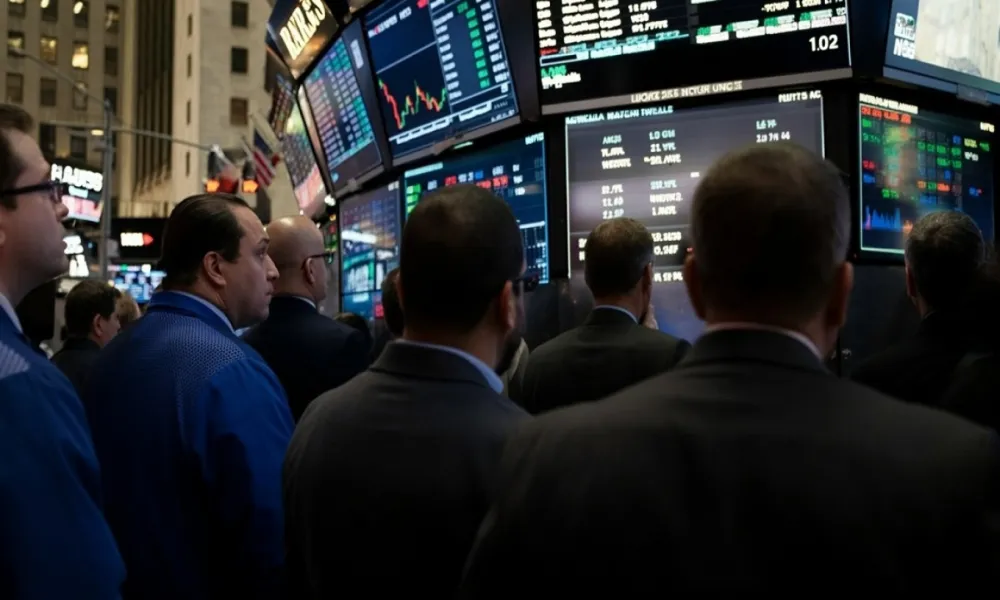

A stock market shockwave swept through global markets, wiping out trillions of dollars in market value within hours and sending some of the world's largest technology companies into sharp decline.
The wave of selling that began on Wall Street on Thursday, 5 November, spread to Asian markets on Friday, unsettling investors and reviving concerns that a stock market bubble may have formed around artificial intelligence.
According to Reuters, approximately $3 trillion was wiped from the combined market value of companies in the S&P 500 during a single trading session, as investors rushed to reduce exposure to higher-risk stocks.
The S&P 500 fell 4.4%, marking its steepest one-day decline since April 2025, when tariff announcements by Donald Trump triggered turbulence across global markets.
Losses were even heavier on the technology-focused Nasdaq, which plunged 5.5%, while the Dow Jones Industrial Average lost more than 1,800 points, falling 3.4%.
Artificial intelligence under pressure
The largest losses were recorded among technology companies, particularly those linked to artificial intelligence, semiconductor production and data-centre construction.
According to Bloomberg, the Nasdaq 100 dropped 6.4%, wiping approximately $2.3 trillion from the market value of the companies included in the index.
Nvidia, one of the companies at the centre of the global AI boom, saw its share price fall by around 9%.
Other companies in the sector were hit even harder. According to Reuters:
- Micron Technology, AMD and Marvell each fell by about 17%.
- SanDisk lost 22% of its market value.
The Philadelphia Semiconductor Index declined by more than 12%, highlighting the scale of the sell-off across the sector.
Investor concern extends beyond political developments in the United States.
Market participants are increasingly questioning whether the hundreds of billions of dollars being invested in artificial intelligence will ultimately generate profits large enough to justify the lofty valuations of technology companies.
The sell-off spreads to Asia
The wave of selling continued in Asian markets on Friday, 6 November.
In South Korea, the Kospi index plunged more than 8% at the opening of trading, triggering market-wide circuit breakers and a 20-minute trading halt.
In Japan, the Nikkei index was down approximately 5%, while markets in Taiwan also came under pressure due to their significant exposure to semiconductor manufacturing and data-centre infrastructure.
Reuters noted that companies forming the backbone of the global technology supply chain are among the sectors most vulnerable to the current market turmoil.
Trump blames Democrats
At the same time, US President Donald Trump sought to link the market collapse to the Democrats' sweeping victory in Tuesday's midterm elections.
According to Axios, Trump argued that voters should blame themselves for the market decline because they chose to strengthen the Democrats' position in Washington.
The election changed the political balance of power, with Democrats securing control of Congress.
Investors have expressed concern that the new political reality could result in stricter regulation of artificial intelligence and greater restrictions on the construction of new data centres.
According to a Reuters analysis, several Democratic candidates campaigned in favour of slowing or imposing stronger oversight on the expansion of such facilities, citing environmental concerns and their substantial energy consumption.
Analysts, however, stress that the Democratic victory is not the sole explanation for the market turmoil.
Fears of a new technology bubble
The sudden collapse has renewed questions about whether the rapid rise in technology stocks was built on overly optimistic expectations regarding the future profitability of artificial intelligence.
Analysts interviewed by Reuters said valuations at many companies had reached exceptionally high levels, leaving them particularly vulnerable to any negative developments.
At the same time, higher borrowing costs and financing challenges facing smaller technology infrastructure firms have added to uncertainty.
Bloomberg reported that Thursday's sell-off erased within hours the gains recorded just a day earlier, when markets initially reacted positively to the election results.
The abrupt shift in investor sentiment reflects the level of nervousness gripping global financial markets.
The key question now is whether this represents a sharp market correction following months of strong gains or the beginning of a deeper crisis in the technology sector.
For now, investors remain confronted by an explosive combination of political uncertainty, elevated valuations and doubts about the real economic returns that artificial intelligence can deliver.