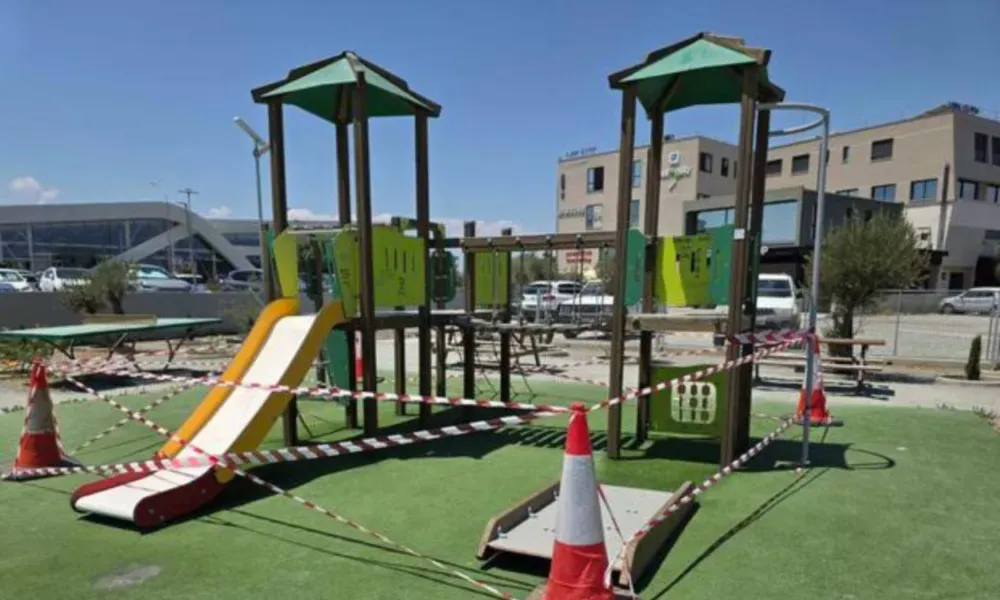

Playgrounds and parks across Cyprus are increasingly being targeted by vandalism, while reports of drug use and trafficking are adding to the concerns of local authorities.
By day, parks are filled with children, families, walkers and residents seeking recreation and relaxation. After dark, however, conditions in some public spaces change dramatically. Damaged play equipment, torn-up safety surfaces and signs of drug activity have become recurring problems, alarming residents and creating a growing challenge for municipalities.
The incidents are no longer isolated. Repeated acts of vandalism are increasing maintenance costs, keeping playgrounds out of service and forcing local authorities to rethink not only policing but also how public parks are designed.
Surveillance cameras, additional patrols, improved lighting, night-time closures and more durable materials are all being considered in an effort to protect public spaces without turning them into inaccessible fenced-off areas.
Vandalism in Lakatamia
In Lakatamia, a recent act of vandalism at Dimitris Christofias Park led to its temporary closure for repairs.
Mayor Fotoula Hadjipapa told Politis that efforts were made to reopen the site quickly because it is used daily by families and children.
The incident once again highlighted a problem that emerges mainly during evening hours, when individuals gather at specific locations and cause damage or significant disturbance.
Following the latest incidents, the municipality is increasingly considering the installation of security cameras.
Their presence is viewed both as a deterrent and as a potentially useful investigative tool. However, implementation would require studies, proper placement and compliance with personal data protection laws.
At the same time, Lakatamia Municipality is seeking increased police patrols in parks and other locations where gatherings, disturbances or information relating to possible illegal activities have been reported.
"There are certain locations that require monitoring both by the police and by specialised police units," Hadjipapa said.
According to the mayor, small-scale operations have already been carried out in areas identified by the municipality following complaints from residents.
She also raised concerns about playgrounds created by private developers as part of land division projects that have not yet received final approval or been formally handed over to the municipality.
Although swings and slides may already have been installed, such sites remain legally private property.
As a result, the municipality cannot easily intervene in matters of cleaning or maintenance, despite conditions in some locations being described as deplorable.
Safety surfaces being burned
In Strovolos, as in other parts of Cyprus, repeated damage is increasingly influencing technical decisions.
A common problem involves protective rubber safety surfaces beneath playground equipment.
According to municipal engineer Athanasios Kolyvas, some individuals remove sections of the material and burn them.
For this reason, the municipality is gradually abandoning the familiar square rubber tiles and replacing them with continuous poured safety surfaces that are much harder to remove.
As a result, anti-vandalism measures are increasingly being incorporated directly into the design of public spaces.
Flooring, entrances, lighting systems and electrical installations are now selected not only for functionality and safety but also for their resistance to damage.
Six major parks in Strovolos are currently undergoing upgrades.
Once works are completed, the municipality will begin certification procedures to ensure compliance with relevant standards.
Inspections will cover the proper installation of play equipment, operational safety and infrastructure compliance.
Certification will be renewed annually to ensure facilities remain safe despite wear and heavy use.
Cameras under consideration
Strovolos Municipality is also examining the possibility of installing surveillance cameras.
An impact assessment has already been completed for at least one park, while the necessary data-protection approvals are still required.
The proposal is being discussed in response to vandalism, complaints about noise and reports of possible drug use or trafficking.
Other measures already implemented or under consideration include improved lighting, patrols, entrance controls and fixed operating hours.
The largest parks in Strovolos generally close at around 10pm or 11pm, particularly those located near residential areas.
Despite being locked, some youths continue to enter the sites and use sports facilities until the early hours of the morning.
In one case, individuals broke into the main electrical switch box in order to override the timer system and turn on the lighting.
The municipality subsequently had to replace the system.
"You fix one thing and another breaks," Kolyvas told Politis.
The financial burden is significant.
Every repair requires funding, staff resources, technical inspections and periods during which facilities remain closed to the public.
'Impunity encourages youngsters'
Beyond the financial cost, Kolyvas argued that the vandalism raises broader social concerns.
He linked the recurrence of incidents to a sense of impunity.
"Impunity encourages youngsters to do these things," he said.
He also stressed that responsibility for the damage should not be indiscriminately attributed to foreigners.
Concern among parents
Parents who spoke to Politis described a situation that is becoming increasingly worrying.
"I take my children to the park very often in the afternoons. When you see broken swings, rubbish or damaged play equipment, you no longer feel safe. The first thing you think about is whether your child could get hurt," said one mother of two.
Another mother said it was upsetting to explain to a young child why the neighbourhood playground had been closed for repairs.
Parents pointed out that parks are among the few free recreational spaces available to families and should be protected.
At the same time, however, the prospect of installing cameras has divided opinion.
While many acknowledge that surveillance could act as a deterrent and improve feelings of safety, some are concerned about their children and families being recorded during normal visits to public parks.
Local authorities recognise that no technical solution alone can solve the problem.
Cameras can record incidents, locks can restrict access and more durable materials can reduce damage.
Ultimately, however, effective prevention depends on education, community engagement and early intervention.