
Distortions remain in the system of allowances paid to members of parliament as supplements to their parliamentary remuneration, with several of these benefits also counting towards pensions.
In addition to their salary, MPs receive a flat-rate travel allowance worth €8,201 annually, or €685 per month. Another striking feature of the system is that the allowance is paid uniformly to all MPs, regardless of where they live.
An effort launched in the past by the Ministry of Finance and the House of Representatives, at the initiative of parliament itself, to modernise MPs' remuneration and bring it closer to practices in other EU parliaments ultimately failed to produce reforms, and the issue gradually faded.
The initiative, demanded by several MPs, sought to establish a new methodology for parliamentary remuneration and address various inconsistencies that had developed over time.
Among the concerns was the fact that MPs effectively increased their overall earnings through allowances. Rather than raising their basic salary and risking public backlash, parliamentarians opted to increase allowances for representation and secretarial services, which continue to be paid as supplements to their salaries.
These allowances also became pensionable, further increasing MPs' overall remuneration.
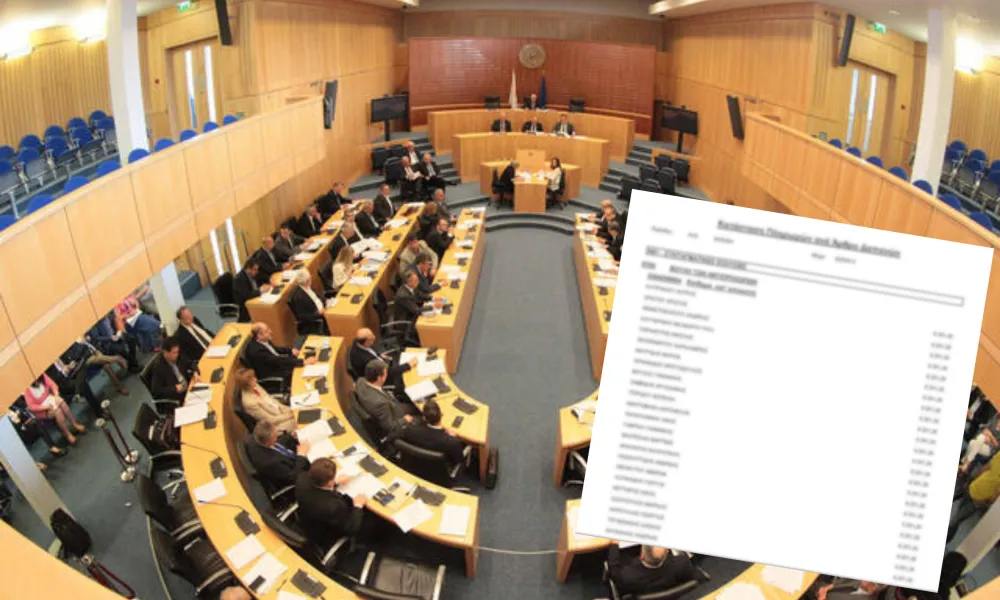
According to figures published recently by the Treasury of the Republic as part of transparency and public accountability requirements, MPs' remuneration is further enhanced by the monthly €685 flat-rate payment, which is effectively a travel allowance.
Same allowance for everyone
The monthly travel payment is made to all MPs without exception for their participation in House sessions and other parliamentary duties, regardless of whether they come from Nicosia, Paphos or the Kokkinochoria region.
The allowance was established as a uniform lump-sum compensation for travel expenses for all MPs through a Council of Ministers decision on 13 July 2005.
Prior to July 2005, travel allowances were paid only to MPs living outside Nicosia:
- Paphos: €384 per month
- Limassol and Paralimni: €213 per month
- Larnaca: €128 per month
Following the Cabinet decision, all MPs received an increase in their monthly earnings because the allowance was revised and standardised across the board.
The greatest beneficiaries were MPs from Nicosia, who began receiving a tax-free travel allowance for the first time, despite previously not qualifying for such compensation.
Paid regardless of attendance
The monthly lump-sum travel allowance is paid regardless of whether MPs attend parliamentary committee meetings or plenary sessions.
The payment also continues during the summer recess when parliament suspends its work.
Audit Office calls for reduction
In a report on parliament published in April 2020, the Audit Office recommended that the secretarial services allowance and representation allowance, since they are pensionable, should be incorporated into MPs' salaries in the interests of transparency.
The recommendation has also been supported at different times by several MPs and political parties.
Regarding the travel allowance, the Audit Office argued that it cannot be considered a reflection of actual travel costs incurred by MPs while attending parliamentary sessions and carrying out their duties.
It therefore recommended linking the allowance to real travel expenses and, if it continues to be paid as a lump sum, reducing it substantially.
€6,150 net per month
According to Treasury figures for 2026, MPs' total net monthly earnings, including allowances, amount to €5,466.
To this figure is added the €685 monthly travel allowance, which is paid through a separate transfer from the House of Representatives rather than through the Treasury.
Based on these figures, MPs receive approximately €6,150 net per month.
Pension rights and tax-free gratuity
Like government ministers, MPs are entitled to receive a tax-free gratuity from the state.
They are also entitled to a pension for their service in office.
Under a recent legislative amendment, MPs and ministers will now receive their parliamentary or ministerial pension from the age of 65, instead of 60, as was previously the case.
Former MPs and former ministers who were elected or appointed before the change in the law will continue to receive their pensions from the age of 60.
The retirement-age reform could not be applied retrospectively because doing so would have raised constitutional concerns.