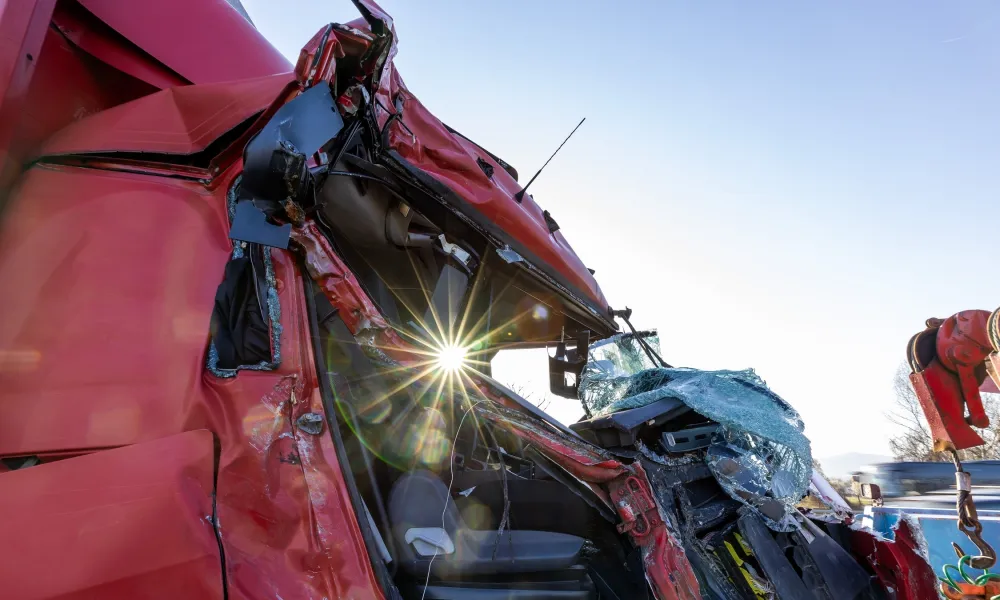

The Cyprus Scientific and Technical Chamber (ETEK) has called for a series of emergency drills under the "Nestor" incident management plan following Thursday's major crash on the Nicosia-Larnaca motorway, arguing that the system should be tested against a wider range of scenarios.
ETEK President Constantinos Constanti said the implementation of the plan during the motorway incident was a positive first step, noting that the chamber had been submitting proposals for a coordinated response framework for years.
Speaking to CNA, Constanti said the focus should not be limited to how the plan functioned in Thursday's accident, but also whether it can respond effectively to different types of emergencies.
Call for broader emergency scenarios
Constanti said every emergency response plan must account for a range of circumstances and clearly define responsibility for action in each case.
He cited examples such as fuel spills on road surfaces and other incidents that may require different operational responses.
"Exercises must be carried out with many different scenarios so that we know how we respond and who is responsible for taking action in each case," he said.
He added that a comprehensive risk assessment framework should form part of the overall planning.
Cranes could be kept on standby
The ETEK president also suggested maintaining cranes on standby so they can be deployed immediately when serious incidents occur.
He argued that prolonged closures of major transport arteries create significant disruption for the public and can have wider economic consequences, including effects on access to airports and ports.
"It honours no one for national road networks to be shut down, for citizens to suffer inconvenience and for airports and ports to be affected," he said.
Authorities urged to assess performance
Constanti called on the relevant authorities to explain whether, and to what extent, the Nestor plan functioned effectively during Thursday's incident.
"If shortcomings were identified, they should be presented so that proposals can be submitted for the optimisation of the plan," he said.
He added that any weaknesses should become the subject of public discussion in order to improve the system.
The ultimate goal, he said, should be the continuous enhancement of the plan in the public interest and the prevention of similar disruption for citizens in future emergencies.