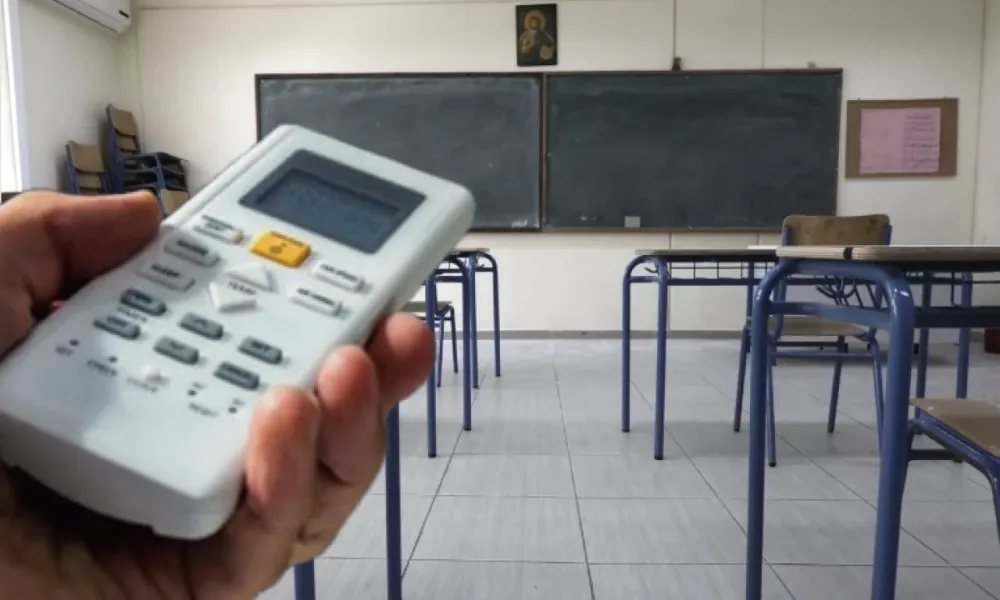

The installation and operation of air-conditioning units in all public schools must be completed to ensure safer and more suitable learning and working conditions for pupils and teachers, the House Education Committee, education organisations, parents and the Pancyprian Federation of Student Unions (PSEM) have said.
During a House Education Committee session on Wednesday, stakeholders called for a clear timetable for completing the installation and ensuring that units are fully operational.
The education ministry, meanwhile, said it expects the project to be completed in full during the current academic year.
MPs raise concerns over school boards' absence
Committee chairman Chrysanthos Savvides criticised the absence of the school boards of Limassol, Paphos and Larnaca, which had been invited to attend the session but did not appear.
He said only the Nicosia School Board had consistently attended committee meetings and arrived prepared to provide information.
Savvides proposed that the committee send a strongly worded letter to the school boards, while AKEL MP Christos Christofides suggested that they should be formally summoned to appear before the committee.
The issue was registered for discussion by DIKO parliamentary spokesman and deputycommittee chairman Panikos Leonidou.
Leonidou said the government had demonstrated political will to address what hedescribed as a long-standing problem, adding that significant progress had been made, with air-conditioning units already installed and operating in a number of schools.
However, he said the ultimate objective remained coverage of every school.
“Technical and energy difficulties, particularly in older school buildings, are real,” Leonidou said. “They cannot, however, be a reason for further delays.”
He called for closer coordination between the Ministry of Education, school boards, the Electricity Authority of Cyprus (EAC) and the Electromechanical Services.
Ministry cites infrastructure and safety issues
Deputy Director of Secondary General Education Dr George Koutsidis said several factors had contributed to delays, including school energy upgrades, the installation of substations, low electrical loads, ageing electrical installations and the need to ensure pupils' safety while work was being carried out.
He said the tendering process, which was being implemented in three phases, had alsocontributed to the delays.
Koutsidis stressed that the ministry had not stopped the project, saying priority hadinitially been given to lyceums and gymnasiums before moving on to primary schools and kindergartens.
“We consider that this project will have been completed 100% during the currentacademic year,” he said.
A representative of the Ministry of Finance said funding was available, with €5 million provided for the current year and provision for a further €10 million in 2027, subject to approval of the state budget.
Nicosia school board warns of lengthy electricity upgrades
Nicosia School Board chairman Nikos Megalemos said all school boards were following aspecific guide setting out the specifications for air-conditioning units.
He said installations had begun in Nicosia in 2024 but warned that completing the work would be difficult within the proposed timeframe.
Megalemos said that where electrical substations were required, the EAC needed atleast 18 months to complete the necessary work.
The EAC said it had received 219 applications over the past two years concerninginspections of air-conditioning installations. Of these, 142 had been inspected, while 77 remained pending.
Teachers and parents demand fully working systems
Education organisations said that while progress had been made, many pupils and teachers were still working in classrooms without adequate cooling.
OELMEK president Konstantinos Konstantinou said work had been carried out, butpupils were still experiencing temperatures of around 40°C.
He said the final stage of the project meant little to teachers and pupils who werewaiting for air conditioning to be operational in every classroom.
POED president Myria Vassiliou said it was important that the project had begun, but called for a clear timetable and greater transparency over the specifications and number of operational units.
She also raised concerns over what she described as inconsistencies between figures and statements concerning which air-conditioning units had been installed and which were functioning.
Vassiliou highlighted the impact of power cuts, noting that when electricity fails in a school, fans also stop operating. She described the situation in classrooms with around 25 young children, particularly where there are only limited windows for ventilation.
“We want safe conditions for the children and staff,” she said.
Technical schools report gaps in installations
OLTEK general secretary Lenos Loizou said the Technical School of Agios Lazaros hadrequested 20 air-conditioning units, 12 had been approved, but only four had ultimatelybeen installed.
He said some other technical schools had received units through donations fromsponsors and parents' associations.
According to Loizou, no units had been installed in some schools in Limassol andPaphos, while units installed at a technical school in Nicosia were not operational.
Parents' representatives also expressed concerns over the implementation of theprogramme.
Yiannos Ioannou, president of the Pancyprian Confederation of Federations of Parents' Associations of Primary Schools, said the planning process had failed.
He said that in his child's classroom, the air-conditioning units had been cutting out repeatedly on the first day, while only one fan was working and was unable to cool allthe pupils.
Loizos Konstantinou, president of the Pancyprian Confederation of Federations of Parents' Associations of Public Secondary Schools, said the process had begun but thatthe objective of having the installations ready in secondary schools during the summer had not been achieved.
Students question changing completion dates
PSEM general secretary Despina Kyprianou said students recognised that work had been carried out and that some schools now had functioning air conditioning.
However, she criticised what she described as changing assurances from the Ministry ofEducation.
Kyprianou said the ministry had previously assured students that the installations would be completed and fully operational by the end of 2026.
“We want to know. Give us a timetable that you can implement,” she said.
She also referred to students' request to be allowed to wear shorts during the summer because of classrooms where air conditioning was not operating.
Kyprianou said the students' organisation had sent a letter to the ministry the previousMonday but had not yet received a response.
Committee calls for accountability
Following the session, Savvides said installing and operating air conditioning in schools was an important intervention to improve learning and working conditions in public education.
He acknowledged the government's decision to launch the project, but said someschools continued to experience very high temperatures and that in several cases unitshad been installed but were not operational.
Savvides again criticised the absence of several school boards, arguing that they should provide explanations about the progress of the installations.
He said the committee would seek to have absent school boards summoned if they failed to attend future meetings.
DISY MP Prodromos Alambritis said the issue concerned basic and dignified learningand working conditions for pupils and teachers.
He noted that the President had previously announced that air conditioning would beinstalled in all schools within three years, but said the target had not yet been achieved.
Alambritis said the committee had again been assured that all schools would have airconditioning installed by the end of the academic year.
“What we are asking is for the air conditioners to be installed and working in all schools,” he said, adding that the effective operation of schools could not depend solely on announcements and assurances.
Not a luxury item
AKEL MP Christofides said a three-year timetable had originally been given, with completion expected by September 2026.
He claimed that air conditioning had not yet been installed in half of the schools and that, in a number of cases, installations had been funded through parents' associations, donors or other authorities.
He said adequate classroom conditions were not a luxury and were particularly important given temperatures approaching 40°C in parts of Cyprus.
ELAM MP Polys Anogyriatis said the committee had been told that average air-conditioning functionality stood at just 30%, taking into account installation, inspectionand operation.
He called for specific figures on how many units were currently operational, the reasons others were not working and a clear, binding timetable for completion of the project.
The education ministry has maintained that the full project will be completed duringthe current academic year, while school boards, teachers, parents and students have called for clearer information on the timetable and the actual number of fully operational units.
Source: CNA