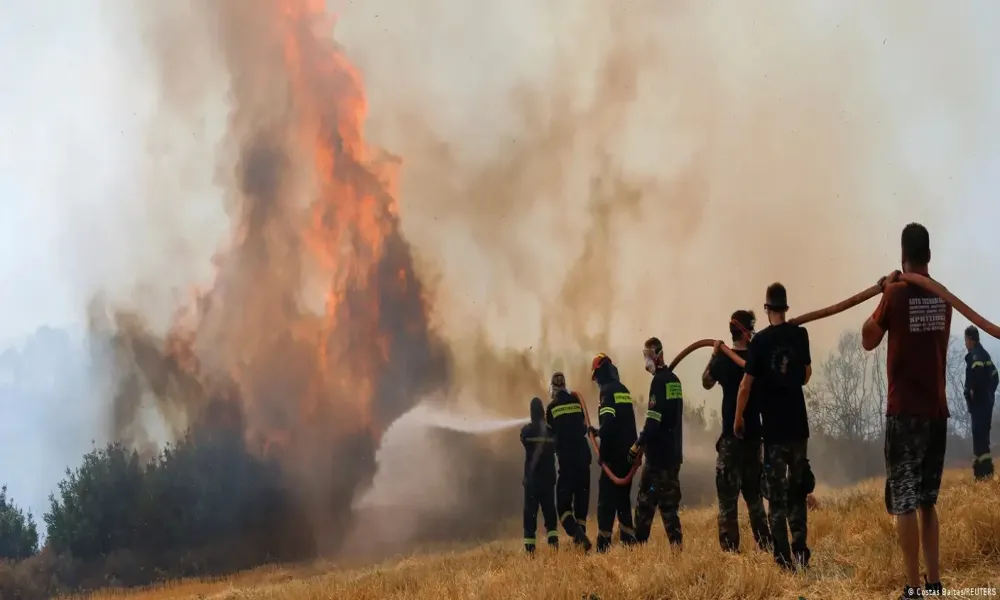

Data from major European forecasting bodies, including the European Centre for Medium-Range Weather Forecasts (ECMWF) and the European Forest Fire Information System (EFFIS), indicate that temperatures in southern Europe, and particularly in the south‑eastern region where Cyprus lies, are set to remain above average during the June to September period, increasing the risk of wildfires.
ECMWF outlook
Temperatures are expected to be higher than normal, suggesting that heatwave episodes are possible, said the director of the Department of Meteorology, Dr Filippos Tymvios. He noted that the forecasts do not represent an extreme scenario for Cyprus, where higher‑than‑average temperatures are a familiar feature each summer.
At the same time, he clarified that current models do not allow for reliable predictions on whether heatwaves will be prolonged. However, they do indicate a likelihood of intermittent heatwave conditions extending through to September.
EFFIS warnings
The elevated wildfire risk during the summer months was also highlighted by the European Commission’s Directorate-General for Civil Protection and Humanitarian Aid Operations. Presenting EFFIS estimates for the June to September period, officials stressed that temperatures across Mediterranean countries are expected to exceed average levels, increasing the likelihood of forest fires.
Rainfall from September to December
A more positive signal comes from projections pointing to increased rainfall between September and December, according to Dr Tymvios. However, he cautioned that such long‑range forecasts carry significant uncertainty, as they extend several months ahead and remain highly dynamic.
Estimates suggest that rainfall volumes in southern Europe could exceed average levels in September, although these projections are subject to change as new data emerge.
Limited impact of summer rain
In addition to higher temperatures, slightly increased rainfall compared to normal is also expected during the summer months. However, this is not expected to significantly improve the island’s water reserves.
Average summer rainfall in Cyprus, across June, July and August, is typically around 8 millimetres in total, while May alone saw around 28 millimetres this year. Despite this limited contribution to water resources, localised summer showers may still play a role in reducing wildfire risk.
Recent showers, particularly those affecting forested areas, were described as beneficial, acting as a deterrent to fire outbreaks. Nevertheless, officials stress that the risk of wildfires now exists on a daily basis and that the public must remain vigilant.
2025 worst year on record
Looking at the past two decades, 2025 was the worst year in terms of burned areas, with approximately 14,000 hectares affected, well above the long‑term average.
Data for 2026 so far, up to the end of April, indicate that the situation is currently close to the average for the past 20 years.