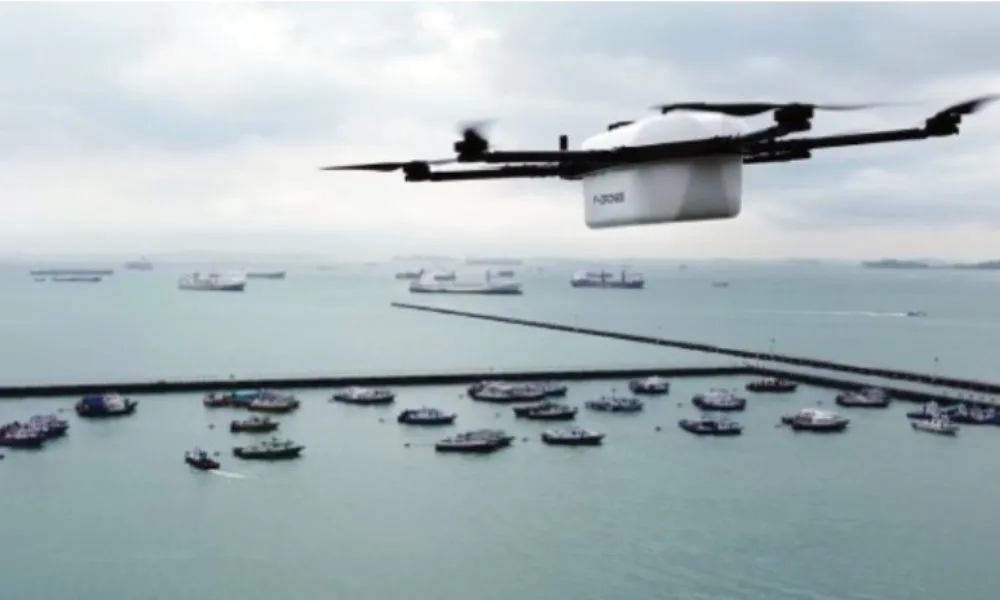

From Ayia Napa to Lara Bay in Akamas, Cyprus’ coastal waters are set to gain a new airborne guardian tasked with monitoring and deterring marine pollution. A sophisticated long-range unmanned aerial vehicle (drone) powered by an internal combustion engine is expected to arrive on the island in mid-July following a request by the Deputy Ministry of Shipping.
The aim is to enforce existing legislation through fines against owners of pleasure craft and vessels that cause environmental degradation in Cypriot waters through the discharge of sewage or the creation of oil spills. This comes despite the fact that the Republic already provides appropriate facilities in ports and marinas for the disposal of sewage and other liquids harmful to the marine environment and public health.
An EMSA-funded initiative
The project, valued at approximately €1 million and running until the end of the year, is being funded entirely by the European Maritime Safety Agency (EMSA), the EU body responsible for promoting a safe, green and competitive maritime sector.
The funding covers the deployment of a complete operational mission to Cyprus, including:
- A long-range drone equipped with high-resolution aerial photography and video capabilities;
- The salaries and accommodation costs of two specialised and certified pilots who will travel from abroad through a contractor working with EMSA;
- Additional equipment, including both permanent systems for the command centre to be established at Vasilikos and mobile equipment such as specialised antennas.
Enforcing the law
A source at the Deputy Ministry of Shipping told Politis that if the drone detects a pollution incident, whether near the coast or offshore, authorities will be able to analyse the resulting evidence and combine it with data from the relevant authorities regarding vessel movements and usage at the time of the incident.
This will make it possible to identify offenders and bring enforcement action against them.
The source stressed that the objective is not punishment for its own sake but the proper enforcement of environmental legislation in order to reduce pollution incidents, protect swimmers and send a clear message that violators can and will be identified and fined where required by law.
Island-wide surveillance
Depending on operational needs, the two pilots will be stationed either at Vasilikos or at Lara Bay in Akamas.
From these locations, the drone will be capable of covering the entire coastline of government-controlled Cyprus thanks to its long-range capabilities and internal combustion engine.
The aircraft is a vertical take-off and landing (VTOL) drone, combining the ability to hover and launch vertically with long-range, high-speed flight performance.
All necessary flight permits have already been obtained, enabling it to operate near airports and other state infrastructure where required.
Additional uses
Because of its advanced capabilities, the drone is also expected to support data collection in other sectors following expressions of interest from various government departments.
Among them are:
- The Water Development Department, for monitoring water abstraction linked to desalination plants;
- The Department of Fisheries and Marine Research, for fish-farming oversight.
Should the need arise, and subject to the necessary approvals, the drone could also be deployed during wildfire emergencies.
Its primary mission, however, will remain the monitoring of marine pollution.
The initiative forms part of a broader framework of actions being implemented by the Deputy Ministry of Shipping in cooperation with other government departments and local authorities to address environmental degradation in Cyprus’ seas.
First deployment of its kind
The Deputy Ministry of Shipping has worked closely with EMSA in recent years on marine pollution issues, including the satellite detection of oil spills through the European CleanSeaNet programme and training programmes for public- and private-sector personnel.
However, this marks the first time EMSA has deployed both equipment and personnel to Cyprus specifically for direct surveillance of its maritime area.