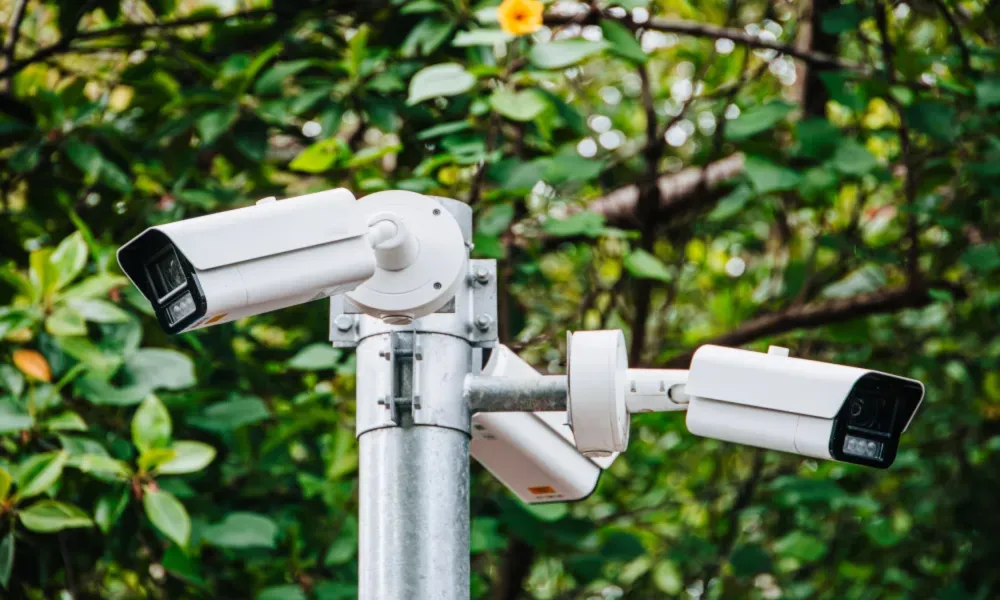

Communities and municipalities are set to acquire a new preventive tool to combat the re-emergence of illegal dumping sites at locations that have already been cleared but remain unguarded, following conditional approval from the Commissioner for Personal Data Protection.
At a meeting of relevant stakeholders held at the Ministry of the Interior, the next steps were agreed for the implementation of the measure.
The Commissioner's Office has given the green light, subject to conditions, for the installation of closed-circuit surveillance cameras in rural areas where illegal dumping sites are repeatedly created. Apart from polluting the environment, these sites are frequently linked to the outbreak of fires.
As a result, discussions are now under way among the relevant authorities on how to use the new tool to prevent the re-establishment of illegal dumps at locations that have been cleared during Department of Environment campaigns over the past two years, as well as at other sites where needed.
Until recently, the Union of Cyprus Communities had cited the inability to install surveillance cameras, due to objections from the Data Protection Commissioner's Office, as one of the main reasons communities struggled to control illegal dumping despite their legal responsibility to clean affected areas.
According to the Fire Service, there are now more than 800 illegal dumping sites across Cyprus. For the country's fire prevention authorities, they remain one of the biggest weaknesses in prevention efforts. While several other issues have been addressed in recent months, illegal dumps continue to be viewed as a "time bomb".
Preconditions
"We are in consultation with the Union of Communities, the Union of Municipalities and the Data Protection Commissioner to determine how this project will move forward," Ministry of the Interior Director-General Elikkos Elia told Politis.
He said one of the Commissioner's conditions is the installation of signage informing the public that the site is under camera surveillance.
A number of issues identified during a stakeholders' meeting held at the ministry on 20 July will need to be addressed before implementation.
These include establishing the technical specifications for the cameras, launching a procurement tender, selecting the locations where cameras will be placed and determining which body will manage the surveillance data.
"We are leaning towards the Union of Communities and the Union of Municipalities," Elia said.
He also stressed that no legislative amendment is required before the cameras can be installed.
Remote locations
The plan focuses mainly on remote areas.
"As a matter of priority, we want to monitor locations where irresponsible individuals go and effectively create dumpsites," Elia said.
The 20 July meeting was attended by representatives from the Ministry of the Interior, Ministry of Agriculture, the Office of the Commissioner for Personal Data Protection, the Union of Cyprus Communities, the Union of Cyprus Municipalities, the Fire Service, the Department of Environment, the Game and Fauna Service and the Nicosia District Administration.
Commissioner: Legitimate measure under conditions
"The installation of video surveillance systems at dumping sites for the prevention and/or early detection of fires may constitute a legitimate measure serving the public interest, provided it is necessary and proportionate to the intended objective and is implemented with appropriate safeguards for the protection of personal data," Commissioner for Personal Data Protection Maria Christofidou told Politis.
She said the meeting at the Ministry of the Interior was convened on her own initiative.
During the meeting, the Data Protection Authority pointed out that surveillance systems at locations such as dumping sites, which constitute a primary source of fires, could be used for fire prevention purposes provided the measure is necessary, proportionate and serves the public interest.
"Protecting and preserving our country's flora and fauna is a duty of the highest importance for all of us. However, this measure must be implemented with suitable safeguards for the protection of personal data," Christofidou said.
She added that the operation of surveillance systems must comply with the EU General Data Protection Regulation (GDPR) and national legislation.
Specifically, there must be an appropriate legal basis for processing data, while key principles such as proportionality and data minimisation must be respected through suitable technical solutions.
Where required under Article 35 of the GDPR, a Data Protection Impact Assessment must also be carried out before processing begins.
According to the Commissioner, the legality of every video surveillance system must be assessed on a case-by-case basis, taking into account its specific characteristics and mode of operation.