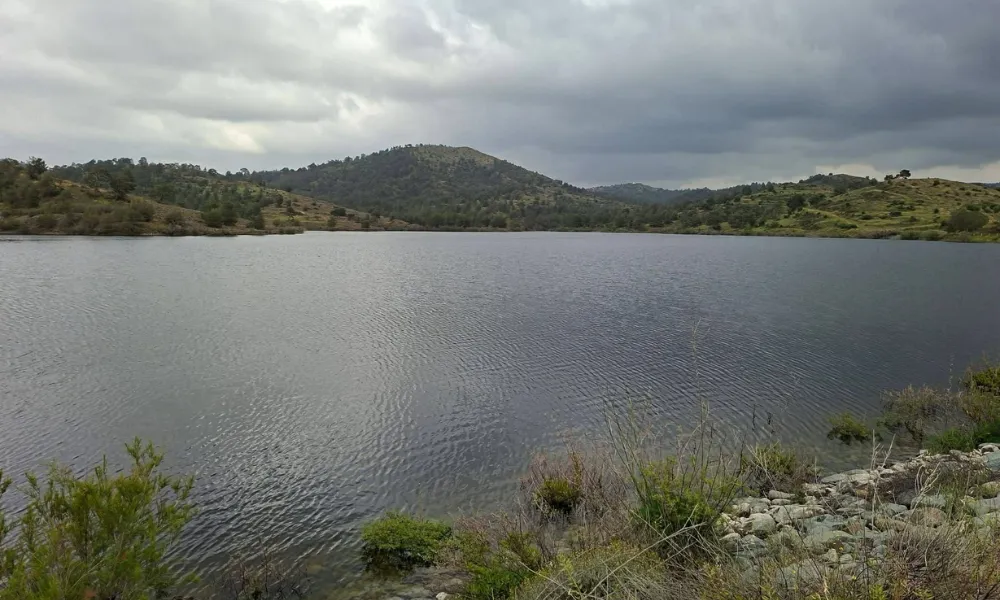

Reservoirs across Paphos district are holding around 43.3 million cubic metres of water, approximately four times the volume recorded at the same time last year, according to the Water Development Department (WDD).
Despite the sharp improvement, officials stress that careful management remains necessary, warning that prolonged drought and climate change continue to pose serious challenges for Cyprus's water security.
Reservoir levels show strong recovery
Speaking to the Cyprus News Agency, Alexios Frangeskou, Executive Engineer at the WDD's Irrigation Projects Operation and Maintenance Service, said reservoir levels have improved significantly compared with 2025.
As of 7 September 2026, the reservoirs serving the Paphos Major Irrigation Project (Asprokremmos, Kannaviou and Mavrokolympos) contained approximately 30.9 million cubic metres of water, representing 39.2% capacity, compared with just 9.4 million cubic metres a year earlier.
The reservoirs serving the Chrysochou Irrigation Project (Evretou, Argaka, Pomos and Agia Marina) held approximately 12.4 million cubic metres, with storage levels reaching 42.5% capacity, compared with 3.8 million cubic metres during the same period in 2025.
Rainfall boosts supplies
Frangeskou attributed the improvement largely to increased inflows during the 2025-26 hydrological year.
He said beneficial rainfall during the spring, combined with isolated summer showers, played a key role in replenishing reserves and reducing irrigation demand.
However, he emphasised that reservoir management continues to be based on a multi-year approach rather than short-term improvements.
No additional restrictions expected for farmers
According to the WDD, there is currently no indication that additional irrigation restrictions will be required during 2026.
Frangeskou said water requirements for permanent crops and greenhouses have largely been met, while additional quantities have also been allocated to professional farmers for seasonal crop production.
Water allocation continues to prioritise drinking water supplies, followed by irrigation needs.
Additional water from reservoir overflows
Officials also highlighted the benefits of reservoir overflows recorded during the year.
Farmers in areas affected by overflow from the Argaka, Pomos and Agia Marina reservoirs received additional water allocations that were not counted against their annual approved quotas, providing further support for agricultural production.
Drought remains a long-term threat
Frangeskou warned that drought can no longer be considered an occasional or exceptional event.
More frequent dry periods, increasingly unpredictable rainfall patterns and rising temperatures are creating a new reality for Cyprus and the wider eastern Mediterranean region, he said.
As a result, water management policies must be designed to cope with repeated and prolonged periods of drought rather than relying on the arrival of favourable hydrological years.
Desalination and recycled water increasingly important
The WDD said non-conventional water sources now play a central role in Cyprus's water strategy.
Desalination plants and the reuse of treated wastewater have become key pillars of water security, reducing dependence on rainfall and reservoir storage.
In Paphos, approximately half of the 20 million cubic metres of water supplied annually for domestic consumption now comes from desalination facilities.
Reclaimed water also makes a significant contribution to agriculture. During 2026, around 5 million cubic metres were allocated for agricultural use in Paphos, reducing pressure on reservoir reserves.
No immediate risk to supply
Frangeskou said water security can no longer be assessed solely on the basis of reservoir levels.
Paphos now relies on a combination of reservoirs, desalination and reclaimed water, making the district's water system more resilient than in the past.
While current reserves do not point to an immediate risk of shortages, he said rising consumption, continued drought conditions and climate change mean that responsible water use and continued investment in alternative sources remain essential.
Source: CNA