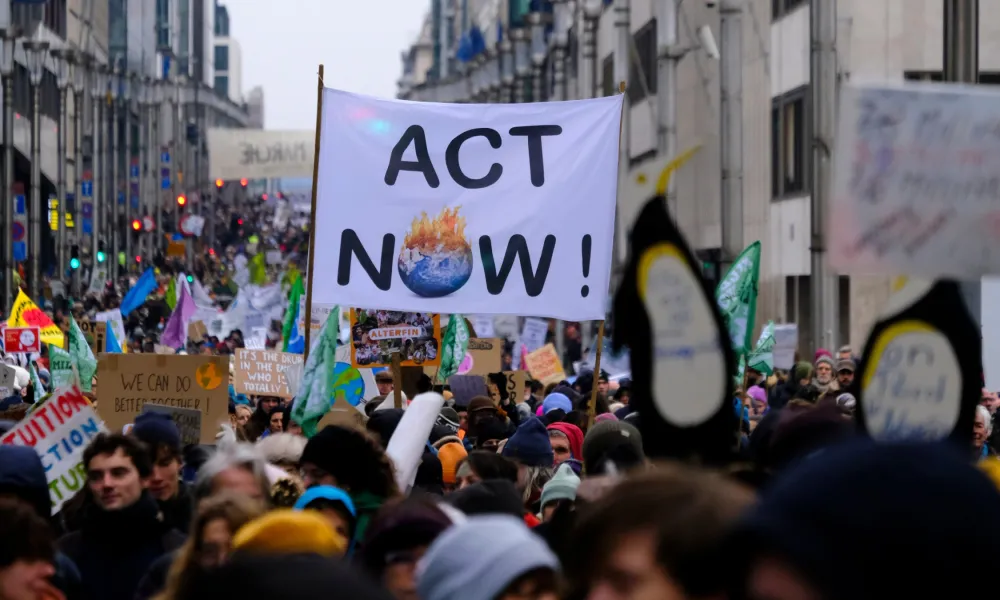

The days are approaching when global attention will once again turn to climate change and global warming. According to United Nations scenarios, based on current government policies worldwide, the planet is on track for an increase in average global temperatures of between 2.6°C and 2.8°C by 2100.
The annual UN Climate Change Conference (COP31), taking place in Antalya, Türkiye, from 9 to 20 November, will serve as the main arena for climate diplomacy, where participating states will assess progress and negotiate new agreements aimed at protecting the environment.
Europe is expected to play a leading role, pressing other countries to strengthen their climate action commitments.
Cyprus will be represented both at head-of-state level, with President Nikos Christodoulides attending the Leaders' Summit, and at ministerial level, with Minister of Agriculture, Rural Development and Environment Christos Senekis participating during the conference's second week. The President will be accompanied by Foreign Minister Constantinos Kombos. An official delegation will also attend throughout the conference to follow negotiations.
Adapting to a 3°C scenario
One indication of the urgency of climate action is the increasing frequency and intensity of floods, heatwaves and wildfires.
Last Tuesday, European Commissioner for Climate and Environment Wopke Hoekstra told the Financial Times that member states must take greater responsibility for addressing the damage caused by such events. He was referring to new EU rules that would require countries to prepare adaptation plans based on a scenario in which global temperatures rise by 3°C above pre-industrial levels.
According to Hoekstra, efforts to reduce emissions alone are "nowhere near sufficient".
The proposal would become the first legal initiative requiring EU member states to prepare for such a scenario when shaping public policies and investments.
At the same time, countries would be required to identify the authorities responsible for managing climate risks across different sectors of the economy, according to a draft proposal that has been reported in the media.
The initiative marks a shift in emphasis by the European Commission, reflecting growing recognition that climate policy must now address not only emissions reductions but also adaptation to the impacts already being experienced.
Some climate activists have expressed concern that increased emphasis on adaptation could divert resources away from efforts to reduce greenhouse gas emissions.
50,000 heat-related deaths
"Even if we do everything right today on climate mitigation, it will not be enough to keep our citizens safe from risk," Hoekstra told the Financial Times.
"Last summer proved that this alone is no longer anywhere near enough."
High temperatures resulted in approximately 50,000 deaths across Europe this summer, substantially exceeding the previous record of 29,000 heat-related deaths recorded during the summer of 2022, according to two studies published or accepted for publication in the scientific journal Nature Health.
Cyprus and EU positions ahead of COP31
The new EU initiative comes only weeks before COP31, where Europe is expected to push for stronger international climate commitments despite recent retreats on some of its own proposals.
The Republic of Cyprus will be represented at COP31 by President Christodoulides during the Leaders' Summit on 11 and 12 November. He will be accompanied by Foreign Minister Kombos.
Environment ministers will participate in the conference's high-level segment from 16 to 20 November, where final political decisions are taken. Cyprus will be represented by Agriculture, Rural Development and Environment Minister Senekis, accompanied by officials from the ministry and the Department of Environment.
According to sources in the Ministry of Agriculture who spoke to Politis, Cyprus' priorities remain aligned with the common positions of the European Union, aimed at strengthening global climate action and ensuring effective implementation of the Paris Agreement.
Priorities
Strengthening global climate ambition: Promoting the implementation of national commitments to reduce greenhouse gas emissions in line with Paris Agreement targets.
Adaptation to climate change: Expanding international cooperation and encouraging measures to improve resilience and adaptation to climate impacts.
Climate finance: Supporting efforts to mobilise funding and provide effective assistance to developing countries confronting climate change.
Just transition: Promoting a socially fair and economically sustainable transition to low-emission economies.
International cooperation: Strengthening multilateral cooperation and ensuring effective implementation of commitments made at previous climate conferences.
A senior ministry technocrat told Politis that particular importance is also being attached to initiatives launched during Cyprus' Presidency of the Council of the European Union in the first half of 2026.
These initiatives focus on strengthening the EU's international presence, improving coordination among member states and shaping a more coherent long-term strategy for global climate negotiations.
Cyprus' new adaptation strategy
Returning to the EU proposal requiring adaptation planning for a 3°C warming scenario, and Hoekstra's call for member states to assume greater responsibility for the impacts of floods, heatwaves and wildfires, the question is how Cyprus intends to respond.
The Ministry of Agriculture points to the ongoing revision of the National Climate Change Adaptation Strategy, which extends to 2050.
The updated strategy includes 119 measures across 15 policy sectors, with particular attention given to water scarcity, heatwaves and urban resilience.
Its objectives include strengthening the protection of water resources, agriculture, forests, public health, coastal zones and critical infrastructure.
According to ministry officials, a draft is expected to be submitted to the Council of Ministers in the near future.
The need for revision was reinforced by a new Climate Risk and Vulnerability Assessment, completed in 2024.
Its findings point to rising temperatures, more frequent warm nights and prolonged drought periods, with significant consequences for the economy, ecosystems and daily life.
Among the priorities identified are reducing water losses, improving irrigation efficiency, expanding the reuse of treated wastewater and strengthening wildfire prevention.
At the same time, the strategy promotes urban interventions, including increased green areas, tree planting, shaded public spaces and better stormwater management in an effort to mitigate heat stress and flood risks.
Role of local authorities
Local government is expected to play a crucial role.
A new EU-funded technical assistance initiative lasting 24 months will support regional planning, local climate-risk assessments and improved stormwater management.
At the same time, Cyprus continues efforts to reduce emissions through its National Energy and Climate Plan, updated in December 2024.
At European level, the targets remain climate neutrality by 2050 and a reduction in net greenhouse gas emissions of at least 55% by 2030, compared with 1990 levels.
"The major challenge for Cyprus is now implementation," a ministry technocrat told Politis.
"Securing funding and establishing clear timetables will determine whether the proposed measures are transformed into meaningful protection for citizens and the economy."