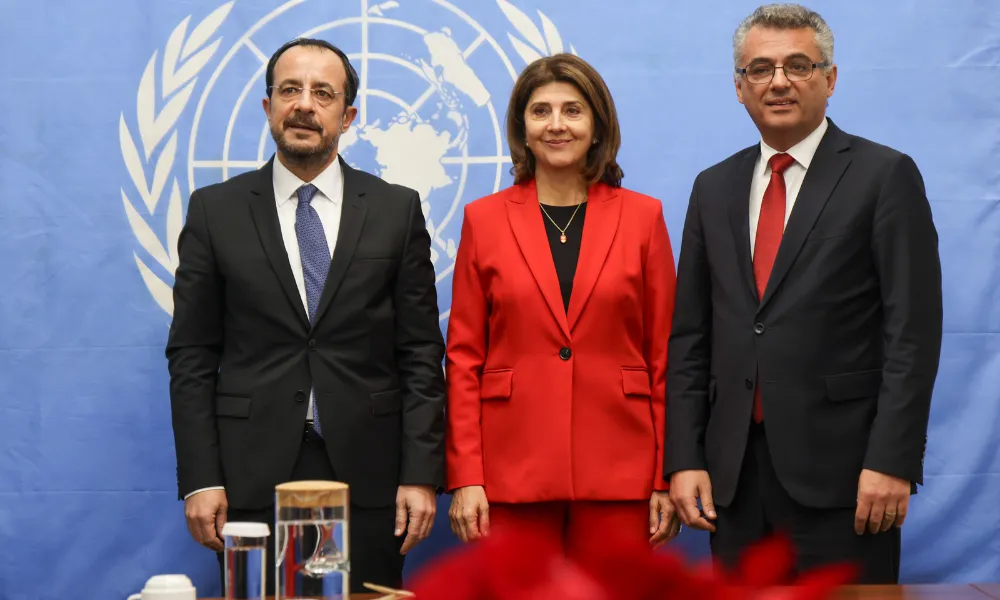
The committee is responsible for determining protection arrangements and will assess several key issues, including whether to maintain, reduce or adjust existing deployments.
Among the questions under consideration:
– Whether to maintain or reduce the security detail of House Speaker Annita Demetriou, depending on whether she is re-elected.
– Whether to assign police protection to the leaders of the newly formed parliamentary parties ALMA and Cyprus Direct Democracy, Odysseas Michaelides and Fidias Panayiotou respectively. Panayiotou’s case is considered unusual, as he spends most of his time in Brussels due to his duties as an MEP.
– Whether to strengthen the security detail of ELAM leader Christos Christou.
Concerns persist that the number of police officers assigned to political leaders has historically been determined primarily by electoral strength rather than objective risk assessment. The Audit Office reached the same conclusion in a report on the police published in November 2023, where it strongly criticised this practice.
Typically, the leaders of the two largest parties, DISY and AKEL, have the largest security details, with four officers each. Leaders of smaller parties have one or two fewer officers.
The committee will also examine whether to withdraw security protection for the president of EDEK, as the party no longer holds parliamentary representation. Party leader Nikos Anastasiou continues to be protected by two officers, a detail inherited from his predecessor Marinos Sizopoulos.
By contrast, DIKO president Marios Karoyian will retain his security detail despite the party failing to secure a parliamentary seat, due to his status as a former Speaker of the House.
Green Party leader Stavros Papadouris does not have a police guard. Until 1 January 2020, the party received a monthly allowance of €1,200 from the Ministry of Finance to employ a driver–guard for its leader. That allowance was later abolished at the party’s own request. For other party leaders, driving duties are carried out by members of their police protection teams.
How decisions are made
Changes to security arrangements follow a formal process.
The Police Security Committee convenes and carries out a risk assessment based on set criteria. It then records its recommendations for each case and submits them to the Chief of Police.
The Chief of Police forwards proposals to the Minister of Justice, who in turn submits them to the Council of Ministers for approval.
The committee is chaired by Deputy Chief of Police Panikos Stavrou.
Cuts introduced in 2021
Emily Yiolitis became the first justice minister to implement significant reductions in security details for political figures. In January 2021, following her proposal, the Council of Ministers decided to cut protection for party leaders and former Presidents of the Republic and the House by 20 per cent.
At the time, 97 police officers were assigned to guard politicians and officials at an annual cost exceeding €1 million. The cuts reduced that number by 21.
Two months earlier, on 29 October 2020, the then Speaker of the House Adamos Adamou had written to the Chief of Police requesting that his personal security detail be reduced from 15 officers – the same number assigned to his predecessor Demetris Syllouris – to eight, noting that the state was incurring unnecessary costs.
Demetriou reduced her own security
After taking office in June 2021, Annita Demetriou further reduced her security detail from eight to five officers. She also rejected a police proposal for her official vehicle to be escorted by a second police car and asked for her protection team to remain discreet and operate without flashing lights.
Current protection levels
AKEL Secretary-General Stefanos Stefanou currently has four police officers assigned to his protection.
DIKO president Nikolas Papadopoulos and ELAM leader Christos Christou each have three officers.
DIKO’s Marios Karoyian and EDEK’s Nikos Anastasiou are each protected by two officers.
Protection for former presidents
Former President of the Republic Nicos Anastasiades has the largest security detail, with 13 officers. Six are assigned to his close protection, while the remainder guard his residence.
Former Speakers of the House Yiannakis Omirou and Demetris Syllouris each have two officers.
Audit Office intervention over misuse
In November 2023, the Audit Office, then led by Odysseas Michaelides, published a report calling on the Chief of Police, Stelios Papatheodorou, to issue strict instructions to officers serving in protection units.
It warned against abuses such as transporting politicians’ children to school or private lessons or carrying out personal errands such as supermarket shopping.
The report stressed that such activities “constitute an abuse of power” and that any instructions from officials to perform non-duty tasks are unlawful. Officers should not comply, it said, and would bear responsibility if they did.
Protection linked to political strength
The Audit Office also criticised the broader framework governing police protection.
It noted that, although the issue should be regulated by law, current arrangements rely on subjective and non-transparent risk assessments that lack sufficient factual basis.
That conclusion is reinforced, it said, by the fact that the number of officers assigned to party leaders appears to be proportional to their parliamentary strength. As a result, the provision of state protection risks being treated as a de facto entitlement rather than a measure based on genuine security needs.
The report contrasts this with the United States, where legislation clearly defines protection eligibility, limiting it to the sitting President, former Presidents and the incumbent Vice President.