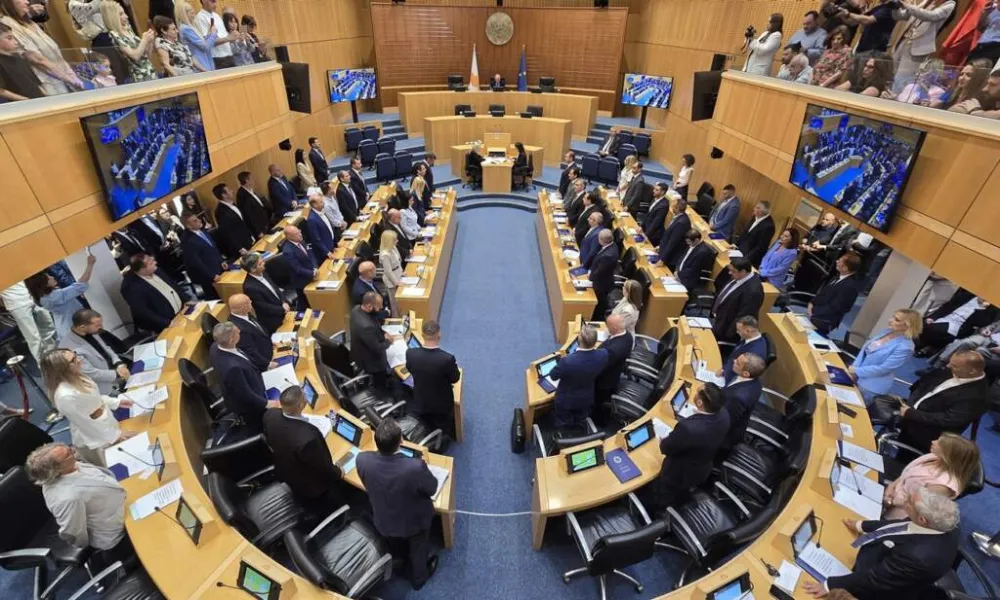


A few days after the parliamentary elections of 24 May 2026, four former MPs, who either failed to win re-election or chose not to seek a new term, have shared their experiences of how the House of Representatives and its parliamentary committees actually function.
Harris Georgiades (DISY), Costas Costa (AKEL), Charalambos Theopemptou (Citizens' Alliance/Movement of Ecologists) and Alexandra Attalides (independent, Volt) speak candidly about the weaknesses, distortions and chronic ailments of the system, as well as the reforms they believe are necessary.
Despite their differing political backgrounds, several of their observations converge. They point to delays in examining bills and the poor preparation that often precedes their submission, pressure from organised interests, and concerns over the quality of legislative work, the functioning of committees and the internal workings of parliament itself. They argue there is a need for greater transparency, better preparation of legislation, stronger accountability and a more substantive role for parliamentary institutions.
Harris Georgiades
It is the people who make the difference
Asked about the most significant problems in how parliament functions, the president of the Glafcos Clerides Institute, Harris Georgiades, said that "parliament, any parliament, will only be as good as the quality and competence of its members." He explained that under the same rules and procedures, some MPs and committees carry out serious and substantive work, exercising scrutiny or examining bills thoroughly, while others effectively turn the parliamentary process into a display of populism and demagoguery. "So, as is often the case, it is people who make the difference, not procedures," added the former DISY MP and ex-finance minister.
Are there factors that hinder the effectiveness of parliamentary work?
There is indeed one very important factor, namely the complete separation of powers. We are the only EU member state where the executive and legislative branches are entirely independent of one another, with no requirement for a vote of confidence in the government and no guaranteed government majority in parliament, which would otherwise ensure efficiency and speed. In our case, a majority has to be built case by case, inevitably involving the opposition as well. This leads not only to delays but also to compromises that, in some cases, undermine the original purpose of the legislation. At the same time, because the concepts of government and opposition are institutionally less clear cut, it becomes much harder for citizens to assess and judge political behaviour and choices, whether positively or negatively. For example, who should a citizen who disagrees with the recent tax reform hold accountable: the government side that tabled it, or the opposition that shaped and voted for it? The advantage of our system, of course, is political stability and a more consensual parliamentary process. I do not underestimate the benefits of our system, but I think I would prefer a parliamentary system…
Sixteen committees!
How would you assess the way the parliamentary committees operate?
A key problem, and a topical one, is the sheer number of committees. In a parliament of 56 members, having 16 committees, each with 12 members, is unthinkable. I understand that at the start of each five year term, the desire to retain committee chairs makes it difficult to agree on reducing their number, but over the coming five years we will see committees that effectively operate without quorum and without the necessary focus. Even so, the role of the committee chair remains extremely important. It is the chair who determines whether a committee operates with the institutional seriousness required, or whether it turns into a coffee shop.
During your time in parliament, did you feel that party interests took precedence over substance when examining bills or proposals?
Pre-election considerations certainly exist. How else can one explain the fact that, over the last ten years, an issue involving repossessions and loans has consistently surfaced at the very last sitting before elections?
Parallel monologues
What changes would you propose to improve how parliament functions?
Besides reducing the number of committees, I would like to see livelier debates in the plenary. There should be substantive political discussion of an issue, with brief interventions from MPs, argument and counter argument, and possibly the participation of the relevant minister. Instead, what we often see in our parliament is parallel monologues.
Applause is banned!
How often did input from outside bodies, lobbies or organised interests influence committee decisions more than the data submitted officially?
I do not necessarily believe that "official" views, meaning those submitted by state services, are always correct, while those submitted by non-governmental bodies are suspect or mistaken. All views should be heard, and MPs' decisions should be based on the public interest, as they themselves understand it.
Are there aspects of how parliament works internally that would surprise citizens if they became widely known?
That applause, or any form of acclamation, is banned in the plenary. I see this as a sign of false solemnity rather than genuine seriousness…
Alexandra Attalides
Predetermined votes
"My five years in the House of Representatives convinced me that the biggest problem with Cypriot parliamentarism is not a lack of capable people. It is the dominance of party management over the institutional mission of parliament," said the former independent MP (Volt), Alexandra Attalides, when asked about the problems facing the Cypriot House of Representatives.
Does parliament produce quality legislative work?
Parliament does produce significant work. Unfortunately, however, citizens also elect people who do not participate systematically in either the committees or the plenary, without any meaningful consequence. This negatively affects the quality of parliamentary work. Fortunately, there are several MPs who work seriously and devote countless hours to committee work. Very often, however, the final position parties take on a bill or proposed law was not shaped through committee debate or the evaluation of evidence submitted. The vote had, in practice, already been decided by party leaderships before the parliamentary process was even complete. This undermines the role of committees and discourages substantive debate.
Invisible processes
How should parliament function?
Parliament should not operate as a place that simply ratifies party decisions made elsewhere. It should function as a space for synthesis, scrutiny and policymaking. Otherwise, its very reason for existing is undermined. During my time in parliament, I saw many cases where proposals with broad social support were delayed, weakened or altered for reasons more closely tied to political alignments than to the public interest. These processes are not always visible to citizens, but they affect both the quality of legislation and trust in institutions.
Inequalities
What other problems have you identified?
Another serious problem is the unequal distribution of resources among MPs. All MPs are elected under the same constitutional mandate and have the same obligations to citizens. Yet they do not all have the same tools to carry out their work. Access to scientific, legal and technical support remains inadequate, particularly for MPs from smaller parties and independents. At a time when we are being asked to legislate on artificial intelligence, the climate crisis and other complex issues, scientific input is not a luxury. It is a precondition for good legislation. I believe committee secretariats should gradually take on a research and scientific role, and I consider it essential to create an independent legal service for parliament and appoint an independent legal adviser.
What causes the delays?
Delays in committees are not only down to parliamentary procedures. Bills often arrive in parliament without having been adequately worked through by the executive. Crucial studies are missing, necessary consultation has not taken place, or questions of constitutionality arise during debate. Very often, parliament is called upon to fix problems that should have been resolved before a bill was even submitted.
Strengthening transparency
What needs to change to improve how parliament functions?
If I had to choose one reform to push forward immediately, it would be strengthening transparency and accountability in the legislative process. Creating a mandatory, fully public register of meetings with lobbying representatives would be an important step in that direction. At the same time, committee sittings, documents submitted and MPs' votes should be easily and directly accessible to every citizen. If there is one thing I can say more freely today, it is that Cyprus needs less political manoeuvring and more institutional courage. Citizens should not be asking politicians to be likeable. They should be demanding that they be useful, that they legislate for the benefit of society and exercise meaningful scrutiny over the executive. Restoring trust in institutions will not come through better communication. It will come through institutions that function better. And that requires a parliament that is more independent, more transparent, better informed and more willing to serve the public interest rather than party interests.
Costas Costa: Provisions of harmonisation bills were removed, and they thought no one would notice
The former AKEL MP, Costas Costa, admits that during his time in parliament he recognised cases where party interests took precedence over substance when examining bills or proposed laws. "Unfortunately yes, in some cases I realised that what was driving certain political forces was political expediency rather than the public good. And of course, this led to major or minor, but substantive, changes to the texts of bills or proposed laws, passed by majority in committees or during plenary debate, through last minute written or verbal amendments," he said.
No one takes responsibility
Why are there such excessive delays in committees?
To begin with, for 15 years I repeatedly said it was unthinkable for successive governments to delay so badly in submitting harmonisation bills to parliament for debate and eventual approval in the plenary, often years after the deadline by which harmonisation should have taken place, and just one step before the Republic faced referral to the European Court of Justice. Worse still, whenever the relevant parliamentary committees raised the issue, we always heard excuses and finger pointing between ministries and the Law Office over who was responsible for the delay. Unfortunately, after so many years and so many objections, nothing changed, and no one ever took responsibility. I said many times that if the Republic were ever fined by the European Court of Justice for unjustified delays in transposing a European directive, the fine should not be paid by the taxpayer, but by those responsible. I must also say that on many occasions, bills submitted to parliament were found, during committee debate, not to have undergone the public consultation that should have taken place beforehand, with that consultation effectively having to happen in committee instead. In addition, the texts often contained significant gaps or technical drafting problems. Time and again, while reading bills or regulations brought by the government, I identified very serious errors and omissions, which the relevant officials acknowledged, yet no one could explain how none of the responsible ministries, departments, agencies or services, including the Law Office, had spotted them. On occasion, I also found that provisions of the European directive we were supposed to be transposing were missing from the text submitted to parliament, and officials always called this a mistake, something I personally never accepted. Beyond that, I often discovered that harmonisation bills had additional provisions added to them, beyond what the European directive required, provisions which, I believe, those responsible hoped would pass unnoticed.
Millions flying around
How often did input from outside bodies, lobbies or organised interests influence committee decisions more than the data submitted officially?
No one ever approached me to try to influence me. On the contrary, I personally clashed with major interests, for instance after my complaints about profiteering in fuel prices and the sell off of the new Limassol port. I exposed scandals on my own, such as the new bus stops, and fought alongside colleagues against many powerful interests, including the Vasiliko terminal, the electricity interconnector, the Takata airbags and the speed camera scandal, among others. I often said, during sittings of the Commerce Committee, in discussions on energy issues such as renewables, that I felt as though millions of euros were flying over our heads in that room, and that unfortunately everyone looks out for their own interest rather than the common good.
Were there cases where pieces of legislation were advanced or shelved for reasons that were never explained publicly?
I did see bills or proposed laws shelved due to pressure, or withdrawn by the government shortly before reaching the plenary. I also saw bills and proposed laws changed at the last minute because of various pressures.
Secrets and concealment
What could you not say publicly while you were a sitting MP?
I genuinely experienced a great deal. In the 15 years I spent in parliament, both as an MP and as parliamentary secretary, I saw and heard a great many things. I was present on some nights that changed the country's history: the approval of ELA support for Laiki Bank, the rejection and then the approval of the deposit bail in, the foreclosures bill, the closure of the Cooperative Central Bank, the proposal for oversight of the nationalised Cooperative sector by the Audit Office, the bank guarantees bill, and the procedures before the election of parliamentary speakers, among many others. What happened away from the public eye, people do not know. I also could not say publicly that, in highly sensitive closed sessions, mainly of the Commerce Committee, on energy matters, we heard confidential information, particularly concerning the natural gas infrastructure scandal at Vasiliko and the electricity interconnector. I said many times, in all honesty, during those sessions, that if people knew what was really happening with all of this and more, I do not know how they would react.
Charalambos Theopemptou: Wasted time and lack of consultation
Parliament is staffed by extremely capable people with impressive knowledge and skills, notes the former president and MP for the Movement of Ecologists, Citizens' Cooperation, Charalambos Theopemptou, while pointing out that "it is unacceptable to see parliamentary staff reduced to tears because of rude or otherwise poor behaviour from MPs."
Based on your experience, what do you consider the most important problems in how parliament functions?
A) One major infrastructure issue is how incoming documents are processed and managed, particularly those from the executive. Documents reach MPs as scanned PDF images, making any editing impossible. The IT systems need significant upgrading, including automatic software updates. At the same time, there is no protocol for sending emails, with many sent by individuals rather than by the relevant service or committee, and often without a subject line.
B) Public consultation before a bill is sent to parliament is mandatory. The way government services handle this is problematic. Whether because consultations were carried out three years earlier, or because departments lack the time or are rushing, bills are sent to parliament without adequate consultation, leaving the relevant committees to spend a great deal of time doing what the government should have done. Perhaps such bills should be sent back to the government when a committee finds that proper consultation did not take place. At the same time, the documentation submitted to demonstrate that public consultation took place, and with whom, is often inadequate. Parliament therefore needs to propose changes to how such information is submitted to the House. This is a serious problem, since an enormous amount of time is lost as a result, holding up other matters, as the lack of consultation means issues are debated for months before the committee in question can reach a conclusion.
C) Not always, but often, committees lose valuable time on MPs' "opening remarks," with members speaking before invited guests are heard. This can take so long that guests sometimes leave without getting the chance to speak at all. This needs serious change, because it is unacceptable for guests, say from Paphos, to travel in to explain their position only to be told to come back the following week because MPs simply spoke for too long.
D) The current system, where everyone speaks first and lists a series of questions, which the government side must then answer, does not work well. There should also be an option for a question to be asked and answered by the government side before the next question is put. As things stand, MPs ask their questions, and there is a risk that some go unanswered or are "forgotten," with no written response ever given.
Tricks too
Are there excessive delays in committees because bills and proposed laws arrive without adequate preparation?
Yes. As I explained above, there is a problem with procedural delays, but at times I had the impression this was done deliberately, so that pressure from the EU would build and the relevant committee would not have time to examine the matter carefully. It is worth noting that the EU normally allows two years or more for transposition into national law. This tactic is usually used when there is a desire to serve certain interests, or to avoid implementing what the directive requires.
Do submissions from outside bodies, lobbies or organised interests influence committee decisions?
This is a very common occurrence, as groups that disagree with provisions of a bill send written submissions through parliament setting out their views, or arrange meetings to explain their position. The problem arises when the changes they propose harm the public interest or create difficulties for vulnerable groups in order to serve other interests.