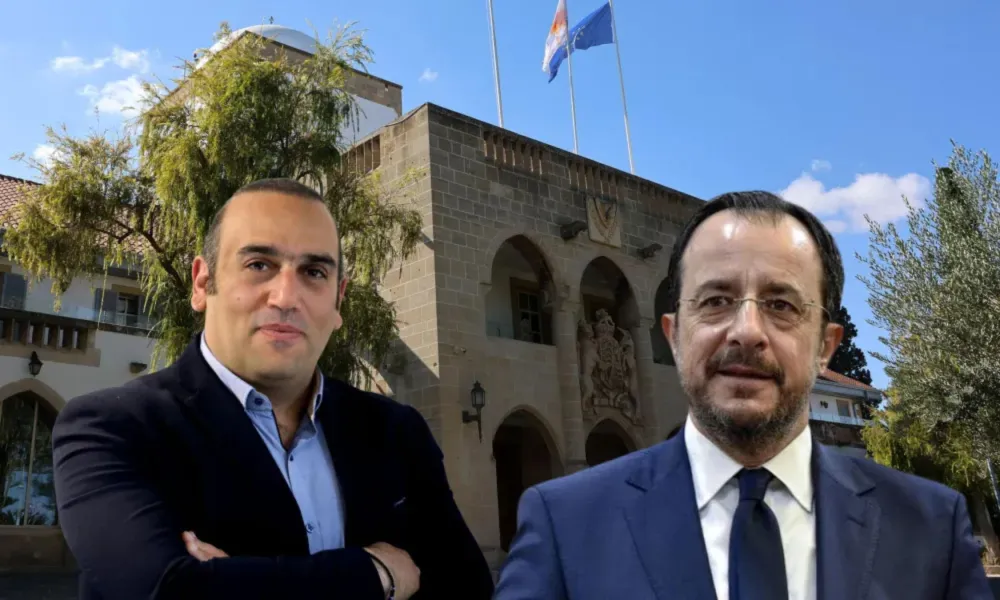

The confrontation between President Nikos Christodoulides and the leadership of the Democratic Rally (DISY) has developed into one of the most intense political disputes of recent months, fuelled by the impending cabinet reshuffle but also by lingering tensions from the 2023 presidential election and an ongoing battle for influence within Cyprus' centre-right political space.
The escalation followed allegations by DISY officials that the Presidential Palace had approached party members to gauge their willingness to accept government appointments.
According to figures within the party, such contacts were aimed not only at filling vacancies arising from the reshuffle but also at reshaping the political balance by drawing personnel from DISY and projecting the image of a broader base of political support for the government.
President revives 2023 election divisions
President Christodoulides did not leave the accusations unanswered.
Rather than simply denying the claims or seeking to lower tensions, he used an interview with ANT1 to revisit the 2023 presidential election campaign, arguing that members of the current DISY leadership had worked in favour of the candidate backed by AKEL during the second round of voting.
Through that argument, the president sought to challenge the moral authority of those accusing him of political defections or of attempting to weaken the party from which he emerged.
DISY responds
The remarks triggered an immediate response from Pindarou, the headquarters of DISY.
Party vice-president Yiannis Karousos replied in unusually strong terms, arguing that a politician who had left the political movement that helped elevate him could not position himself as the judge of others' political consistency.
Mr Karousos also rejected the president's argument regarding the 2023 election.
He pointed out that DISY's official position during the second round was to allow members a vote according to conscience, meaning that individual choices made by party officials at the time could not be equated with the subsequent political course followed by Mr Christodoulides.
Questions about political identity
The dispute did not end with competing interpretations of events surrounding the 2023 election.
Mr Karousos went further by making pointed references to the president's broader political trajectory and his relations with the political left, citing decisions and public interventions from previous years.
The objective, according to the party's narrative, was to reinforce the argument that Mr Christodoulides has moved decisively away from the political identity traditionally associated with DISY.
Reshuffle broadens the dispute
At the same time, DISY sought to widen the scope of the confrontation beyond the reshuffle itself by turning attention to the government's overall performance.
In a statement, the party accused the administration of inefficiency, poor planning and mismanagement on a range of major issues, including:
- The cost of living.
- Water shortages.
- Energy prices.
- Wildfire management.
- Foot-and-mouth disease.
- The implementation of major infrastructure projects.
DISY also accused the Presidency of prioritising political confrontation with the official opposition rather than focusing on addressing citizens' concerns.
Battle for the centre-right
Behind the public exchanges lies what many observers view as the central issue driving the dispute.
The confrontation is fundamentally about control of the broader political space traditionally occupied by DISY, the balance of forces ahead of future electoral contests and the continuing rivalry between President Christodoulides and the party leadership.
While the cabinet reshuffle has become the immediate trigger for the clash, the deeper struggle concerns political influence, representation of the centre-right electorate and the alliances that could shape the political landscape ahead of the 2028 presidential election.