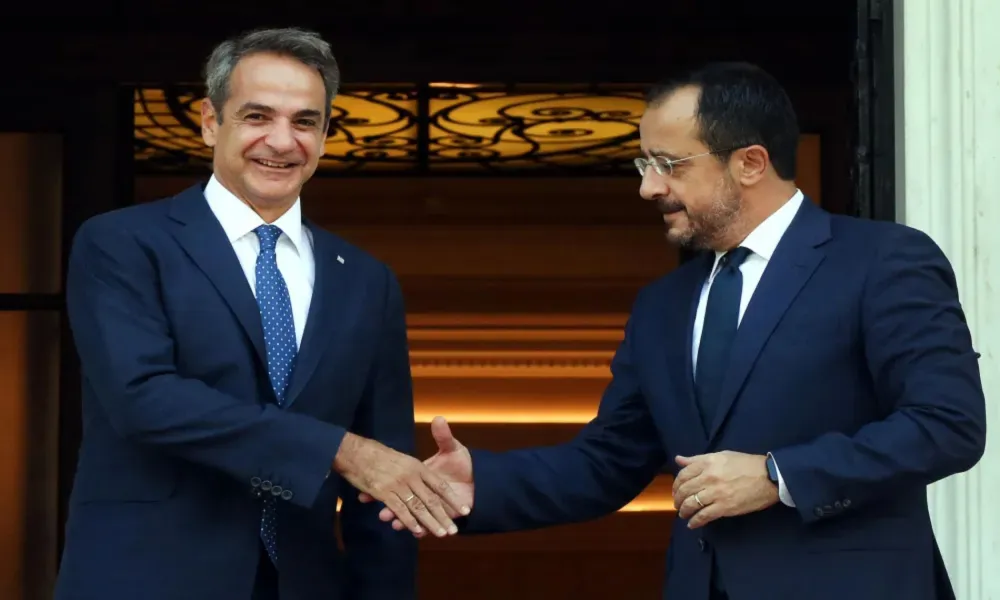

Cyprus and Greece are set to strengthen their strategic partnership through closer institutional cooperation and coordination across a wide range of policy areas, Government Spokesman Konstantinos Letymbiotis said on Tuesday, ahead of the fourth Intergovernmental Summit in Nicosia.
The summit, scheduled to take place on Wednesday, will be co-chaired by President Nikos Christodoulides and Greek Prime Minister Kyriakos Mitsotakis. It will bring together 24 ministers and deputy ministers, including 11 from Cyprus and 13 from Greece, alongside the two leaders.
Speaking to the media, Letymbiotis described the meeting as a confirmation of the “new momentum” in the strategic relationship between the two countries.
He said cooperation between Nicosia and Athens had traditionally been close and particularly important in areas such as foreign policy, security and the protection of shared national interests. However, the establishment of regular intergovernmental summits had created a more structured framework for joint policymaking, the exchange of expertise and the implementation of initiatives, supported by a permanent mechanism for coordination and monitoring.
The initiative to institutionalise the summits was put forward by Christodoulides and agreed with Mitsotakis in March 2023. Letymbiotis described it as a political decision with significant strategic importance.
As examples of tangible results achieved through bilateral cooperation, he pointed to the development of Cyprus's Digital Citizen application, which has attracted more than 170,000 users, and its interconnection with Greece's Gov.gr application. Other initiatives include bilateral agreements on organ transplantation, cooperation on the mutual academic recognition of qualifications and an agreement to establish a Long-Term Planning Unit at the Cyprus Presidency.
“What gives this institution its particular importance is precisely this dimension: the ability of two states, with such strong historical and national ties, to jointly design policies that deliver measurable benefits,” he said.
Artificial intelligence and civil protection high on the agenda
Artificial intelligence (AI) will be one of the central themes of Wednesday's summit, with discussions focusing on its application across government, the exchange of expertise and the adoption of best practices.
The issue is particularly relevant for Cyprus, coming just days after the Cabinet approved the country's National Artificial Intelligence Strategy for 2026-2032.
Letymbiotis said that drawing on Greece's experience, exploring practical applications and developing joint initiatives could support the implementation of Cyprus's national priorities.
Other areas identified for closer cooperation include foreign policy, civil protection, justice and public order, healthcare, education, employment and skills, shipping, tourism, culture and digital governance.
On civil protection, particular emphasis will be placed on preventing and responding to natural disasters, operational preparedness, safeguarding critical infrastructure and making use of new technologies.
Letymbiotis also noted that discussions on legislation to reform Cyprus's civil protection system would continue in the House of Representatives on Thursday, the day after the summit.
The government's objective, he said, was to establish a “modern, unified and effective civil protection mechanism”.
Coordination ahead of EU Council presidencies
European affairs and coordination between the two countries' upcoming EU Council presidencies will also feature prominently in the discussions.
Cyprus will hold the rotating presidency during the first half of 2026, followed by Greece in the second half of 2027.
The exchange of experience, the transfer of expertise gained during Cyprus's presidency and the coordination of priorities will be cross-cutting themes in the bilateral ministerial meetings.
According to Letymbiotis, the consecutive presidencies offer an opportunity to ensure greater continuity in European policymaking and promote shared strategic objectives more effectively, at a critical time for the European Union's future.
Great Sea Interconnector to be discussed, maritime delimitation excluded
Asked whether the two leaders would discuss the delimitation of maritime zones between Cyprus and Greece, Letymbiotis said the issue was not included on the summit's agenda.
“Our position is well known and has been expressed publicly on many occasions. Any actions and decisions will be taken in close coordination with Greece,” he said.
The Great Sea Interconnector, however, is expected to feature in the discussions.
Letymbiotis said progress on the electricity interconnection project was proceeding normally and in accordance with the agreed roadmap.
Responding to a suggestion that the failure of the two countries to delimit maritime zones between them, despite having reached agreements with other states, reflected a longstanding reluctance on the part of both governments, he rejected the characterisation.
“There is no such fear syndrome. The defence of and self-evident respect for our sovereign rights are a given, as is respect for international law and the Law of the Sea,” he said.
He added that coordination with Greece was “close, honest and continuous”, reiterating that Cyprus had repeatedly expressed its readiness to discuss the matter.
Agreements and joint declaration expected
The summit's programme will include a private meeting between Christodoulides and Mitsotakis, bilateral meetings between ministers and deputy ministers, and a plenary session chaired by the two leaders.
Memoranda of understanding and cooperation agreements are expected to be signed on the sidelines of the meeting.
At the conclusion of the summit, the two sides will issue a joint declaration outlining their shared priorities and next steps. The leaders will subsequently hold a joint press conference.
Letymbiotis said the fourth Intergovernmental Summit demonstrated the strategic importance of the institutional cooperation established in 2023, providing a framework for joint strategic planning and the coordinated implementation of policies across an increasingly broad range of areas affecting citizens' lives.
Source: CNA