
Behind-the-scenes political manoeuvring ahead of the 2028 presidential election is accelerating, with opposition parties increasingly focused on potential alliances and common candidates.
At the centre of the discussions is Akel, which has begun a series of consultations with other political forces, while Odysseas Michaelides' Alma movement is pursuing parallel contacts.
Positive signals from ALMA talks
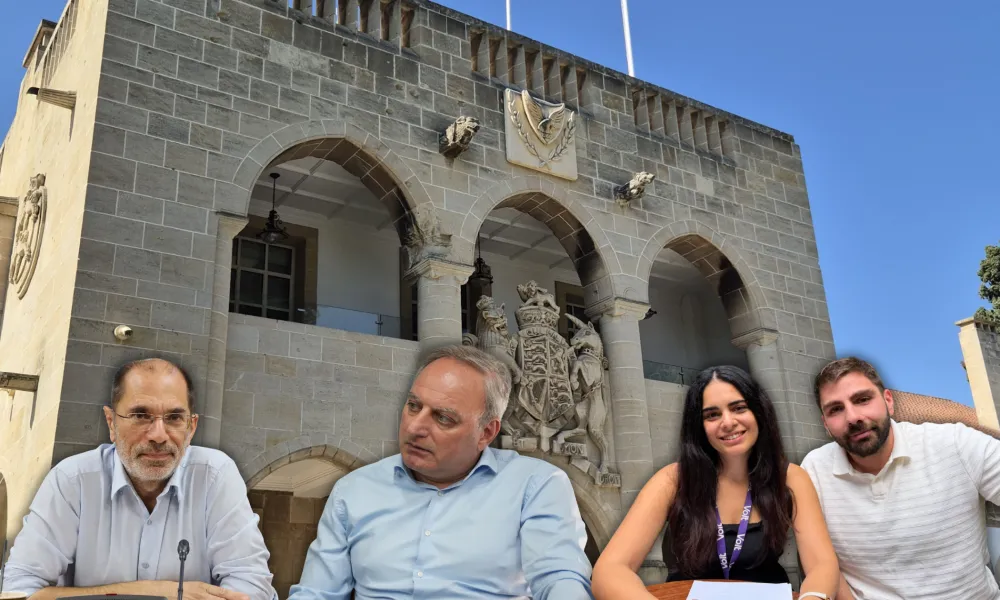
Michaelides says there is encouraging ground for cooperation following consecutive meetings with Akel secretary-general Stefanos Stefanou and Volt co-presidents Lysia Demetriou and Pieros Karoullas.
According to the Alma leader, both meetings took place in a constructive atmosphere and laid the groundwork for further discussions expected in mid-December.
Speaking on Politis Radio, Michaelides said his meeting with Stefanou, the second between the two sides, focused on substantive political issues. Stefanou reportedly briefed the Alma delegation on the criteria Akel has set out internally regarding the presidential election.
Areas of convergence
Michaelides said the discussions revealed common ground on several key issues, including:
- Institutional reform, which Alma considers a central priority.
- Economic policy based on an open economy combined with state intervention where necessary to protect the welfare state.
- Support for deeper European integration.
On the Cyprus issue, he acknowledged differences in rhetoric between the two sides but stressed that Alma remains committed to a federal solution in line with United Nations resolutions. He argued that these differences do not constitute an insurmountable obstacle to finding a common candidate.
No candidate names discussed
Despite growing public speculation over possible contenders, Michaelides said no names were discussed during the meeting with Akel.
He also confirmed that there was no discussion regarding Andreas Mavroyiannis, despite Alma's previously stated position that it could not support a potential Mavroyiannis candidacy.
According to Michaelides, identifying a candidate capable of attracting broad support is more important than promoting party-based candidacies.
He argued that even complete agreement on policy positions would have little impact if a joint candidate failed to convince voters, adding that "90 per cent" of success ultimately depends on the person selected.
Volt talks to continue
Alma's meeting with Volt also ended with an agreement to continue discussions once Volt completes its internal decision-making process.
Michaelides reiterated that Alma's preferred strategy, described as its "Plan A", is cooperation with other political forces to support a joint candidacy.
If that proves impossible, the movement would consider running independently as a "Plan B", although no decisions have been taken regarding either a candidate or the form such a campaign would take.
Remarks on Haralambidou and Neophytou
Asked about claims by Irene Charalambidou that he had encouraged her to seek the presidency, Michaelides said Alma does not wish to put forward figures who are perceived by voters as closely tied to traditional party structures.
He added that although Charalambidou is not a member of Alma, her views carry significant weight and it would be positive if she supported the movement's eventual choice.
Michaelides also acknowledged the leadership abilities of Averof Neophytou but ruled out cooperation, saying Alma was created to bring political change and move away from policies associated with recent decades.
Koulias pushes AKEL-DIKO cooperation
Meanwhile, Diko MP Zacharias Koulias continues to publicly advocate closer cooperation between Diko and Akel, a stance that has generated debate within his party.
Speaking on Sigma TV's Protoselido, Koulias noted that Diko and Akel have cooperated on three occasions in the past and suggested there may already be a figure capable of serving as a joint candidate.
"We already have the candidate, but we will not name him," he said, without providing further details.
Koulias also adopted a critical tone towards Disy, arguing that cooperation with the party appears increasingly uncertain.