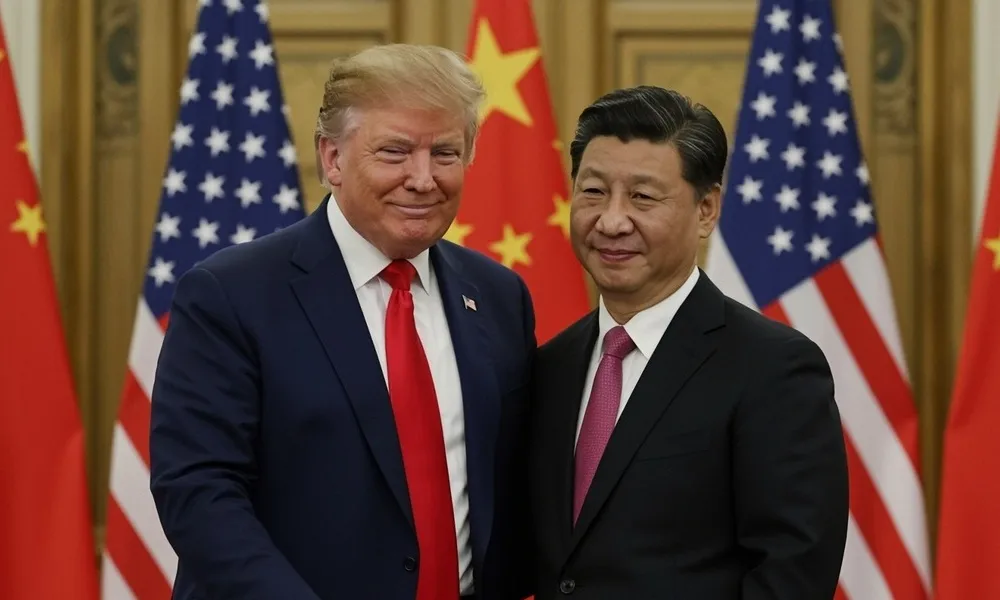

Donald Trump arrives in Beijing this week for a two-day summit with Chinese President Xi Jinping carrying an agenda shaped as much by what has gone wrong as by what he hopes to achieve. The meetings, scheduled for 14 and 15 May, come after months of political turbulence for the American president: a bruising Iran war, repeated court setbacks on trade tariffs, and approval ratings that have left him in need of a visible foreign policy win.
The visit marks the first by an American president to China in almost nine years, arriving at a time of heightened bilateral tensions over trade, technology and defence, and intersecting with a precarious US-Iran ceasefire and a dual blockade of the Strait of Hormuz that is driving up energy prices and weighing on global economic growth.
The pomp will be considerable. Trump will attend a welcome ceremony and a bilateral meeting with Xi, followed by a visit to the Temple of Heaven and a state banquet. He will be accompanied by a business delegation that includes Tesla's Elon Musk and Apple's Tim Cook. But for all the pageantry, analysts across Washington and Beijing are tempering expectations sharply.
A trade truce, not a breakthrough
The modest expectations for Trump's meetings with Xi, the first since they paused a bruising trade war in October, underscore how Trump's approach has failed to deliver an advantage ahead of the talks. A year ago, Trump predicted that sweeping tariffs would bring America's main economic rival to heel. That ambition has since been blunted by court rulings, and his goals have narrowed to a few deals on beans, beef and Boeing jets, and enlisting China's help to resolve his unpopular Iran war.
China's aim is to buy more time to consolidate its technological and industrial position and reignite its faltering economy; the US aim is probably to secure symbolic wins rather than more meaningful structural reforms to China's economic model. Beijing is probably willing to buy Boeing aircraft and American soybeans for stability, and to announce a bilateral Board of Trade and Board of Investment already sketched out in previous working-level talks. Whether even these modest deliverables materialise remains uncertain. The reported meagre bureaucratic preparations for the meeting limit the prospects for progress, and by signalling early a desire for multiple presidential encounters this year, the Trump administration may have reduced Beijing's incentive to offer major concessions.
China has quietly sharpened its economic pressure toolkit since the two leaders' last meeting, while Trump has been preoccupied fighting court rulings against his tariffs and a war with Iran that has sapped his approval ratings ahead of November's midterm elections.
Taiwan: the most dangerous item on the agenda
Behind the trade optics, the question of Taiwan carries the greatest long-term consequence. Beijing has declared Taiwan the core of China's core interests, and Xi is expected to press Trump on US arms sales to the self-governing island, a policy that China has sought to roll back for years.
In a phone call in February, Xi urged Trump to handle the issue of arms sales with "extreme caution." The Trump administration approved $11 billion in arms sales to Taiwan late last year, drawing condemnation from Beijing, which quickly held a two-day military exercise near the island. Another arms sale package worth around $14 billion is awaiting final approval, and Trump has held off making a decision for months.
Xi may also push for a change in Washington's formal language on Taiwanese independence. Taipei is particularly worried that Beijing will successfully persuade Trump to express "support" for peaceful unification, or to state that the United States "opposes" rather than "does not support" Taiwan independence, a shift that analysts say would be easily used by China to claim Washington is taking Beijing's side. Secretary of State Marco Rubio, who will accompany Trump to Beijing, last week brushed off speculation that the summit could produce a shift in US policy toward Taiwan, saying both sides understand each other's positions.
Iran: Trump needs China's help
The Iran war has fundamentally altered the dynamics of this summit. More than 60% of Americans disapprove of the Iran war, according to a Reuters/Ipsos survey last month, and Trump wants China to convince Tehran to make a deal with Washington to end the conflict. China maintains ties with Iran and remains a major consumer of its oil exports.
Some fear that Beijing will want something significant in return, and that the top of Xi's agenda is Taiwan, with even a nuanced change in Washington's wording raising anxiety about the commitment of Taipei's most important backer, reverberating across other US allies in Asia. In April, Defence Secretary Pete Hegseth announced that Beijing had provided high-level assurances to the White House that it would not send weapons to Iran. That was seen as a meaningful diplomatic gesture ahead of the summit, though analysts note it falls well short of the active mediation Washington is seeking.
China's confidence, Trump's constraints
The broader picture, analysts say, is of a China that enters these talks from a position of relative strength. Xi has long told cadres that time and momentum are on China's side. His confidence was further strengthened last year when he successfully pushed back against Trump's unprecedented trade escalation, which pushed tariffs past 140%, by wielding China's rare earth minerals as a pressure tool, and Trump folded rather than credibly threaten escalation.
Trump "kind of needs China more than China needs him," said Alejandro Reyes, a professor specialising in Chinese foreign policy at the University of Hong Kong. "He needs a foreign policy victory: a victory that shows he is looking to ensure stability in the world and that he's not just disrupting global politics."
The most likely outcome, in the assessment of Washington think tanks, is a superficial ceasefire largely to China's advantage, with both sides claiming enough to justify the spectacle. The summit can be understood more for what it aims to avoid than what it seeks to achieve. For Trump, walking away with trade announcements, a renewed truce and no visible concessions on Taiwan would count as a success. For Xi, simply keeping the relationship stable while the US remains entangled in the Middle East may be sufficient.