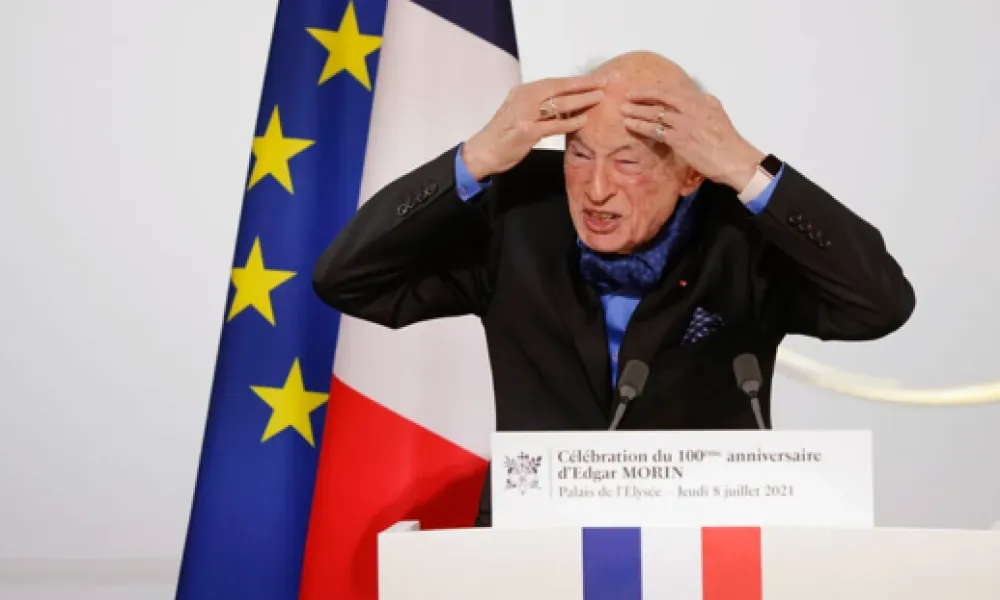
French sociologist and philosopher Edgar Morin, one of the country’s most influential intellectual figures, has died aged 104, his wife said.
Morin, whose work became known across the world, challenged the boundaries of traditional sociology and developed a body of thought centred on humanity, science and the need to understand reality in all its complexity.
“Until the last days of his life, Edgar Morin remained committed to the world, to others and to the great human questions that nourished his thinking,” his wife, Sabah Abouessalam Morin, said in a statement sent to Agence France-Presse.
The originality of Morin, a secular Jew who described himself as a “poacher of knowledge”, lay in his refusal to accept the fragmentation of knowledge. Instead, he argued for an interdisciplinary cultural and scientific vision capable of confronting “the complexity of reality”.
Often described as a “global thinker”, Morin sought, through his concept of “complex thought”, to connect what is usually treated as separate.
He believed that the greater the risks created by crises, the greater the possibility of finding solutions. Asked frequently whether he was an optimist or a pessimist, he replied in 2005: “I am an optimist-pessimist. I hope against a backdrop of despair.”
Born Edgar Nahoum in Paris on July 8, 1921, into a Jewish family with roots in Thessaloniki, Morin joined the Communist Party in 1941 and later became active in the French Resistance under the name Morin.
He made a major impact with the publication of Autocritique in 1959, an account of his expulsion from the French Communist Party, where he had been a prominent figure, and of his own blindness towards Stalinism.
Around the same period, he was also among the founders of the Committee of Intellectuals Against the Algerian War.
A forerunner of the “sociology of the present”, Morin focused on subjects that had received little attention from sociology at the time, including cinema, new technologies, sport and the transformation of rural life.
In the fifth volume of his landmark work La Méthode, he wrote: “The more we know about humanity, the less we understand it. The divisions between disciplines fragment it, drain it of life, substance and complexity, and some sciences that are considered human even drain away the very concept of humanity.”
Source: Amna