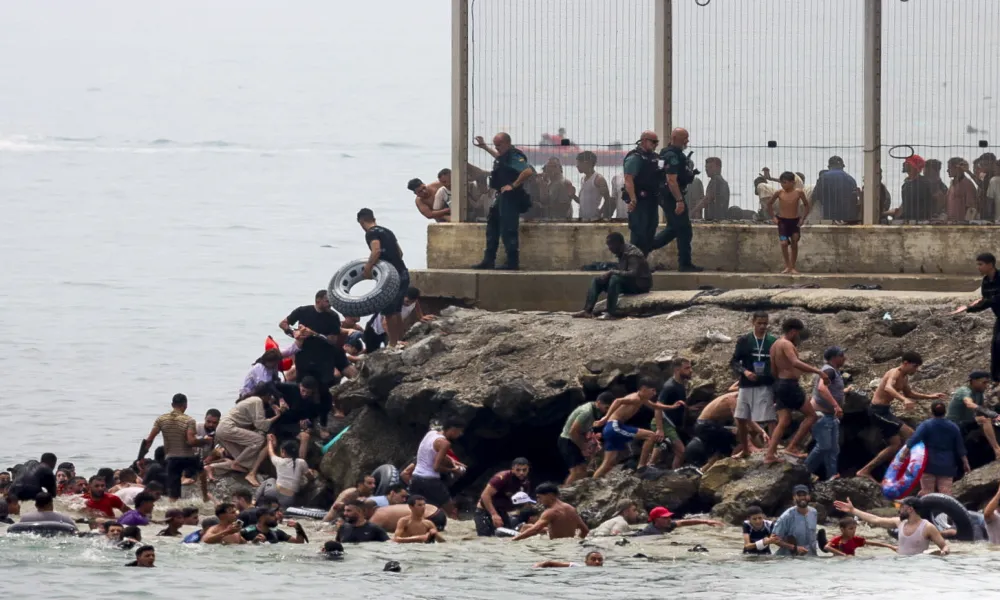

Thousands of migrants have entered the Spanish enclave of Ceuta on foot after scaling the border fence separating the city from Morocco, according to Spanish state news agency EFE.
Footage showed hundreds of young men climbing the fence while it was apparently unguarded by police. Members of Morocco’s auxiliary forces, responsible for security in the area, were seen withdrawing as the migrants crossed into Ceuta.
Video obtained by Reuters showed some of those entering the enclave shouting, “Long live Spain”.
Reception system overwhelmed
The latest crossings follow the arrival of at least 1,500 migrants who swam to Ceuta last week, according to regional authorities.
Ceuta and Melilla, Spain’s other autonomous city in North Africa, form the European Union’s only land borders with Africa. Both enclaves periodically experience sharp increases in attempted crossings by people seeking to reach Europe.
The head of Ceuta, Juan Jesús Vivas, called on Spain’s national government to declare a state of emergency, warning that the recent arrivals had overwhelmed the city’s reception system and left hundreds of migrants sleeping outdoors.
“We are facing a situation of absolute humanitarian and social emergency,” Vivas told Cadena SER. He said facilities for unaccompanied minors were operating at 2,400% of their capacity.
In a separate interview with Onda Cero, he described the situation as a national emergency and called for a “decisive, dynamic and coordinated response under a single command structure”.
Around 300 arrivals each day
Vivas said arrivals were averaging about 300 people a day. At that rate, he warned, Ceuta could face conditions comparable to the migration crisis of May 2021, when 10,000 people entered the enclave within several days.
He also highlighted the human cost of the crossings, saying that 60 bodies had been recovered from the sea in recent months. Vivas argued that tighter migration controls would help prevent further deaths.
Spanish Interior Minister Fernando Grande-Marlaska is due to visit Ceuta on Friday to meet local authorities and security officials. The Spanish government said several ministries were coordinating efforts to strengthen border controls and provide humanitarian assistance.
Spain’s Interior Ministry said Moroccan security forces were helping to limit arrivals from Morocco.
Call for legal changes
Vivas also called for changes to Spain’s migration framework, saying legal shortcomings highlighted by a recent Supreme Court ruling needed to be addressed.
Earlier in July, the court ruled that migrants intercepted at sea while attempting to reach Ceuta or Melilla could not be returned through summary procedures under the special border-rejection system.
According to the Interior Ministry, no migrant arrivals by sea had been recorded in Ceuta up to 15 July 2026. Only four people arrived by that route in 2025 and 28 in 2024.
The main route used by migrants attempting to reach Spain remains the dangerous Atlantic crossing to the Canary Islands from the north-western coast of Africa.
Previous crisis in 2021
More than 10,000 migrants entered Ceuta from neighbouring Morocco over two days in 2021 after Rabat relaxed border controls amid a diplomatic dispute with Madrid.
The dispute centred on Spain’s decision to provide medical treatment to Brahim Ghali, leader of the Polisario Front independence movement in Western Sahara.
The diplomatic crisis ended in 2022 after Madrid reversed decades of neutrality and changed its position on the sensitive issue of Western Sahara.
Source: CNA.