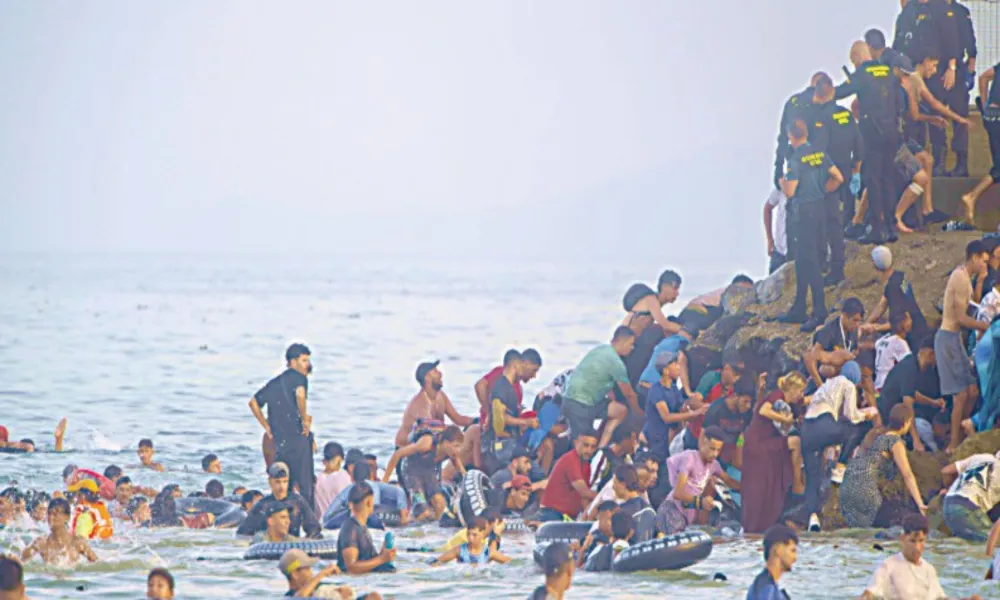

Spain is confronting its worst migration crisis in Ceuta since 2014 after tens of thousands of migrants crossed from Morocco into the Spanish enclave in North Africa.
The number of arrivals is estimated at at least 60,000 people, while the latest reports indicate that 34 people died attempting to reach European territory.
The surge has plunged the enclave into crisis and intensified pressure on the government of Prime Minister Pedro Sánchez.
Crisis escalates
Warning signs had emerged in the days before the mass crossing.
Hundreds of migrants had been entering through the border fence on foot, while around 1,500 people arrived by swimming within a single week. At the time, daily arrivals were averaging about 300 people.
Ceuta's regional leader, Juan Jesús Vivas, had already called on Madrid to declare a state of emergency, warning that facilities for unaccompanied minors were operating at 2,400% of capacity.
Spanish Civil Guard sources later accused Morocco of tolerating the build-up of migrants near the border.
According to reports in El Mundo, security officials said thousands of young people had arrived from across Morocco in the days leading up to the crisis and could have been prevented from approaching the frontier.
Delayed response
Spanish newspaper El País reported that, despite the growing influx, only 55 police and coastguard officers were initially deployed in Ceuta as hundreds of migrants entered the enclave.
Although Vivas requested military assistance early in the day, several hours passed before the Sánchez government announced the deployment of army personnel and additional Civil Guard officers.
Moroccan authorities subsequently established control points around one kilometre from the Ceuta border fence, while pressure also increased around Melilla, Spain's second enclave in North Africa.
Madrid and Rabat agreed to the return of migrants who entered illegally, but reports indicate the measure has not significantly reduced pressure on the border.
Spanish news agency EFE reported that the rush towards Ceuta was partly fuelled by rumours that the border had been opened to people without the necessary travel documents.
Political fallout
Spain's opposition Popular Party (PP) has called for changes to migration legislation to ensure that immediate returns can be applied not only to land crossings but also to migrants intercepted at sea near Ceuta and Melilla.
The party cited a recent Supreme Court ruling that migrants intercepted while attempting to reach the enclaves by sea can no longer be returned through summary procedures.
The crisis comes only months after the Sánchez government launched a major regularisation programme for undocumented migrants that could potentially affect around 500,000 people.
At the time, Sánchez described the initiative as recognition of the reality that hundreds of thousands of undocumented migrants were already part of Spanish society.
Echoes of 2021
According to figures from Spain's Interior Ministry, no sea arrivals had been recorded in Ceuta before 15 July this year. Only four arrivals were registered during 2025 and 28 in 2024, highlighting the scale of the current influx.
Local officials have warned of a repeat of the May 2021 migration crisis, when more than 10,000 migrants entered Ceuta within a matter of days after Morocco relaxed border controls during a diplomatic dispute with Spain over Western Sahara.
That crisis eased after Madrid shifted its position on the Western Sahara issue in 2022.
A disputed territory
Ceuta's status remains a longstanding source of tension between Spain and Morocco.
The city was first captured by Portugal in 1415 before passing to Spanish sovereignty under the Treaty of Lisbon in 1668, centuries before the establishment of Spain's protectorate in Morocco.
When Morocco gained independence in 1956, Spain treated Ceuta and Melilla as integral parts of the Spanish state rather than colonial possessions, a position Rabat continues to contest.
Morocco regards both enclaves as remnants of European colonial rule on African soil, while Spain maintains that they are sovereign Spanish territories.
Unlike Gibraltar, Ceuta does not appear on the United Nations list of non-self-governing territories, a distinction that continues to underpin differing interpretations of its status.