
By Valia Kaimaki
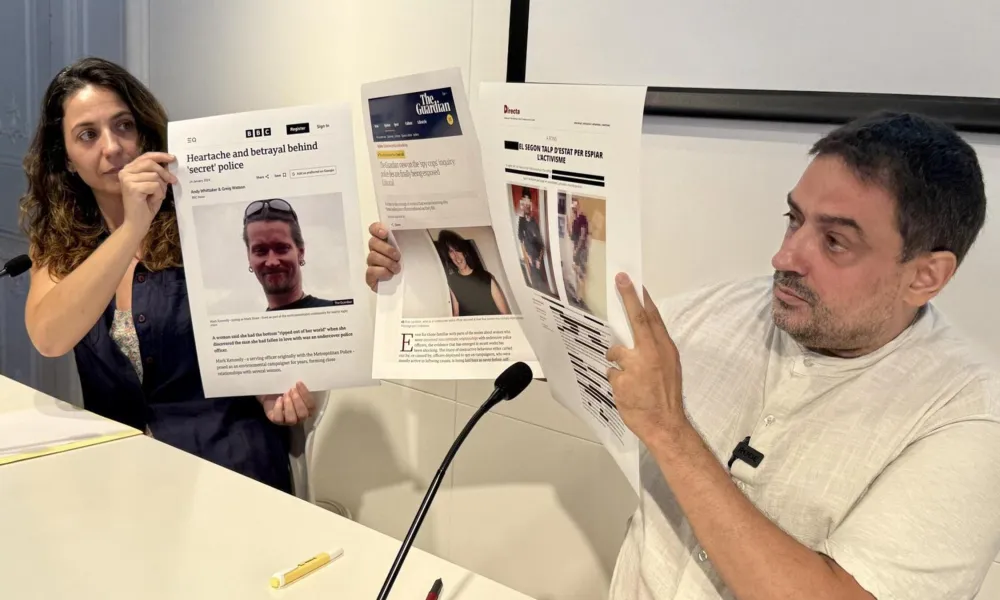
For years, police officers lived under false identities while embedded in social and pro-independence movements. Yet rather than public answers being provided about those operations, Spain's Data Protection Agency has launched proceedings against the media organisations that exposed them.
The case directly affects the Catalan newspaper La Directa and the news website VilaWeb, while independent Spanish outlet El Salto has also received a similar request.
Last Wednesday, La Directa announced that it had been notified of sanction proceedings initiated by the Spanish Data Protection Agency. The authority is proposing a €7,000 fine over the publication of personal data relating to four police officers whom the outlet had identified as agents who infiltrated social movements and organisations linked to the Catalan independence movement.
The fine, however, is only one aspect of the case.
According to La Directa, the authority is demanding that the articles, photographs and information contained in the investigative reports be removed within three months. The request reportedly extends even to the false identities used by the officers during their infiltration activities.
A similar procedure has been launched against VilaWeb, which republished and followed up on the revelations.
The case
The proceedings against the Catalan newspaper began following a complaint lodged by a police officer who had infiltrated social movements in the cities of Girona and Salt.
The Spanish Data Protection Agency considers problematic the publication of both the false name used by the officer and her real name once it was made public by the organisations she had infiltrated.
The authority also questions the publication of photographs showing her at demonstrations, including one image in which her eyes had been obscured, arguing that the alterations were insufficient to protect her identity.
The case file also includes VilaWeb's reference to the initials of her brother, who is also a police officer, as well as information that he had participated in events organised by Jusapol, a police union organisation.
The authority is considering imposing a fine of at least €7,000 on VilaWeb and has given the outlet 10 working days to submit its objections.
If the decision becomes final, some of the articles concerned will no longer be accessible to readers.
El Salto has also announced that it received a similar request concerning its own reporting on police officers who infiltrated social organisations in Madrid.
In its case, however, the process remains at an early stage and no final decision has been issued.
The dispute
The current controversy stems from investigations first published in the spring of 2022.
La Directa in Catalonia and Valencia, and El Salto in Madrid, sought to verify information suggesting that young police officers had entered lawful social and political movements using fabricated identities.
Over a period of roughly 18 months, the two outlets uncovered six such cases.
According to their investigations, most of the officers had recently graduated from Spain's National Police Academy in Avila and belonged to the General Information Directorate of the Spanish police.
They presented themselves as young people with no previous political involvement, participated in community gyms, assemblies, food banks, anti-racist organisations and neighbourhood groups, and gradually gained the trust of members.
In some cases, the infiltration went beyond monitoring political activities.
Officers developed close friendships, gained access to family circles and entered into romantic relationships with women who were unaware of their true identities.
One of the agents identified by La Directa is alleged to have had relationships with eight women.
Those women subsequently filed legal complaints, arguing that their consent had been obtained through deception and requesting investigations into possible offences involving sexual abuse, violations of moral integrity and the disclosure of confidential information.
To establish that the false and real identities belonged to the same individuals, journalists gathered evidence from social media platforms, public records and photographs.
In at least two cases, specialist facial comparison analyses were also used.
According to El Salto, Spain's Interior Ministry did not deny that the individuals named belonged to the police force but maintained that their actions were lawful.
This is at the heart of the legal dispute.
Spanish law provides for the use of undercover officers operating under false identities in organised crime investigations under specific conditions and with judicial oversight.
The media organisations and lawyers supporting the legal complaints point out that the officers in question were not formally designated as "undercover agents" but as "intelligence agents", a status which, they argue, lacks a clearly defined legal framework.
At the same time, it remains unclear whether any information gathered by the officers resulted in criminal proceedings.
None of the six agents identified by the media appeared as witnesses in any related court case.
Lawyers who spoke to El Salto therefore argue that the operations more closely resembled broad intelligence-gathering exercises without specific indications of criminal activity, effectively monitoring groups in the hope of discovering wrongdoing after the fact.
Personal data
The Data Protection Agency approaches the matter from the opposite direction.
It argues that the identities and photographs of the officers constitute personal data that must be protected.
The media organisations maintain that publication was necessary because the individuals themselves constituted evidence of the infiltration and because the activities of state officials inside lawful political organisations are clearly matters of public interest.
Sonia Oliveya, a lawyer with the Irídia Centre for the Defence of Human Rights, described it as particularly revealing that the only state investigation to advance was launched following complaints by the police officers themselves and was directed against the journalists.
She also argued that both the European Court of Human Rights and Spain's Constitutional Court have recognised that the publication of personal data may be justified where there is a strong public interest and where the information is necessary for informed public debate.
La Directa and VilaWeb have announced that they will challenge the decisions and, if sanctions are upheld, will take the matter to Spanish and European courts.
Their position has received support from journalists' associations, cooperative media outlets and human rights organisations.
The issue at stake is not merely a €7,000 fine.
As VilaWeb director Vicent Partal argues in an editorial republished by Politis with permission, the real question is whether an administrative authority can order a media outlet to delete a documented investigative report without any prior court ruling finding defamation, invasion of privacy or factual inaccuracy.
Because this is an administrative penalty rather than a civil lawsuit, the concern, he notes, is that similar approaches could appeal to other administrations across Europe.
Political implications
The case has already moved beyond a dispute between specific media organisations and Spain's Data Protection Agency and has developed into a broader debate about the limits of press freedom in Europe.
Journalistic organisations and editors' associations in Catalonia argue that the compulsory removal of published investigations constitutes an exceptionally serious measure because it goes beyond the imposition of an administrative fine and affects the public record itself.
They argue that if it becomes accepted that an administrative authority can order the deletion of documented journalistic investigations, a precedent will be created that could affect other reporting conducted in the public interest.
The issue has also acquired political dimensions.
Catalan political parties have called for parliamentary scrutiny of the authority's decisions and for representatives of the affected media outlets to be invited to hearings, arguing that it is necessary to examine whether an appropriate balance exists between personal data protection and the public's right to be informed about actions by state officials that affect fundamental rights.
At the same time, critics of the sanctions cite Article 85 of the European Union's General Data Protection Regulation, which provides exemptions for journalistic activity when it serves the public interest.
An interesting international comparison is the case of the United Kingdom, where revelations about undercover police officers infiltrating political, environmental and social organisations over several decades led to the establishment of the public Undercover Policing Inquiry (UCPI).
The inquiry was created to examine undercover policing practices in England and Wales since 1968 and continues to this day, having already published thousands of documents and testimonies concerning undercover police operations.
The British revelations sparked particular outrage because they extended beyond intelligence gathering.
The inquiry uncovered cases in which officers adopted false identities for years, infiltrated hundreds of organisations and entered into romantic relationships with female activists without revealing their true status.
In some cases, the identities of deceased children were even used to create the officers' false identities.
The case bears notable similarities to the recent revelations in Spain.
However, in the British case, the primary institutional response was the launch of an extensive public inquiry into the legality and oversight of the operations, whereas in Spain the most immediate state intervention has so far focused on the journalistic investigations that exposed the infiltrations.
The comparison raises broader questions about where the balance should lie between state security, individual rights and the freedom of investigative journalism.