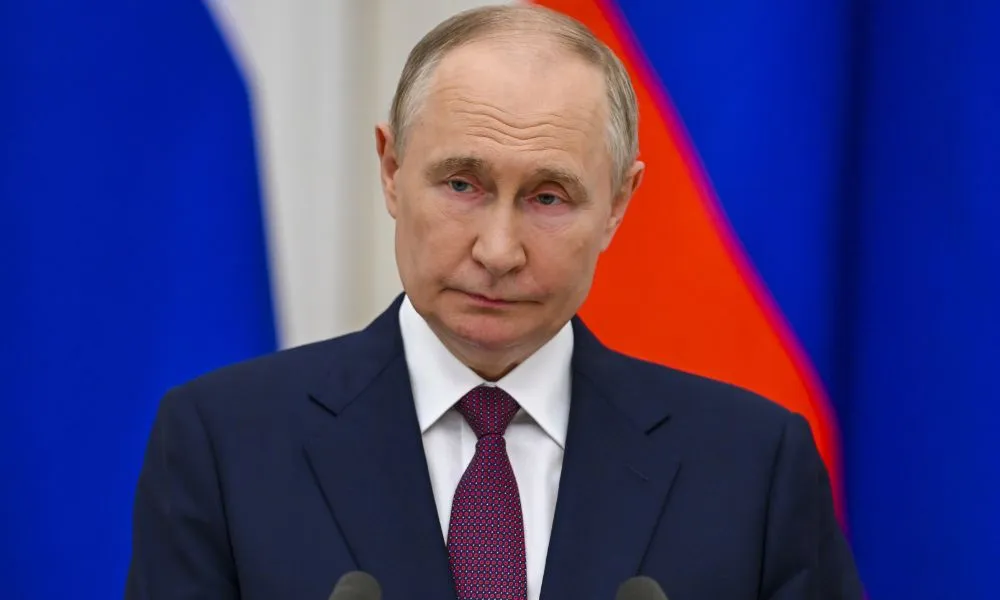

A new US intelligence assessment is examining whether Russian President Vladimir Putin could launch a limited attack against a NATO member within the next few years.
Such an operation would not necessarily seek to seize territory. Instead, it could be designed to test the alliance’s unity and, crucially, Washington’s willingness to uphold its commitments to its allies.
The scenarios range from large-scale cyberattacks and other hybrid operations to a limited ground incursion along NATO’s eastern flank.
According to the Wall Street Journal, US intelligence agencies had previously assessed that Putin was unlikely to open a second front while the war in Ukraine continued. That assessment has reportedly shifted significantly since early 2026.
Analysts are now considering the possibility of Russian military or hybrid action against a NATO member between autumn 2026 and 2029.
Why the US assessment changed
The revised outlook is partly linked to the difficulties Russia continues to face on the Ukrainian front.
US officials assess that Ukrainian drone strikes are causing increasing damage to Russian military sites and energy infrastructure. At the same time, Russian forces continue to suffer significant losses without achieving similarly substantial territorial gains.
Under these conditions, analysts are considering whether Putin could pursue a different strategic move that would strengthen his domestic position while challenging the credibility of the Western alliance.
US intelligence agencies believe the main objective would not necessarily be territorial conquest. Instead, an operation could be intended to test NATO’s unity and Washington’s readiness to honour its commitments to an ally.
Three scenarios under consideration
US intelligence agencies do not consider all the scenarios equally likely.
The first and least severe scenario involves a large-scale cyberattack against a NATO country or other hybrid operations targeting critical infrastructure.
The second scenario involves the deployment of armed personnel without identifying insignia, similar to the so-called “little green men” who appeared in Crimea in 2014. Their objective could be to seize a limited area while Moscow deliberately maintains ambiguity over their identity.
The third and most serious, but least likely, scenario involves a limited ground incursion along NATO’s eastern flank.
US assessments continue to place the likelihood of such an operation at a low level, although analysts warn that the risk could increase over time.
The Article 5 grey area
Particular concern surrounds the possibility that Russia could act below the threshold of a clearly defined military attack, creating uncertainty over whether and how NATO should invoke Article 5.
Article 5 states that an attack against one NATO member is considered an attack against all members of the alliance.
Heather Conley, a former Pentagon official and researcher at the American Enterprise Institute, said Putin’s Russia has consistently sought to test NATO’s limits and widen divisions between the United States and its European allies.
Cyberattacks, sabotage and limited hybrid operations could create a “grey area” in which a collective military response would not be automatic.
US and European officials point to incidents in recent years that they view as indications of such a strategy, including Russian missiles landing on Polish territory and Russian drones entering Romanian airspace.
Concerns over US weapons stocks
The new assessment comes as the Pentagon faces concerns over supplies of certain critical munitions.
Years of military support for Ukraine, combined with US operations in the Middle East, have substantially increased the use of advanced weapons systems.
According to the report, concerns have been raised over stocks of long-range Precision Strike Missiles and ATACMS, as well as air defence systems and interceptors including Stinger, Patriot, THAAD and SM-3.
These systems are considered critical to deterrence in both Europe and Asia.
The Pentagon has rejected suggestions that the US faces an operational shortfall. Officials say the armed forces have the necessary capabilities to carry out any mission ordered by the country’s political leadership.
The White House has also said that a programme to expand US defence production is already under way.
Russia, Iran and China shape US planning
The new assessment of Putin’s intentions adds another challenge to an increasingly complex geopolitical environment for Washington.
The war in Ukraine continues, developments in the Middle East require substantial US military resources, and China remains Washington’s principal long-term strategic challenge in the Indo-Pacific.
Against this backdrop, US intelligence agencies are considering whether Putin could carry out a limited but highly symbolic operation against NATO.
The objective would not necessarily be to provoke a wider conflict, but to determine whether the alliance would respond collectively to a controlled challenge.
Such a test could have consequences far beyond the incident itself, affecting both European security and the credibility of Western deterrence.