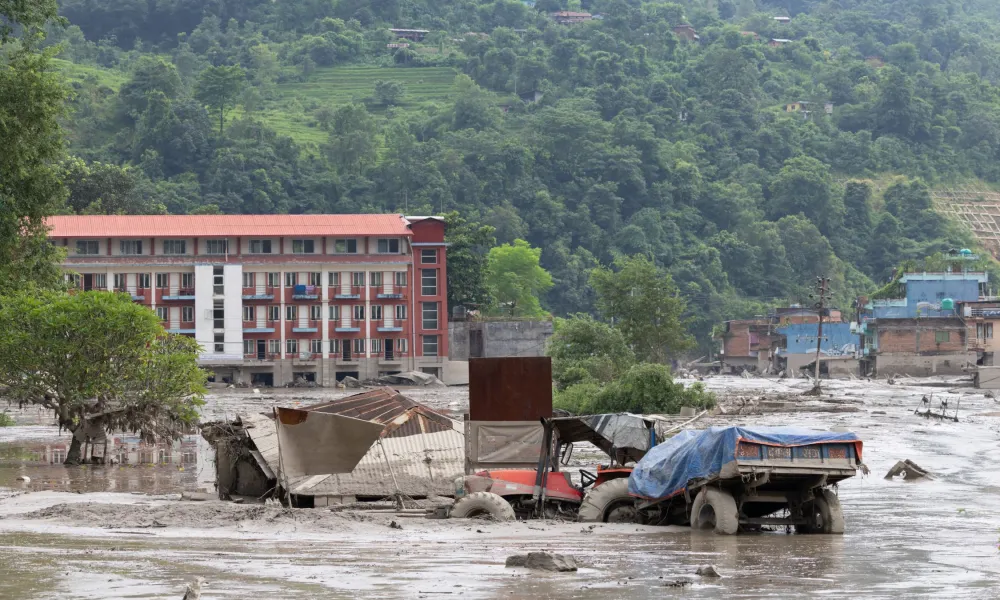



A lake formed by a landslide on the Nepal-China border began overflowing on Friday, threatening areas already devastated by Wednesday's flash flood and forcing a temporary halt to rescue efforts, authorities on both sides of the border said. Residents in Nepal's Rasuwa district, which borders China's Tibet region, were seen rushing up hillsides to escape any surge in the river, according to a Reuters witness.
Chinese state broadcaster CCTV said all Chinese rescue personnel and vehicles had withdrawn to a safe area because of the risk of the lake bursting, while an army officer in Nepal said rescue operations there had been paused for 90 minutes.
The confirmed death toll from Wednesday's glacier collapse rose to 469 in Nepal, with almost 1,000 more people missing across Nepal and Tibet. A massive torrent of rock, ice, mud and debris swept through Himalayan river systems after the collapse, tearing through villages and valleys and destroying power stations, roads and bridges along a route linking Kathmandu with Lhasa that is popular with trekkers and pilgrims. At least 540 of those missing are foreign nationals.
The debris left behind formed a barrier lake threatening further flooding downstream. China sent an eight-member engineering team to conduct aerial surveys and 3D modelling of the lake on Thursday, and by Friday its volume had grown to more than 2.5 million cubic metres, up from an estimated 1.5 to 2 million cubic metres recorded a day earlier.
Torrent tore through border crossing
Narendra Pariyar, the most senior official in hard-hit Rasuwa district, said authorities had received warning that the glacial lake had broken its bank. "We can see that the level of water in the river is rising," he said, adding that the current water level remained unclear.
Nepalese rescue teams earlier used helicopters to search for survivors and drop emergency supplies to thousands of people cut off in towns and valleys, while emergency services, some using sniffer dogs, recovered dozens of bodies swept down into the plains. Dibga Tamang, among the last people rescued from Rasuwa on Thursday and airlifted with three others to an army camp in Nuwakot, said he had lost everyone. "All of our people have gone. They are dead," he said.
Nepal has said it does not currently need international search and rescue assistance despite offers pouring in. Foreign ministry spokesperson Lok Bahadur Chhetri said Nepal's own security agencies were handling the operation and did not require outside help at this stage. A South Korean rapid response team is already in Kathmandu but has not been deployed, as Nepal's government has yet to finalise a plan for accepting foreign rescue teams, according to South Korea's foreign ministry.
On the Chinese side, rescuers had yet to reach the worst-hit area at the Gyirong border crossing by Thursday evening, as crews worked to clear debris from the main access road. Dramatic footage from Wednesday showed torrents of muddy water and debris tearing through the crossing within seconds, engulfing people as they tried to flee. CCTV reported 558 people missing in Tibet's Gyirong county, including 260 foreign nationals, with only three deaths confirmed so far on the Chinese side. China's Premier Li Qiang, the country's second-ranking official, visited the disaster site in Gyirong on Thursday afternoon, according to state news agency Xinhua, a visit suggesting Beijing is treating the disaster as a matter of the highest national priority.
Families search for answers
Around the world, relatives of the missing were left searching for information. Sneha Sudhir, one of ten women from northern Virginia whose husbands had set out on a trek toward Tibet's Mount Kailash when disaster struck, described the wait from her home in Chantilly, Virginia. "Where are they?" she asked. She said the women were supporting one another while reaching out to officials and family in both the United States and India.
US President Donald Trump said Washington had offered support to Nepal, describing the scale of destruction as unlike anything he had seen, with sturdy buildings reduced to rubble, and said the US had told Nepal's leadership that any assistance needed would be provided.
Source: Reuters