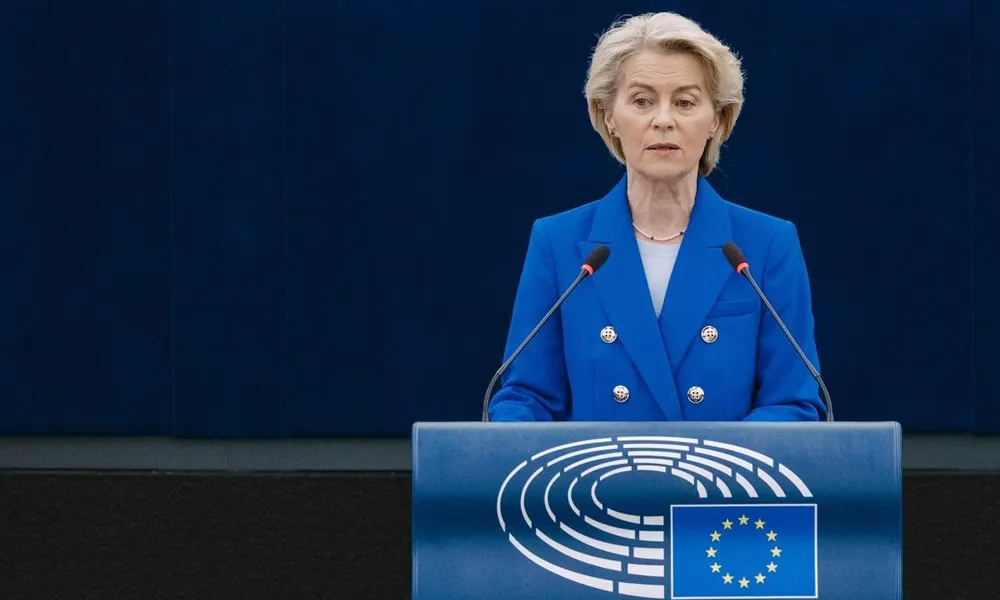

European Commission President Ursula von der Leyen is expected to deliver her sixth State of the Union address on 16 September, with geopolitical challenges, security, competitiveness and defence among the key issues likely to feature in her speech.
According to a briefing published on Friday by the European Parliament Research Service (EPRS), von der Leyen is expected to set out the Commission's main priorities and flagship initiatives for the year ahead, building on its political guidelines for the 2024-2029 period.
The speech will be her second State of the Union address during the current legislative term.
Ukraine and European security
The address comes against a backdrop of heightened geopolitical pressure, with the ongoing war in Ukraine expected to be a central issue.
The EPRS briefing highlights the continued need to maintain pressure on Moscow, as well as recent airspace violations involving Poland and Romania.
It also points to the risk that a fragile ceasefire in Ukraine could leave the EU exposed to renewed instability along its eastern borders.
At the same time, concerns over a possible reduction in US involvement and support for Kyiv are expected to remain part of the European security debate.
These developments are likely to reinforce calls for greater European responsibility for the continent's defence and security.
Tensions with US and China remain on agenda
Transatlantic relations are also expected to feature in the wider discussion.
The EPRS notes that tensions remain between the EU and the United States despite the EU-US trade framework that entered into force on 1 July 2026.
Outstanding issues include digital services taxes and the application of the EU Digital Markets Act to US technology companies.
Relations with China are also expected to remain on the EU agenda, as the bloc seeks to balance economic interdependence with efforts to reduce risks in strategically important sectors.
Middle East tensions raise energy concerns
Developments in the Middle East are another factor shaping the European agenda, particularly amid tensions involving Iran.
The EPRS highlights concerns over energy security and oil prices, with potential or actual disruption to shipping through the Strait of Hormuz and attacks on Gulf refineries capable of affecting energy costs.
Such developments could have wider consequences for inflation, economic growth and household budgets across the EU.
Enlargement among key priorities
Further EU enlargement is also expected to be addressed, particularly in relation to Montenegro, Albania, Moldova and Ukraine.
The EPRS identifies both strategic opportunities and institutional and financial challenges associated with a larger European Union.
Enlargement could strengthen the EU's geopolitical position, but would also require changes to the bloc's institutions and budgetary arrangements.
Competitiveness and investment pressures
On the economic front, the EPRS identifies weak GDP growth, high energy prices and the widening competitiveness gap with the United States and China as major challenges for the EU.
The bloc faces significant investment needs in areas including innovation, productivity, and the green and digital transitions.
The briefing points to the additional annual investment requirement of between €750 billion and €800 billion identified in the Draghi report.
The proposed 2028-2034 Multiannual Financial Framework is another major issue. With a proposed budget of almost €2 trillion, negotiations over the next EU budget are expected to have a significant impact on the bloc's ability to finance its internal and external priorities.
Seven political priorities
Von der Leyen's address is also expected to reflect the seven political priorities she set out when she was re-elected in 2024.
They include sustainable prosperity and competitiveness; European defence and security; social policies; food and water security and nature protection; defending democracy; Europe's role in the world; and preparing the Union for the future.
The priorities are expected to provide the framework for the Commission's agenda as it seeks to respond to growing security, economic and geopolitical pressures.
Annual address dates back to 2010
The EPRS notes that the practice of an annual State of the Union address began in 2010 under then Commission President José Manuel Barroso.
Unlike the US presidential State of the Union address, the speech is not required by the EU Treaties. Instead, it was established through the framework agreement between the European Parliament and the European Commission.
A new framework agreement adopted in 2026 retains provision for an annual debate during the first September plenary session of the European Parliament.
During the address, the Commission president reviews developments over the previous year and presents priorities for the year ahead.
The speech is followed by a debate in the European Parliament involving the Council presidency and representatives of the political groups.
Source: CNA