
While missiles and drones cross the skies from Europe to the Middle East, another largely invisible but potentially no less consequential strategic contest is unfolding on the ocean floor, centred on subsea cables and critical infrastructure.
Governments and companies are investing heavily in new technologies designed for underwater use as concerns grow over the vulnerability of telecommunications cables, energy pipelines and other critical infrastructure running across the seabed.
The trend forms part of what is broadly described as hybrid warfare, encompassing cyberattacks, energy sabotage, disinformation and economic pressure, with or without conventional military action.
A changing threat environment
Katja Bego, senior research fellow at Chatham House, told CNBC that the changing threat environment had brought the issue to the forefront.
At the same time, rapid developments in Artificial Intelligence, drones and autonomous technology are enabling new approaches to underwater surveillance.
From autonomous underwater vehicles to sensors connected to subsea cables, governments and military alliances are exploring ways to improve monitoring of the infrastructure underpinning the global economy.
“Our entire economy depends on this,” Bego said.
Nord Stream changed the debate
In September 2022, months after Russia’s invasion of Ukraine, explosions ruptured the Nord Stream gas pipelines beneath the Baltic Sea.
Investigators concluded that the pipelines, which had been built to transport Russian natural gas to Germany, had been deliberately sabotaged.
That incident, together with damage to underwater infrastructure elsewhere, including the Arctic and waters near Taiwan, has focused government attention on vulnerabilities that had largely been neglected in the decades following the Cold War.
In the Arctic, the protection of infrastructure coincides with a broader struggle over mineral resources and emerging commercial routes.
“This issue has been neglected for quite a long time, so there is a lot of catching up to do,” Bego said.
1.5 million kilometres of cables
More than 1.5 million kilometres of subsea communications cables were in operation worldwide by the beginning of 2026, according to telecommunications research company TeleGeography, which tracks global submarine cable networks.
Alongside communications cables and oil and gas pipelines, a growing network of underwater electricity cables is connecting national power markets and transporting electricity from offshore wind farms to land.
The widespread use of drones during the Russia-Ukraine war has demonstrated how autonomous and remotely operated systems can change the nature of warfare.
Bego described the maritime environment as the “next logical domain” for that transformation.
Industry adapts to the new landscape
Italian shipbuilding group Fincantieri announced plans in July to acquire majority stakes in four companies for approximately €600 million, seeking to expand its capabilities in underwater and surface drones, marine surveying and subsea communications.
The company is drawing on more than a century of experience in submarines to move from what CEO Pierroberto Folgiero describes as the “conventional underwater” world towards an “unconventional” environment involving smaller submarines, drones and underwater telecommunications.
Speaking to CNBC in July, Folgiero described subsea communications as “the real enabler of this new ecosystem”.
He envisages future surface ships operating as “mother ships”, coordinating networks of vehicles moving both over the seabed and throughout the water column.
Fincantieri is far from alone.
Major defence groups, including France’s Thales, have developed capabilities encompassing sonar, anti-submarine warfare, mine detection and autonomous underwater systems, as companies of varying sizes seek a role in the emerging market for subsea operations.
Autonomous underwater drones
German defence technology company Euroatlas is another business targeting the potentially lucrative market for seabed protection.
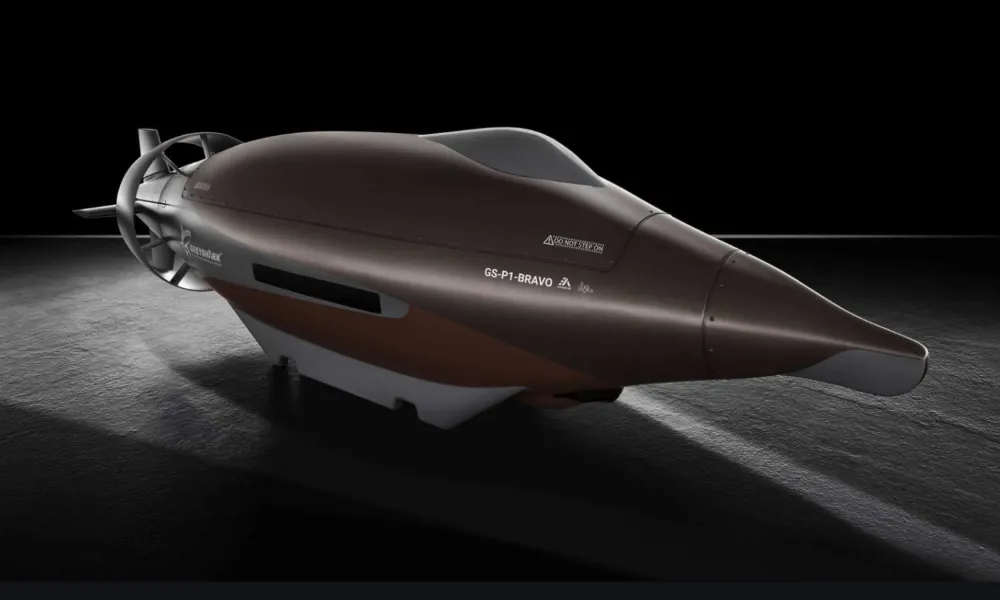
It has developed an autonomous underwater vehicle called GrayShark, which can travel to a designated area and carry out a mission without constant human control, according to the company’s Director of Strategy and Partnerships Verineia Codrean.
The vehicle is designed to avoid obstacles and follow predetermined instructions when it encounters something unexpected.
During a pipeline inspection, for example, it could identify an object resembling a mine, report the discovery and wait for an operator to decide whether further investigation is required.
Instead of attempting to protect every kilometre of cable with warships, Codrean envisages fleets of autonomous vehicles continuously patrolling strategically important areas of the seabed and converging when one detects something unusual.
“It is practically impossible to cover the entire ocean,” she told CNBC. “We simply need to know which areas are of greatest interest so that we have a continuous picture of what is happening there.”
A problem of scale
Codrean argued that the challenge is fundamentally one of scale.
Frigates, submarines and maritime patrol aircraft are too expensive and too scarce to maintain a permanent presence across the enormous areas containing cables, pipelines and other strategic assets.
“The underwater domain faces a broader range of problems that did not exist until now,” she said.
From a purely mathematical perspective, she argued, crewed platforms cannot be everywhere that problems emerge, whether the threat involves sabotage or the movements of a hostile submarine.
Machines against machines
Autonomous vehicles are not being developed solely to monitor infrastructure.
Alongside traditional anti-submarine warfare, where forces seek to detect and track crewed submarines, a new category of counter-AUV missions is emerging.
These operations are intended to detect, monitor and identify autonomous or uncrewed underwater vehicles operated by other countries.
“Whatever we are building, our non-allies or enemies are building too,” Codrean said.
As more states develop autonomous underwater vehicles, she added, operators will need to distinguish between systems belonging to NATO-friendly countries or allies and those originating from potentially hostile states.
The development raises the prospect of greater machine-on-machine confrontation beneath the surface.
Codrean does not, however, expect autonomous systems to entirely replace conventional submarines and warships.
“I would not go so far as to say it will only be drones against drones, but there will certainly be much more drone-against-drone activity, until a crewed platform needs to intervene,” she said.
The emerging technological race suggests that the seabed is becoming an increasingly important strategic domain, with the critical infrastructure supporting communications, energy supplies and the global economy driving investment in an entirely new generation of underwater surveillance and defence systems.
Source: ot.gr