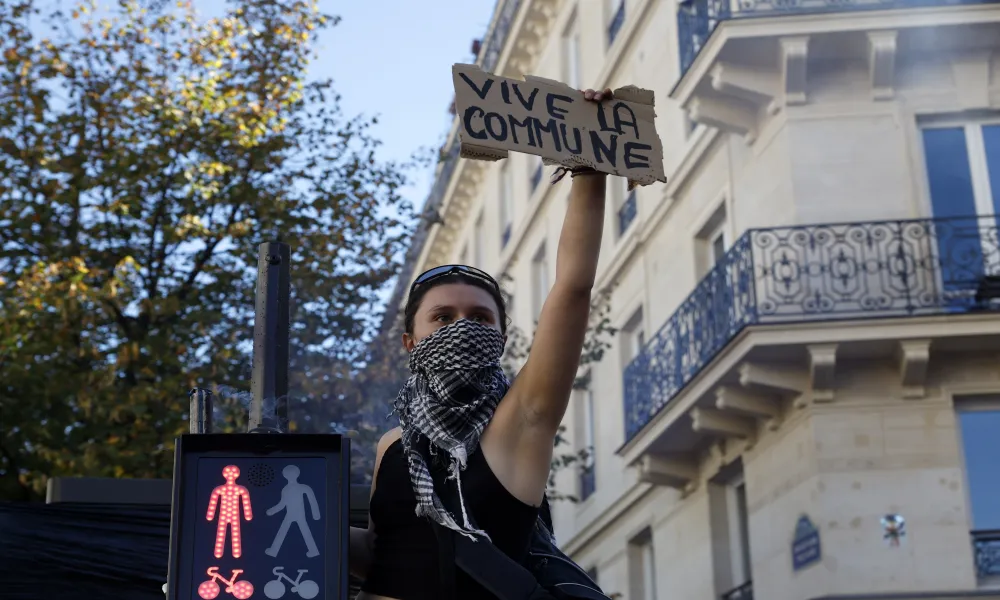

Student and university protests in France are showing no signs of easing. Fresh demonstrations took place in more than 30 cities yesterday, according to student union L’Union Étudiante.
Hundreds of schools were affected, while university faculties were occupied or blockaded. Demonstrations were organised in cities including Marseille, Nice, Nantes, Lyon and Paris, where organisers were expecting up to 40,000 protesters.
Clashes with police were reported in several cities. In Strasbourg, protesters threw firecrackers at police officers, according to Reuters, while disturbances were also reported in Marseille and Lyon.
Hundreds of schools affected
The French Education Ministry said yesterday afternoon that 891 educational institutions had suspended classes either fully or partially because of the protests.
Student union USL, however, reported significantly higher numbers. It claimed that 1,800 secondary schools were either blockaded or closed and that 90% of universities had been affected by blockades.
Last Friday, the same organisation had reported more than 600 secondary schools affected.
The movement began in late September at secondary schools in the Paris region before quickly spreading across the country and into universities.
Students are protesting against teacher shortages, absent teachers not being replaced, overcrowded classrooms and ageing school buildings.
Their demands include mass recruitment of teachers, 150,000 new places in higher education and €10 billion for urgent maintenance work in schools.
Government condemns violence
Education Minister Edouard Geffray acknowledged from the outset that some of the students' demands were “justified”, although the government has strongly condemned the violence accompanying some demonstrations.
Almost 2,000 people were arrested last Thursday, according to the Interior Ministry, while Prime Minister Sébastien Lecornu convened a crisis meeting on the same day.
Justice Minister Gérald Darmanin referred to a “violent minority” and questioned whether all those involved in the disturbances were actually students.
Lecornu has instructed ministers to propose solutions to several of the central grievances.
These include the need to replace absent teachers more quickly, concerns about the length of the school day, which in some cases reaches 10 hours, and calls for a longer lunch break.
The prime minister expects the first concrete proposals, including measures dealing with ageing school buildings, by the end of October.
On Monday, the Education Ministry also launched a national consultation with secondary school students.
So far, however, none of these initiatives has succeeded in calming the protests.