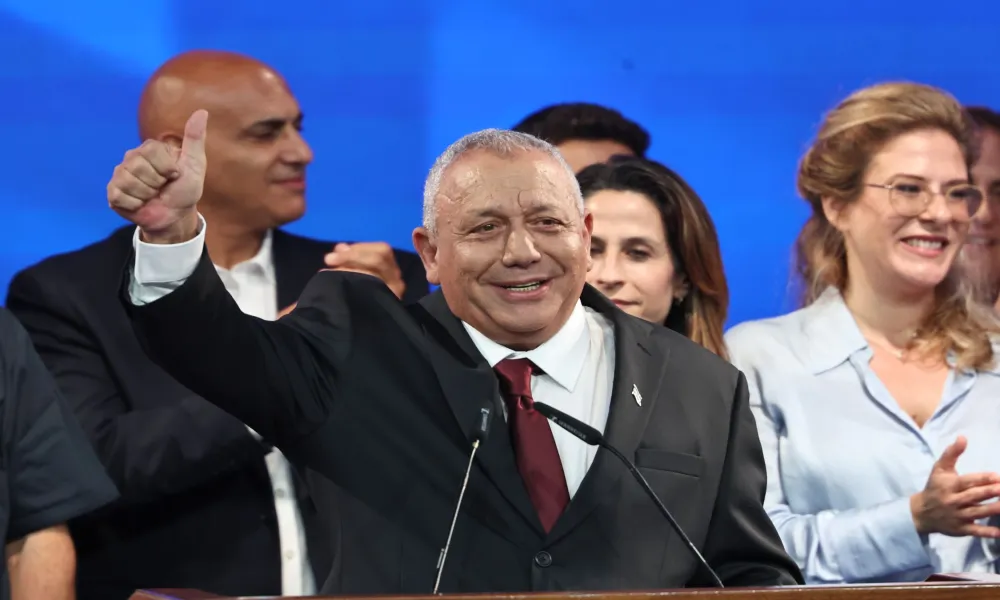

Gadi Eisenkot has secured the recommendations of 67 members of the Knesset for the premiership, surpassing the 61-seat threshold, after the Joint List decided to nominate him to President Isaac Herzog.
Consultations concluded yesterday and Herzog must decide by 11 November whom to appoint to form a government first.
The arithmetic of the new Knesset is now clear. Parties backing Benjamin Netanyahu hold 53 seats, the Jewish opposition controls 48, and the two Arab parties hold 19 seats, the highest combined total in their history: 11 for the Joint List and eight for Ra'am, led by Mansour Abbas, which had announced its support for Eisenkot the previous day.
Support without participation
The Joint List said its decision was unanimously approved by its three constituent parties in order to prevent Netanyahu's return to power and that it was not seeking a role in government.
Its chairman, Yousef Jabareen, told Herzog that turnout within Arab society had reached almost 80% and condemned what he described as a climate of continuous incitement to hatred led by Netanyahu and Itamar Ben Gvir.
MP Ahmad Tibi spoke of arrests, dismissals and disciplinary proceedings against Arab citizens following 7 October.
The support, however, does not automatically translate into a governing majority.
Avigdor Lieberman nominated Eisenkot but ruled out a government reliant on Arab parties. Similar reservations have been expressed by Naftali Bennett.
Eisenkot himself has set conditions for cooperation, including recognition of Israel as a Jewish and democratic state and a clear position regarding Hamas, conditions that are particularly difficult for the Joint List.
At the same time, in a post on X, he pledged to renew and deepen cooperation with the United States.
The ultra-Orthodox factor
A setback for Netanyahu came with the decision of United Torah Judaism, which holds seven seats, not to recommend any candidate, potentially reducing recommendations in his favour to 46.
The party, which withdrew from Netanyahu's government in July 2025 over legislation concerning the military service of ultra-Orthodox Jews, has left its options open.
However, exempting yeshiva students from military service directly clashes with one of Lieberman's core demands.
According to Yedioth Ahronoth, Eisenkot has allowed discussions on the possibility of a minority government backed by 49 votes.
As only more votes in favour than against are required for a government to be sworn in, a coordinated abstention by the Arab parties and United Torah Judaism could allow an Eisenkot government to take office with 49 votes to 46.
His party has not confirmed the scenario.
Netanyahu continues to insist that a government dependent on Arab parties would be dangerous for the country, while figures within Likud have alleged electoral fraud, claims rejected by Noam Solberg, chairman of the Central Elections Committee.
Herzog also reportedly clashed with Otzma Yehudit over statements made against Arab voters.
The candidate tasked with forming a government will have 28 days, with the possibility of a 14-day extension, to build a coalition.
Until then, Netanyahu remains head of the caretaker government. If no attempt succeeds, Israel will be headed for new elections early next year.