For years, Cyprus discussions have often been trapped between slogans, emotional reflexes and sterile repetitions of past positions. One side repeats federation as ritual. Another insists on sovereign equality as doctrine. Yet while diplomats recycle terminology, the region itself is changing at extraordinary speed. The Eastern Mediterranean of today is not the Eastern Mediterranean of a decade ago. Energy competition, maritime disputes, militarization, European security restructuring, and regional wars have transformed Cyprus from a “frozen conflict” into a live strategic variable once again.
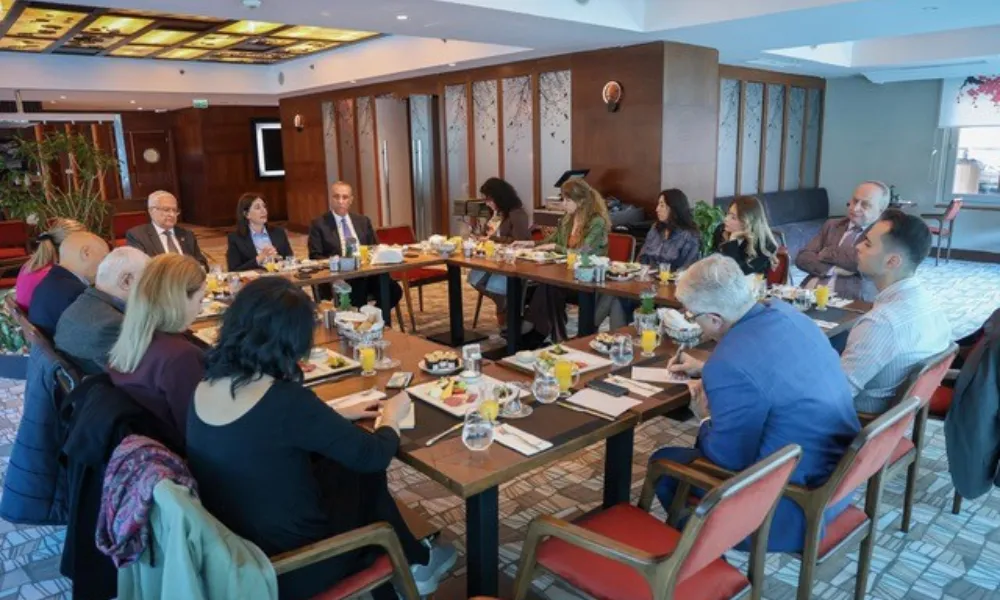
That was perhaps the most important aspect of Republican Turks’ Party (CTP) General Chair Sıla Usar İncirli’s Ankara intervention this week. Her remarks were not simply another conventional defense of a federal settlement model. They reflected a broader and more pragmatic argument: that the current status quo has become strategically unsustainable not only for Turkish Cypriots, but increasingly for Türkiye as well.
Whether one agrees with every element of CTP’s political line or not, there is one reality becoming difficult to ignore. The geopolitical environment surrounding Cyprus is changing rapidly, while the island’s political structure remains frozen in a framework designed for another era.
The Gaza war, the Iran-Israel confrontation, the increasing visibility of Western military assets around Cyprus, the growing competition over energy corridors, and the European Union’s evolving defense architecture are all reshaping the strategic map of the Eastern Mediterranean. In such an environment, inertia itself becomes a risk.
The federation debate is evolving
Perhaps the most politically significant nuance in İncirli’s remarks was her attempt to move the Cyprus debate beyond rigid semantic camps. In Türkiye, the word “federation” often triggers instinctive suspicion. Many immediately interpret it as a geopolitical weakening of Türkiye’s position or as a gradual disengagement of Turkish Cypriots from Ankara.
İncirli appeared fully aware of this sensitivity.
While clearly reaffirming CTP’s commitment to a federal settlement, she simultaneously argued that the real issue is not the label attached to the model, but the legal and institutional substance beneath it. Her message was that as long as a settlement rests on political equality between two self-governing constituent states, the terminology itself becomes secondary.
“We should not enslave ourselves to a semantic discussion,” she said.
This was not a casual phrase. It was a deliberate political formulation.
The essence of the argument is that the future structure must guarantee effective political equality for Turkish Cypriots regardless of how the final arrangement is linguistically packaged. For CTP, the non-negotiable elements remain clear: Rotational presidency, effective participation in federal decision-making, and the “one favorable vote” principle ensuring that no major federal decision can pass without at least one affirmative Turkish Cypriot vote.
In other words, political equality is not symbolic. It is structural.
That distinction matters enormously because it reframes the Cyprus debate away from emotionally loaded terminology and toward concrete institutional guarantees.
The question increasingly becoming central is no longer “What should the model be called?” but rather “Will Turkish Cypriots possess secure and enforceable political equality inside whatever arrangement emerges?”
This subtle but important recalibration may ultimately prove significant in Ankara as well.
The Eastern Mediterranean is no longer static
İncirli’s remarks also reflected a broader anxiety increasingly shared across much of the Turkish Cypriot political spectrum: the fear that the island is being drawn into a rapidly changing regional security environment while Turkish Cypriots remain excluded from the mechanisms shaping it.
The Greek Cypriot administration’s expanding security cooperation with France, the deepening Western military footprint around the island, British sovereign base activity, and the European Union’s evolving defense ambitions are all changing Cyprus’ strategic role.
At the same time, Türkiye has visibly strengthened its own military posture in northern Cyprus, including enhanced air defense capabilities and broader strategic preparedness.
The island is therefore no longer simply an unresolved diplomatic file at the United Nations. It is increasingly part of a broader geopolitical architecture stretching from the Levant to the Aegean.
This explains why İncirli repeatedly stressed that no sustainable regional security mechanism can realistically function while excluding Türkiye and Turkish Cypriots.
Her argument aligns with an increasingly visible strategic reality: no meaningful Eastern Mediterranean energy or security architecture can permanently bypass Türkiye’s geography, economic weight and regional role.
The economics simply do not support such exclusion.
Natural gas transportation routes, electricity interconnections, maritime jurisdiction arrangements, regional trade corridors and European energy diversification strategies all eventually circle back to the unresolved Cyprus issue.
This does not necessarily mean that a settlement is imminent. The political obstacles remain enormous. Distrust remains deep. The memory of failed negotiations still shapes political psychology on both sides of the island. But it does mean that the cost of non-settlement is rising steadily.
Governance may become the decisive issue
Yet perhaps the most important aspect of İncirli’s intervention had nothing directly to do with federalism or diplomacy at all. It concerned governance, state capacity and the growing belief within Turkish Cypriot society that the island’s unresolved political status can no longer be used as the universal explanation for every domestic failure.
For decades, large segments of Cyprus politics operated under an implicit assumption that solving the Cyprus problem would somehow automatically solve everything else. Economic weakness, institutional decay, administrative inefficiency, corruption, budget crises, declining public trust and structural dependency were frequently treated as secondary matters, issues to be postponed until after a settlement. Increasingly, however, Turkish Cypriot society no longer appears willing to accept that logic.
İncirli’s repeated emphasis on good governance, institutional rebuilding, financial discipline, meritocracy and social justice reflects a deeper political transformation now emerging within the Turkish Cypriot electorate. There is visible fatigue with clientelism, ad hoc administration, unsustainable public finances and the perception that institutions have gradually weakened under years of politicization and short-term political calculations.
More importantly, there is growing recognition that even a successful settlement process would fail if the internal administrative structure remains weak, economically fragile and lacking institutional credibility. This may actually be one of the most politically mature realizations to emerge in northern Cyprus in many years. Because functioning institutions matter regardless of the final political model. A weak administration cannot negotiate effectively. A financially broken structure cannot sustain autonomy. A system lacking transparency cannot build international credibility. And a society that loses faith in fairness eventually loses faith in politics itself.
What makes İncirli’s discourse noteworthy is that she appears to frame governance not merely as a technical administrative issue, but as a strategic national necessity. Her repeated references to consultation with trade unions, professional chambers, academics, civil society organizations and sector representatives suggest an effort to redefine governance itself as a participatory and institutional process rather than merely an exercise in electoral arithmetic. This represents an important shift in tone within Turkish Cypriot politics. The emphasis is no longer only on who governs, but increasingly on how the country is governed, how institutions are rebuilt, how public trust is restored, and how long-term sustainability can be achieved in a small and politically vulnerable economy heavily exposed to external shocks and structural dependency.
This governance-centered political discourse is also unfolding against an increasingly fragile domestic political backdrop in northern Cyprus. Although parliamentary elections are formally scheduled for 2027, there is now widespread expectation in political circles that the current three-party coalition government may ultimately be forced to call early elections, most likely sometime around September or October this year. The coalition has been facing mounting criticism over economic management, inflationary pressures, public finances, institutional appointments and broader perceptions of administrative inefficiency. Rising living costs, deepening public frustration over purchasing power, concerns regarding fiscal sustainability and growing perceptions of institutional exhaustion have steadily intensified political pressure on the government over recent months.
Most recent public opinion surveys indicate that CTP currently enjoys a significant electoral advantage. Several polls suggest the party could emerge from an early election either as a single-party government or, at minimum, as the dominant partner in a coalition administration. That possibility gives additional significance to İncirli’s repeated focus on institutional reform and governability.
CTP increasingly appears to be speaking not merely as an opposition movement criticizing the status quo, but as a political force preparing itself psychologically and administratively for power. This may explain why the language emerging from the party leadership now places equal emphasis on settlement diplomacy and state capacity. The underlying argument increasingly appears to be that even if a political solution eventually becomes achievable, Turkish Cypriots will still require functioning institutions, financial sustainability, administrative credibility and social cohesion in order to survive and compete inside any future political arrangement.
In that sense, governance is no longer being presented as secondary to the Cyprus problem. It is increasingly being framed as part of the Cyprus problem itself.
Why Ankara should pay close attention
Another important dimension of İncirli’s remarks was her clear effort to reassure Turkish audiences that a settlement-oriented approach does not necessarily imply strategic divergence from Türkiye.
This matters.
For decades, sections of the Turkish political establishment often viewed settlement advocacy in Cyprus through a lens of suspicion, equating federalist language with geopolitical distancing from Ankara.
But regional realities have evolved considerably. Today, many of the strategic concerns repeatedly emphasized by Turkish policymakers themselves, including energy corridors, maritime jurisdiction disputes, Eastern Mediterranean security balances, EU defense integration and NATO-EU tensions, increasingly intersect directly with the Cyprus problem. This creates a paradox.
The frozen Cyprus issue no longer freezes only Cyprus. It increasingly complicates Türkiye’s own regional strategic maneuverability. That does not automatically validate every federal proposal ever discussed. Nor does it eliminate legitimate Turkish security concerns. But it does explain why Ankara appears increasingly interested in discussions centered on legal substance and strategic guarantees rather than terminology alone.
And this is precisely where İncirli’s formulation becomes politically important.
By emphasizing the institutional content of a future arrangement rather than rigid attachment to labels, she appears to be attempting to build a bridge between longstanding Turkish Cypriot federalist thinking and Türkiye’s evolving strategic calculations.
A political mood that is changing
There is also a broader domestic political dimension that should not be underestimated. The election of Tufan Erhürman with a strong mandate, combined with CTP’s growing emphasis on governance and institutional reform, reflects a visible shift in political mood among Turkish Cypriots.
The electorate increasingly appears less interested in ideological theatrics and more focused on governability, economic stability, institutional trust and international breathing space. This does not mean society is unified around one settlement formula. It is not. But there is growing awareness that permanent paralysis carries its own dangers.
Demographic anxieties, economic dependency, diplomatic isolation, institutional weakening and regional exclusion are no longer abstract concepts. They are increasingly tangible realities shaping daily political consciousness.
And this may ultimately explain why governance and settlement are now becoming inseparable political questions in northern Cyprus.
The real question ahead
Still, caution remains necessary. The Greek Cypriot administration may speak positively about negotiations, but serious doubts persist regarding its willingness to accept genuinely effective political equality. The memory of Annan and Crans Montana continues to shape Turkish Cypriot political psychology.
This explains why Erhürman’s four-point methodology, particularly the insistence on political equality, time-bound negotiations, preservation of previous convergences, and protection against returning to the same failed status quo after another collapse, resonates increasingly inside the community.
Because the central Turkish Cypriot question is no longer simply “Will there be negotiations?”
It is now “What happens if negotiations fail again?”
That question may ultimately define the next phase of the Cyprus issue more than any diplomatic communiqué or summit declaration.
One thing, however, is becoming increasingly difficult to ignore. The old status quo survives institutionally. But intellectually, economically and strategically, it is steadily losing sustainability.