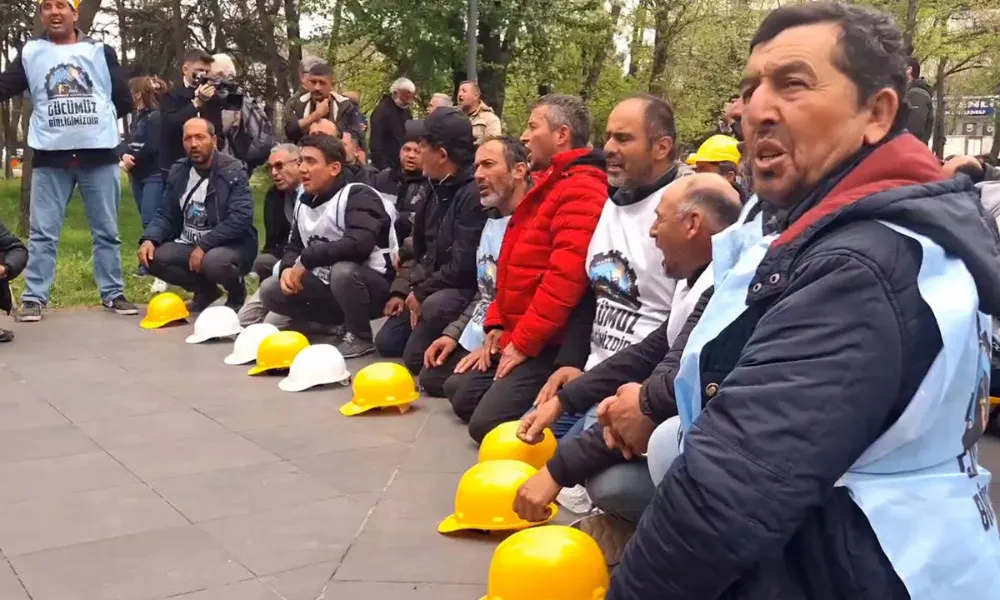
The hunger strike has ended. As of Wednesday, April 29, 2026, Doruk Madencilik workers who marched nearly 200 kilometers from Eskişehir to Ankara have secured what should never have been in dispute: their wages, their rights, their dignity.
After 16 days of protest and a punishing nine-day hunger strike, a comprehensive agreement was reached under the mediation and effective guarantorship of the state. The numbers are concrete. A first tranche of 96.34 million lira has already been transferred to workers’ accounts. The remaining arrears, including unpaid salaries, severance, and other entitlements, are guaranteed within 15 days.
The company has formally acknowledged that practices such as enforced unpaid leave were unlawful and has committed to ending them. Ministries will monitor compliance.
On paper, this is a clean win. In reality, it is a victory wrested from a system that still resists doing the right thing without a fight.
From optics to ultimatum
This outcome did not materialize through routine oversight or predictable rule of law. It came after escalation, public pressure, and a decisive shift by the government from passive observation to active enforcement.
Interior Minister Mustafa Çiftçi and officials from the labor and energy portfolios intervened directly, convening a 90-minute, high-stakes meeting in Ankara with a worker delegation that included union officials and legal counsel. The message to the employer was not subtle. Pay the workers, or face the consequences.
Those consequences were not symbolic. They included the suspension or cancellation of operating licenses for core assets, including the Yunus Emre Thermal Power Plant and associated mines, and the prospect of nationalization or transfer to a compliant operator if unlawful practices continued.
A 23 million lira fine underscored the point that non-compliance would be more expensive than compliance. In short, the state used its full leverage to impose what the system should have guaranteed from the start.
When the state becomes the guarantor
There is a paradox here that cannot be ignored. The same state that, for days, maintained a heavy police presence around the protest area, at times outnumbering the miners severalfold, ultimately became the guarantor of the settlement. The same apparatus that treated the gathering as a public order risk ended up acknowledging that the real risk lay in allowing wage theft and unlawful labor practices to continue.
This is not merely a narrative twist. It is a structural signal. In Türkiye’s current political economy, justice too often requires a threshold event, a moment when the cost of inaction exceeds the cost of intervention. Only then does the system switch from inertia to enforcement. The miners crossed that threshold with their march, their hunger strike, and their persistence.
A “capital-friendly” model under stress
The broader context matters. For two decades, Türkiye has pursued a growth model that privileges capital accumulation, large-scale privatizations, and close state-business alignment in strategic sectors such as energy and mining. Companies like Yıldızlar SSS Holding grew within this framework, acquiring formerly state-run assets and operating at scale. Their leadership’s political background and past recognition by the state have fed a perception, widely shared by unions, of a protective shield. That shield has now been tested.
The government’s intervention signals that political credit has limits when labor practices create visible social strain and reputational risk. This is not a systemic reset. It is a corrective maneuver under pressure. But even corrective maneuvers, once taken, create expectations. Workers have seen that the state can act decisively. The question is whether it will do so before crises, not after them.
Solidarity filled the gap
If the institutional response was late, the societal response was not. From Eskişehir to Ankara, villagers, shopkeepers, and ordinary citizens provided food, water, and shelter to the marching miners.
In Ankara, families joined the vigil, standing in harsh conditions. Unions coordinated support, lawyers and doctors offered voluntary assistance, and social media amplified the message that the miners were not alone. This web of solidarity did more than sustain the protest. It exposed the gap between a living social conscience and a lagging institutional framework. When rights depend on solidarity to be realized, solidarity becomes both a virtue and a necessity. It should not have to be the latter.
Justice as reaction, not routine
The settlement terms are clear and enforceable. The immediate payment has been made. A 15-day deadline governs the remainder. Ministries will oversee compliance. Yet the mechanism that produced this outcome remains reactive. It was not a routine inspection that uncovered violations and triggered timely correction. It was a crisis. It was a march. It was a hunger strike. This is the core of the problem.
A rule-of-law system is measured not by how it resolves crises, but by how effectively it prevents them. If wages can go unpaid until workers reach the capital and stop eating, then justice is not functioning as a system. It is functioning as an emergency response.
A line drawn before May Day
Union representatives have framed the outcome as a significant labor victory and have called for momentum to carry into May Day. The symbolism is unavoidable. A barefoot march has forced a well-connected company to comply. A hunger strike has compelled the state to act as guarantor. A park encircled by police has become the stage for a settlement that should have been automatic.
The message to employers is direct. Unlawful practices will now meet not only public scrutiny but potential license risk. The message to workers is equally clear. Persistence can yield results. The message to the state is the most important. Acting late is still acting late.
What this victory is, and what it is not
This is a victory. It has put money into workers’ accounts, ended unlawful practices, and established a monitoring mechanism. It has also demonstrated that the state can enforce compliance when it chooses to. But it is not a resolution of the deeper issue.
It does not yet transform a reactive system into a proactive one. It does not ensure that the next group of workers will not have to march, fast, and plead to receive what is theirs. It does not, by itself, dismantle the incentives that allow violations to persist until they become politically costly.
Beyond three words
Türkiye has long revolved around three words: rights, law, justice. They are invoked at every moment of strain. The miners’ victory shows that these words can be translated into outcomes when pressure is applied. The task now is more demanding. It is to build a system where outcomes do not depend on pressure. Where wages are paid because the law requires it, not because a minister threatens to cancel licenses. Where dignity is protected by design, not restored by protest.
The miners have won. The system has been put on notice. Whether this moment becomes a precedent or remains an exception will determine if “rights, law, justice” evolve from a chant into a structure.