There are moments when the anguish of a professional sector is entirely understandable. There are also moments when that anguish transforms into a dangerous deviation. The stance of some livestock farmers towards the measures imposed to contain foot-and-mouth disease appears, unfortunately, to fall into the second category.
Let us start from the obvious. For a livestock farmer, the herd is not a number. It is his work, his income, his daily life, and in many cases the livelihood of an entire family. Watching state services arrive to slaughter animals is a harsh, almost violent experience. No reasonable person can dismiss that.
But there is a difference between anger and challenging the very basic rules for managing an epidemic.
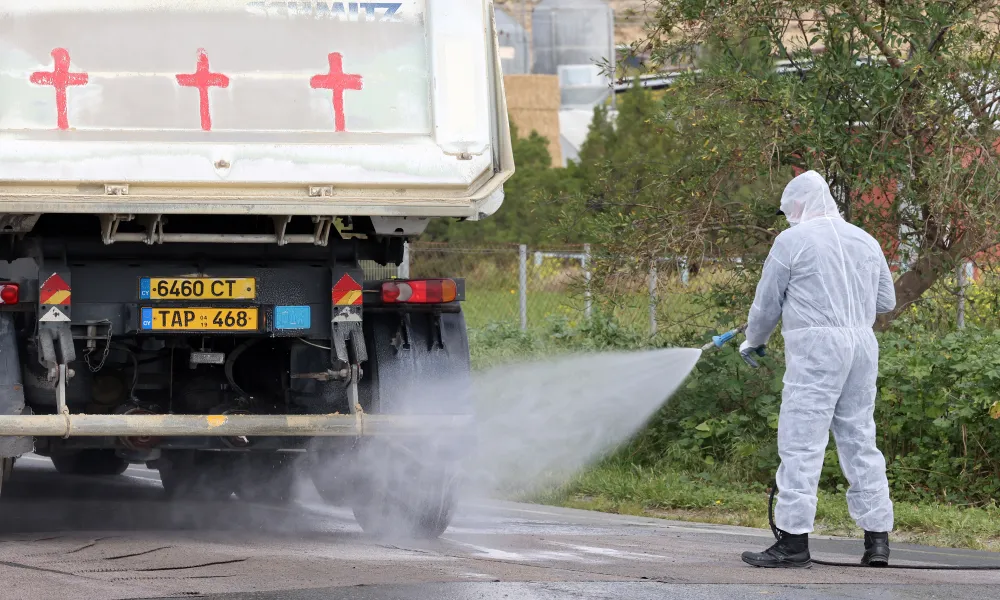
A public declaration that sampling and culling operations will be obstructed is not a simple protest. It is, in effect, a call to undermine the health measures whose precise purpose is to prevent the uncontrolled spread of the disease. And when one hears that "arrest is the least of our concerns," the message is no longer merely political. It is a message of direct confrontation with the rule of law.
Foot-and-mouth disease is not a matter of personal opinion. It is not a question of "belief," nor a referendum on trust in the Veterinary Services. It is an extremely contagious animal disease with well-established international protocols, protocols that were not designed by some office in Brussels to torment livestock farmers, but because decades of experience have shown what happens when control is lost.
The history
History is full of examples of countries that paid an enormous economic and productive price because the spread was not contained in time. In the United Kingdom in 2001, one of the most well-known foot-and-mouth crises unfolded: more than six million animals were slaughtered and the economic cost was estimated in billions of pounds, with devastating consequences for livestock farming, tourism and exports. In Japan in 2010, a major outbreak struck Miyazaki prefecture, leading to the mass culling of hundreds of thousands of cattle and pigs and causing serious damage to agricultural production. In South Korea between 2010 and 2011, one of the largest outbreaks in the country's history emerged, resulting in the culling of millions of animals and a high fiscal cost.
The demand by our livestock farmers for a second sampling or for full transparency in the procedures is legitimate. Seeking explanations from the state is a right. Demanding clear compensation is equally a right. But organising the physical obstruction of inspections and building an informal network of "cells" for immediate mobilisation is something else entirely.
That is where legitimate demand ends and collective irresponsibility begins.
Because if the virus spreads, it will not only affect one farm in Pachna or one unit in the Nicosia district. The entire livestock sector of the country will be at risk, if it is not already, with incalculable consequences for everyone and above all for the very farmers who are resisting today. It will also deal a blow to the country's leading export product, halloumi, since foot-and-mouth disease directly affects milk production.
A deeper problem
There is something even more deeply troubling at work here. In recent years, across many crises, including Covid, a culture has taken hold in which every unpleasant but scientifically necessary measure is framed as more or less an act of state arbitrariness. Every restriction is cast as oppression. Every protocol becomes suspect. This logic is not simply tiresome. It is dangerous.
The state, for its part, also has obligations. It is not enough to invoke European protocols. It must explain, persuade, operate with full transparency and guarantee fair and prompt compensation. Because when people feel they are being destroyed without any protection, anger becomes explosive. But even then, the answer cannot be vigilantism in the face of a contagious epidemic. A virus does not negotiate, and it certainly does not wait for the protest to end.