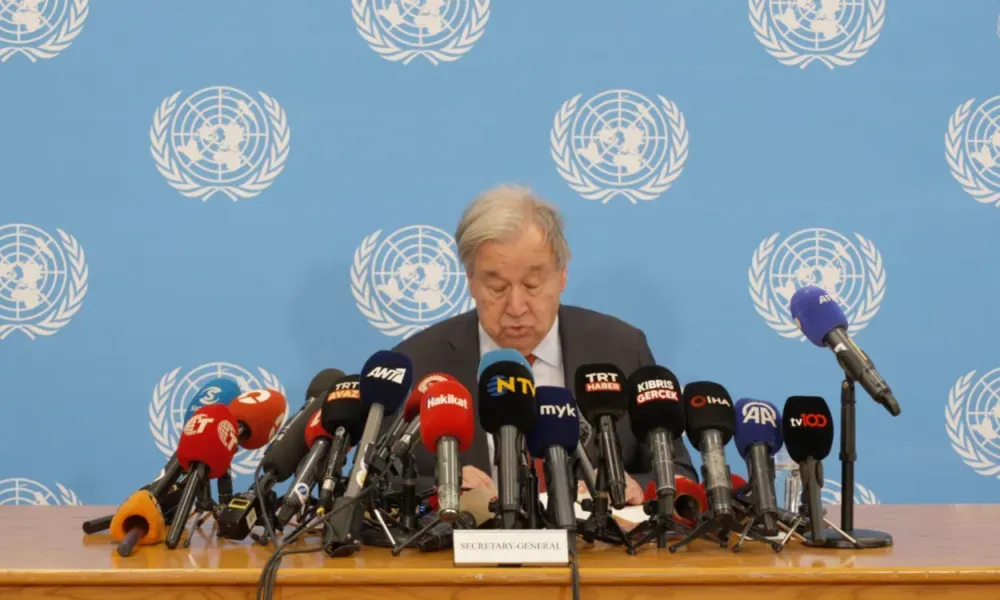

With UN Secretary-General António Guterres' visit to Cyprus now over, President Nikos Christodoulides and his circle appear eager to create the impression that the Cyprus issue has entered a period of renewed momentum that could soon lead to the resumption of negotiations.
However, the facts do not support such a conclusion, and certainly not on the basis of what Guterres himself said before leaving the island.
Beyond his reference to a new 5+1 conference at some unspecified point in the future, the UN chief left behind little that could be described as a concrete breakthrough. This was not for lack of effort on his part. Rather, it reflected the reality that, once again, the two leaders did not appear ready or willing to take bold steps forward.
Even the proposed new 5+1 meeting appears difficult to achieve within the four to five months remaining before Guterres leaves office. Before convening such a conference, he has made clear that he expects progress on confidence-building measures (CBMs), something that currently appears unlikely.
The differing interpretations offered by the two sides underscore the problem. President Christodoulides insists that CBMs are not a precondition for a new conference, while Turkish Cypriot leader Tufan Erhürman maintains that they are. Their contrasting positions illustrate how far apart the two sides remain, even on procedural issues.
Guterres also called for meaningful preparation on methodology, substance and previous convergences reached during earlier negotiation rounds. Yet there is no confirmed common understanding on any of these matters.
Indeed, statements by both leaders following their meetings with the UN secretary-general suggest that achieving alignment on these issues in the near future will be extremely difficult.
If one looks at the situation realistically, there is little tangible evidence to justify celebrations or triumphalism.
The Cyprus problem, both in terms of process and substance, remains in essentially the same deadlock that existed before Guterres arrived on the island. Had any genuine progress been achieved, the secretary-general himself would have announced it. The fact that he did not strongly suggests that no such progress occurred.
Critics argue that, instead of acknowledging their share of responsibility for the absence of meaningful results, the president and those around him continue to play political games with the Cyprus issue.
Through public statements and selective briefings, they are accused of fostering the perception of momentum that does not, in reality, exist.
The reason, the argument goes, is simple: the 2028 presidential election is drawing closer, and the appearance of movement on the Cyprus issue serves a useful political purpose.