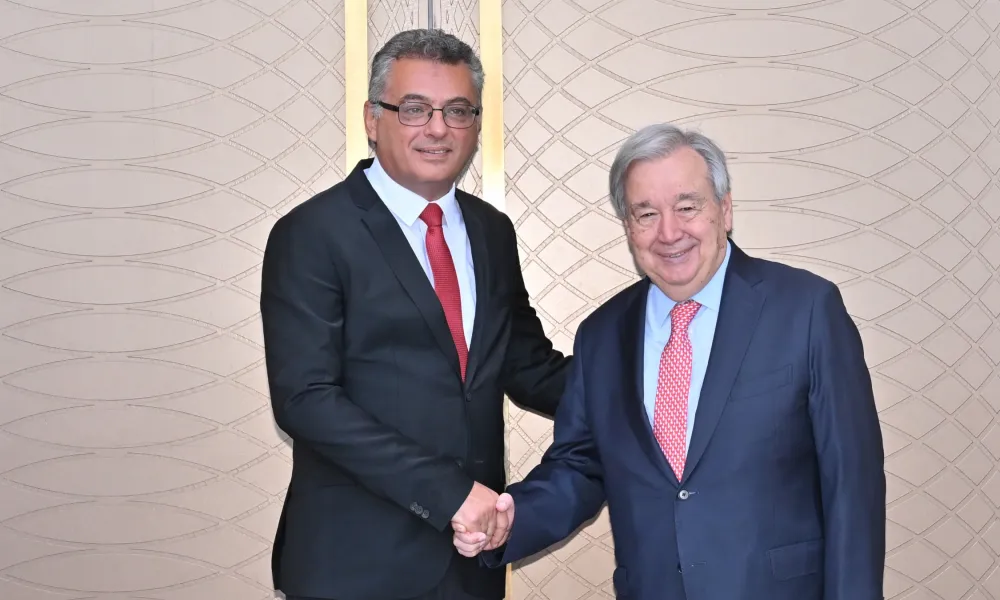
Tufan Erhurman is developing into a problematic leader for the Turkish Cypriots, and murmurs of discontent have already begun inside the Republican Turkish Party, with the party appearing divided. Erhurman was almost offensive during the meeting with Guterres, while in terms of discourtesy he even outdid Anastasiades, repeatedly stepping outside for a cigarette and leaving everyone behind. As for the crossing points, he could have found himself irreparably exposed if Christodoulides had simply said, "OK, let's proceed with Mia Milia only." In that case, the road to a five-party conference would have been wide open, and in order to block it Erhurman would have had to show that he differs little from Tatar when it comes to aligning himself with Ankara. If the President, as he says, truly prioritises the substance of the Cyprus issue, then why is he so consumed by whether one or two crossing points will open?
What did the guests of Antonio Guterres eat at the Dian residence last Tuesday? Guterres wanted to have traditional meze, but his dietitian talked him out of it. Between ourselves, they all had different meals because of their dietary restrictions. To begin with, there were three different salads and starters, and afterwards each person had a choice of fish, chicken or vegetables, all prepared with different seasonings. The dinner was every bit as complicated as the Cyprus problem itself.
Some people, mainly the cheerleaders of Nikos Christodoulides, insist that "we broke the deadlock" in the Cyprus issue. Truly, words seem to have lost their meaning. How exactly, gentlemen, did we break the deadlock? Literally speaking, when you break a deadlock, you create an opening, even a crack, through which something can pass. Figuratively speaking, a deadlock is broken when an idea or thought manages to get through our thick heads and is accepted. What exactly was broken here? Where did we get through and where did we arrive? The deadlock remains, and unfortunately Antonio Guterres realised that as well this time. The man came to Cyprus, spent three days here, yet the two clowns governing Cyprus could not even manage to open a single crossing point. Put simply, contacts and meetings with the UN Secretary-General, which incidentally also took place during Tatar's time, do not break deadlocks.
In the past, every crossing point that opened was another hole in the wall dividing Cyprus. Even Tassos Papadopoulos used to tell us that opening a crossing point weakened the occupation, and five crossings were opened during his presidency. Today, however, under a President who says he is ready for a solution, not a single crossing point is opening. The other day, in front of Antonio Guterres, he failed yet again, aided by the stubborn Erhurman. According to our side, for a crossing point to open, Greek Cypriots must benefit as well and not only Turkish Cypriots. We understand what he means by this, but at the same time we enter the logic of reciprocity that exists between two states. Besides, the existing crossing points already function as borders. To cross, you need identification documents. You must also undergo customs checks and, thirdly and most importantly, it must be verified that you do not have any outstanding traffic fines, which you must collect before crossing into the northern occupied part of our homeland.
Criminal investigator Paschalides told us, in relation to Videogate, that he used the Greek term "faflatismos" because it is allegedly a criminal offence. What is faflatismos? It is excessive talk characterised by pompous, affected or empty content. In other words, someone talks a lot, uses grand words, but says very little of substance. Synonyms include hot air, empty rhetoric, verbalism and verbosity. In Cypriot Greek, a faflatas is someone who "spins yarns" or "talks nonsense". Is faflatismos a criminal offence? It certainly is not a standalone criminal offence under Cypriot law. Criminal liability may arise not because someone is a chatterbox, but because within what is said another specific offence is committed, such as threats or intimidation, public insults under circumstances likely to provoke violence, or the publication of false information capable of disturbing public order or causing public alarm. Put simply, endless chatter may be tiresome, but it is not, in itself, illegal.
Can Europe free itself from dependence on the United States? The most ambitious answer is the creation of a Europe-centred defence alliance that would institutionalise a European command structure independent of NATO, notes Syracuse University professor Glyn Morgan in an analysis for Chatham House. Three things would be required to create a European structure that would replace the American Supreme Allied Commander with a European general staff, integrate national armed forces under continental rather than Atlantic command, and develop the military doctrine and logistical capabilities needed for autonomous action. Such a path would require war-economy-scale investment in three interconnected pillars. The first is the creation, under the leadership of London, Paris, Berlin and Warsaw, of an "E3+Poland" industrial base capable of mass-producing the ammunition, drones, air-defence systems and armoured vehicles that Europe currently buys from American manufacturers. The second pillar is the establishment of a sovereign European satellite network for communications, navigation and intelligence gathering, ending dependence on American GPS, Starlink and reconnaissance systems, a dependence highlighted so vividly by the war in Ukraine. The third is a definitive decoupling from American energy markets through, among other measures, diversification of liquefied natural gas suppliers, accelerated development of European nuclear energy and substantial investment in renewable-energy infrastructure that would not depend on regulatory approval from Washington. Can Europe do it?
Some people in DISY are celebrating the numbers in certain opinion polls. What is actually required for the party's candidate to reach the second round is unity, both at the grassroots level and within the leadership. That, of course, is not reflected in opinion polls at this moment, but it will become apparent soon enough. When a party has two or three prospective candidates and you want to conduct polling, then everyone should be informed, both about the poll itself and, most importantly, about its results before they leak to the press. DISY went into the parliamentary elections united, under the circumstances. We do not see it entering the presidential election particularly united, unless someone takes the initiative to move things in that direction. Based on everything being said and heard, swords will be drawn, which means Christodoulides probably still retains the upper hand.