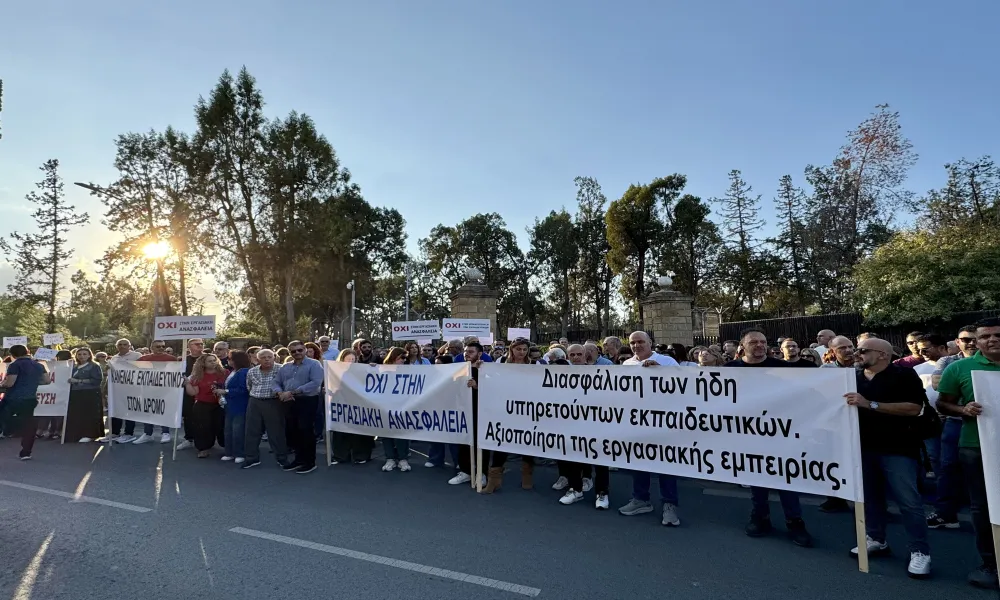



The mobilisation against the new teacher appointments system is the latest episode in a story that repeats itself with worrying consistency. Last year it was the evaluation of teachers and of teaching. This year it is the new appointments system. Every major change in education seems to pass through conflict, red lines, statements, mutual accusations and, ultimately, a battle over who will back down first. On one side, teachers' unions raise walls against changes they believe harm their members. On the other, the Education Ministry insists that without reform the system cannot move forward. Caught between them is the public school, with pupils watching a conflict waged in their name that rarely puts them at its centre. In essence, the grown-ups of the system are once again fighting over the terms on which it operates, while something fundamental has been lost in the classroom: the joy of learning, curiosity, and a child's need to discover, to ask, to try and to learn because they want to understand the world around them rather than because they need a good mark in an exam.
Vested interests
Teachers' unions clearly have the right to defend their members, as that is their role. The problem begins when every change that touches established privileges is treated as a threat to be repelled. Last year the conflict was over evaluation; this year it is over appointments. At its heart lie the examinations, the closed register, the granting of permanent status and the fate of those serving without a permanent post. POED, OELMEK and OLTEK, the unions representing primary, secondary and technical school teachers, warn of professional insecurity and staffing risks after 2027. Behind this rhetoric, however, lies a reality that cannot be ignored. The unions are reluctant to accept a system that links a permanent post to a new evaluation or examination process for those already working in public schools.
How Europe does it
There is no single European model for appointing teachers. In a third of the systems examined by the OECD, examinations or competitive procedures are used. France requires a national competitive exam for a permanent post, Spain combines an exam with qualifications, and in other countries candidates compete for posts through decentralised procedures. In the Netherlands and Sweden, certification and qualifications carry greater weight, while in Austria posts are advertised and candidates apply to specific schools. As for Cyprus' old model, in which the order of appointment was largely determined by when a teacher obtained their degree, there is no equivalent among the European systems examined. This does not mean Cyprus should copy another country, yet the demand for change is neither unreasonable nor unprecedented.
This is where the unions' stance must be judged strictly. Every reform cannot be viewed through the lens of what those already inside the system stand to lose, and a public school cannot plan its future solely around protecting the existing balance.
A satisfied profession
Data from the OECD's TALIS survey make it even harder to sustain the image of a profession permanently under siege. In Cyprus, 93% of teachers say they are satisfied with their job, 73% with their salary and 85% with their terms of employment beyond pay, all above the OECD average. This does not erase the problems, nor does it deprive anyone of the right to press their demands. It does, however, undermine the ease with which every change is presented as an attack on teachers. If the public school is to change, established privileges, habits and certainties will have to be put on the table, because there is no such thing as reform that costs nobody anything.
The ministry's share of the blame
At the same time, it is easy for the Education Ministry to point at the unions and speak of resistance to change, but it is not free of responsibility. The new appointments system did not appear out of nowhere, as the end of the transitional period had been known for years. Even so, the ministry once again came close to the deadline with issues unresolved, timetables that kept shifting and a consultation that deepened suspicion instead of easing it. A ministry that asks a profession to accept far-reaching change cannot at the same time appear relaxed about its own timetables. The same happened in the debate over the new teacher evaluation system. Cyprus cannot function with systems designed for a different school and a different era, yet a reform is judged by more than whether it is passed or implemented. It is also judged by whether the ministry has managed to explain why it is being made, what it fixes and how its success will be measured.
There is a deeper paradox here. The ministry demands more evaluation, accountability and effectiveness from teachers, yet international data show that teachers in Cyprus work within a system that gives them less teaching autonomy than the OECD average and limited involvement in decisions on the curriculum, teaching and school policy. You cannot ask someone to take greater responsibility for the outcome while leaving them less room to decide how to achieve it. The same applies to preparing today's teachers. The school of 2026 is not the school of 20 years ago. 42% of teachers in Cyprus work in schools where more than 10% of pupils have a first language other than the language of instruction, and 74% work in schools with refugee pupils. The classroom has become more complex, more diverse and more demanding.
Yet much of the public debate still revolves around the mechanism: who will be appointed, who will be evaluated, who will go on which list and who will be made permanent. The question the ministry must answer is harder. What does it do with a teacher once they walk through the school door? Does it give them the tools they need and real autonomy? Does it train them for the classroom in front of them rather than the classroom that once existed? Does it remove bureaucracy or add yet another procedure? And above all, when it talks about reform, can it show where it expects to see the difference inside the classroom?
The pupil
While the adults of the system clash over appointments, evaluation, permanent status and rights, another, quieter crisis is unfolding in the classroom. Pupils' performance remains low, and the school is also struggling to make them want to learn. PISA 2025 is more than a league table. It points to a system that struggles to turn school attendance into real learning, with Cyprus remaining below the OECD average in key areas. In 2022, a sharp decline had already been recorded compared with 2018, with performance in maths, reading and science falling markedly. The 2025 results do not erase that picture; they confirm that the problem runs deeper and cannot be explained solely by the pandemic or a bad exam year. The real question, however, is why a growing share of pupils seem disconnected from learning altogether, beyond why their scores are falling.
Today's classroom competes with something schools did not face with the same intensity in the past: endless digital information, mobile phones, social media, videos lasting a few seconds, gaming, artificial intelligence and a pace of life that has accustomed children to a constant stream of stimuli. Concentration becomes harder, and the traditional lesson must win the attention of a child who has learnt to move on to the next stimulus almost immediately. The classroom has also changed socially. Pupils do not all start from the same point, nor do they share the same experiences or needs. Teachers are expected to manage multilingual classes, learning difficulties, social inequality, issues of mental resilience, conflict, delinquency and children who often need someone to listen to them before they need someone to teach them.
Who wins in the end?
This is where the debate on public schools must move beyond who wins each battle. The unions may win protection for their members, and the ministry may push through the reform it considers necessary. Evaluation may change, lists may be rewritten, new exams may be set up and the procedures for permanent appointment may be overhauled. But if pupils have stopped feeling curious, if they find no reason to try and if learning has become a chore to be got through, the system will have won the wrong battles. The public school does not exist to manage the balance between a ministry and its unions. It exists to make a child open a book and want to find out what is on the next page. That is perhaps the biggest challenge of all, and today nobody seems to be fighting for it with the same intensity.