
The tragic death of Giorgos Mazonakis opened up a debate that it would be convenient to consider purely Greek. To look at the doctors in Kolonaki, the licences under investigation, the equipment, the treatments, and shake our heads condescendingly at what's happening "in Greece."
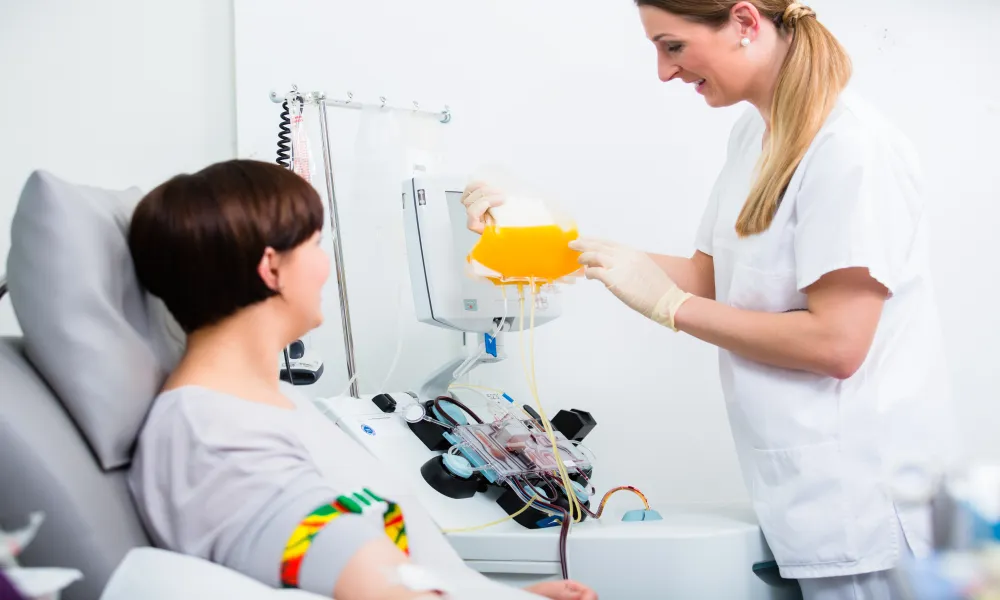
Except the debate quickly reached Cyprus too. Because we suddenly learned that there had been complaints here as well. That a patient, according to a public complaint by a doctor, ended up in intensive care following plasmapheresis. That the case reached the Ministry of Health back in 2023, was passed on to the Police and ended up with the Legal Service, without any criminal prosecution, because it was judged that there was insufficient evidence. This doesn't prove that a criminal offence was committed. Nor does it mean that anyone offering an unconventional treatment is a fraud. What it does mean is that the state knew there was an issue. And today, three years later, we're discussing the exact same thing again.
Doctor Vassos Economou stated publicly that the complaints don't concern a single case. He spoke of several medical centres, of procedures reportedly carried out without the required licences, and of years-long efforts to address the issue. According to what he alleged, the competent authorities had been informed, without effective intervention ever being achieved.
This is where the real problem begins. Not necessarily the criminal one, but the institutional one. A citizen has no way of knowing whether, behind an impressive website, a "longevity centre" label, a luxurious clinic and a few scientific-sounding terms, lies a well-documented treatment or a modern-day quack with expensive equipment. But isn't that precisely what the state, or the Ministry of Health, exists for? Isn't that what the Cyprus Medical Association (PIS)exists for? It isn't enough for the Ministry of Health to respond that it intervenes immediately when it receives complaints. That is clearly not a policy of oversight, but a policy of complaints. It means that someone must first realise something suspicious is happening, know where to report it, and only then does the mechanism move. Public health cannot function that way! Even more worrying is that an official from the ministry itself, referring to the centre in Larnaca, said it had stopped operating under its then name, but that she did not know whether it was operating today under a different one. If that isn't a warning bell for the oversight system, what is? Oversight of a medical activity cannot stop simply because the sign at the entrance changes. The state has a duty to know who the owner is, which doctors work there, what equipment is used, what procedures are carried out, and under what licence.
The Cyprus Medical Association must also be part of this discussion. It is certainly not the Police, nor the Registrar of Private Hospitals, and it cannot, on its own, shut down a facility. But it does have an institutional role in ethics, professional conduct and disciplinary oversight of doctors. Which is why announcements and general warnings to the public are not enough. Who checks a doctor advertising a treatment with no recognised indication? Who examines whether the procedure offered falls within their specialisation? Who checks whether it's carried out in a suitable location, whether the equipment is licensed, and whether the advertising promises things with no scientific basis? And, above all, who connects all this information together?
Today, it seems we have one piece at the ministry, one at PIS, one at the Medical Council, one at the Pharmaceutical Services, one at the Police, and, when things reach an impasse, a file at the Legal Service. Many bodies with responsibility, but no one responsible for the overall picture. Parliament has now decided to examine the licensing of the premises, the licensing of the medical equipment, and the licensing of the professionals carrying out the procedures. The question is why a famous singer has to die in Athens for Nicosia to remember that these things need to be checked. The market for longevity, detox, rejuvenation and wellness keeps growing. And with it grows the financial incentive. Services with impressive promises are sold to people who fear old age, illness, fatigue or the effects of a chronic condition. That's where quacks find their opening. The quack of 2026 doesn't necessarily go around with herbs and folk remedies. He may wear a white coat, own extremely expensive machines, have a flawless website and an impressive Instagram. He may talk about "toxins," "cellular regeneration," "biological age" and "longevity." That is precisely what makes state oversight more necessary, not less. The Ministry of Health and PIS must today be able to say how many such centres are operating in Cyprus, what treatments they provide, who inspected them, when they were inspected, what was found, and how many violations were identified. If they cannot answer, then we already have our answer as to whether the oversight system is working. We don't need to wait for the next tragedy. What we need is for the institutions to finally start searching for the risks before patients find them first.