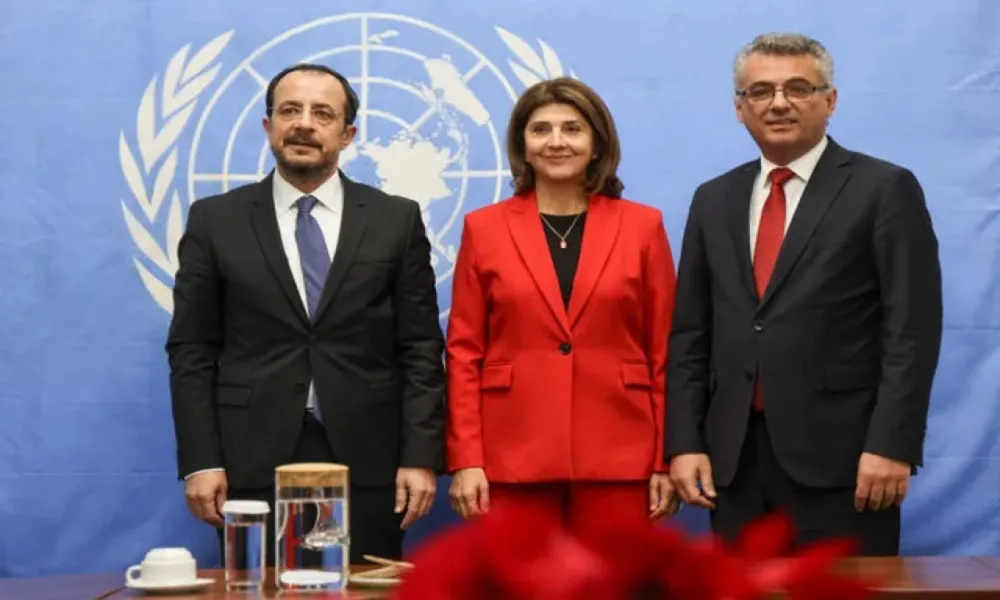

A high-level meeting between the EU and Türkiye is expected to take place before the end of October, while María Ángela Holguín, the United Nations secretary-general’s personal envoy, is due to return to Cyprus in the final week of the month. These contacts could open a new window before UN Secretary-General António Guterres leaves office at the end of the year. But the leaders have yet to agree on confidence-building measures or on the method for conducting negotiations.
In Yasaklar, a play by Devekuşu Kabare, Metin Akpınar delivered a line that seems almost tailor-made to describe the Cyprus process today: “Keep at it, keep at it: no victory in Cyprus.” We once loved Zeki Alasya as much for his stature as an artist as for his family’s Cypriot roots; Akpınar was his equally cherished partner on stage. Diplomacy keeps urging everyone to “keep at it.” Contacts, visits and new meetings are announced. But because the sides cannot agree on critical issues, the result is once again “no victory.”
A busy calendar, uncertain results
The Cyprus diplomatic calendar is filling up in the coming weeks. Holguín is expected to return to the island in the last week of October. Greek Cypriot leader Nikos Christodoulides has announced that a high-level meeting between the EU and Türkiye will take place before the end of the month, with both the resumption of Cyprus negotiations and EU–Türkiye relations on the agenda. Holguín’s visit could be one of the last serious initiatives before Guterres completes his term on 31 December.
Yet the diplomatic activity has not brought the sides back to the negotiating table. The leaders have not agreed on all the confidence-building measures, and the format for future talks remains unclear. A joint social gathering planned for Pyla could help the leaders get to know one another better and build trust. But it has not yet taken place, and even if it does, it will not in itself amount to political progress.
In a message sent to ANKA on Friday, Holguín placed responsibility squarely on the leaders: “The decision to resume negotiations rests with the leaders.” While reaffirming the UN’s commitment to facilitating the process and supporting their efforts, she urged them to work together and explore how they might live together on the basis of political equality.
Coffee is one thing, political equality another
It would certainly be positive for the leaders to attend social events together in Pyla, and perhaps, as former leaders Anastasiades and Akıncı once did, to meet for coffee and a conversation. Getting to know one another and building trust are needs not only of the two communities but of their leaders as well. Such contact, however, cannot replace the resolution of the Cyprus issue’s fundamental disagreements. A coffee meeting may nurture trust; it cannot determine how decisions will be made in a shared administration.
For Turkish Cypriots, political equality is not an issue to be taken up at the end of negotiations or traded for changes to security arrangements. It must be a guiding principle from the outset and ensure effective participation in a shared administration. That includes a rotating presidency and a Turkish Cypriot positive vote in decision-making.
Turkish Cypriots view these arrangements as necessary safeguards against being rendered ineffective by the will of the majority in a future shared administration. The Greek Cypriot emphasis on changing the system of guarantees and security arrangements, meanwhile, fuels concern that political equality could be made conditional on concessions in those areas.
Such a trade-off is unacceptable to Turkish Cypriots. Political equality in governance cannot be bargained away in return for changes to the security framework. Delaying one side’s demands for equality while giving priority to the other side’s security expectations would create a new imbalance.
This is one reason Erhürman wants the method for conducting talks to be agreed before negotiations begin. Christodoulides argues that talks should resume from where they broke off at Crans-Montana in 2017, within the framework of a bi-communal, bi-zonal federation. Erhürman, while saying he is open to a federal process, wants political equality and the method of negotiation to be clarified from the beginning. The disagreement concerns not only the model of a settlement, but also how each side’s fundamental concerns will be safeguarded throughout the process.
Holguín’s recent distinction between “methodology” and “substance” matters here: “Methodology determines how the agenda will be negotiated; substance determines what will be negotiated.” Agreeing on the method does not require either side to abandon its vision of a settlement. Clarifying the principle that “nothing is agreed until everything is agreed,” the possibility of implementing some agreements early, confidentiality and how the public will be informed could make the process more predictable.
The method must also ensure that political equality is respected at every stage of the negotiations. Telling Turkish Cypriots that equality will be addressed later does not resolve their concerns.
Six measures ready, crossings still blocked
Erhürman says the Turkish Cypriot side is ready to proceed with six of the seven confidence-building measures put forward by Guterres. The publicly discussed proposals include demining, joint responses to disasters, cooperation against irregular migration, sports, citizenship issues affecting children of mixed marriages, and a civil society mechanism. The disagreement persists over the package proposing new crossing points.
Holguín has asked the sides why they cannot agree on practical matters such as a new crossing point, demining or tackling plastic pollution. She has also raised a broader question: if the sides cannot reach agreement on issues that could benefit both communities, how will they build a political, economic and social model capable of overcoming decades of division?
The Turkish Cypriot side is calling for a broader package that also includes Akıncılar/Louroujina and Erenköy/Kokkina. The sides remain divided over which points should be included, how the crossings should be linked and whether they should open simultaneously. Erhürman says the proposals have not been rejected outright, but cannot be accepted in their current form.
One way out of the deadlock could be for the UN to consider smaller steps through the bi-communal technical committees. These steps would not replace comprehensive negotiations, but they could demonstrate the practical benefits of working together.
New contacts, old disagreements
The EU–Türkiye meeting announced by Christodoulides could lend fresh diplomatic weight to the Cyprus process. But it also carries the risk of turning the Cyprus issue into part of a broader bargain between Brussels and Ankara. Keeping the EU–Türkiye agenda separate from negotiations between the two sides on the island will be important if the meeting is to support the UN-led efforts.
The 19 proposals Christodoulides presented before the New York meetings have added another layer to the process. They have not been fully disclosed to the public, although Varosha has featured prominently in the debate. Erhürman argues that priority should be given to making progress on Guterres’s seven confidence-building measures. The deterioration in the atmosphere on the island after the New York contacts, and the sides’ mutual accusations over the lack of progress, show that new proposals alone do not build trust.
Holguín has said the UN compilation of convergences reached in previous negotiations will be presented when formal talks begin. She cautioned that circulating the document earlier could trigger further debate and setbacks. The sides, she said, know what was discussed in previous negotiations and have the relevant documents.
The disagreement is over the sequence of steps. Christodoulides presents his proposals as a way to launch substantive negotiations. Erhürman sees progress on the existing confidence-building measures as a test of the sides’ seriousness. For Turkish Cypriots, the sequence must prevent political equality from being tied to concessions on other issues.
What comes after “keep at it”
Holguín’s visit and the planned EU–Türkiye meeting could create a new opportunity before Guterres’s term ends. For that opportunity to produce results, the leaders must move beyond general expressions of goodwill. They need to reach decisions on confidence-building measures, find a workable formula on crossing points and agree on a roadmap that treats political equality as a fundamental principle of the negotiations.
Taking part in social events together, or meeting for coffee and conversation in the future, could help create a calmer atmosphere. Those encounters have not yet taken place, and even if they do, they cannot substitute for political decisions. There is more diplomacy in Cyprus today, but no real movement yet. Unless this familiar call to “keep at it” is followed by genuine agreement, the punchline will once again ring true: “No victory in Cyprus!”