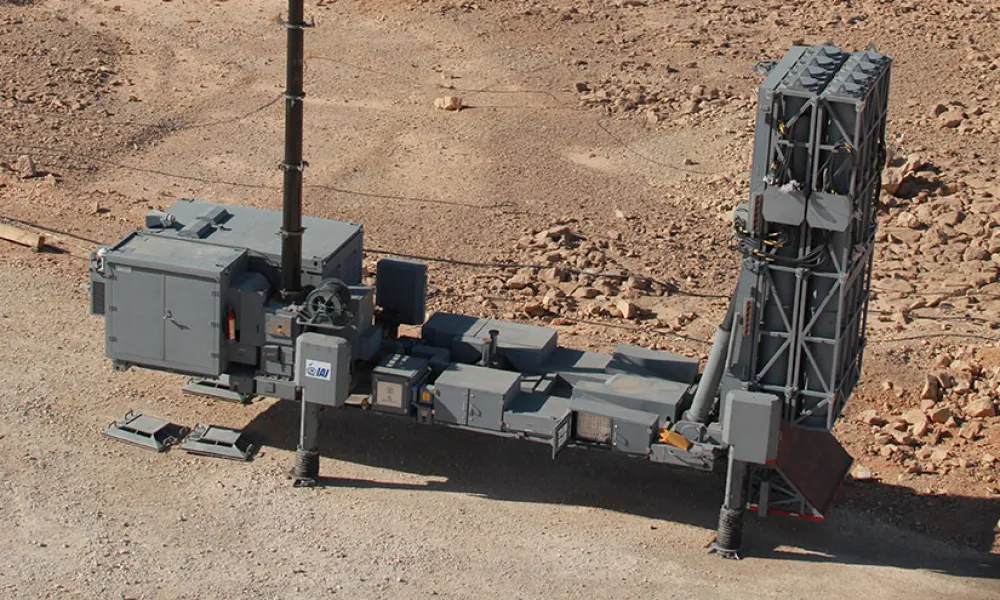

With the full operational readiness of the new anti-aircraft system acquired by the National Guard from Israel, one of the most significant gaps in the country’s defence is now covered — arguably in the best possible way. The Republic’s air defence is now developing into one of its strongest assets, as the Barak MX system is considered one of the most modern and flexible systems, capable of addressing a variety of threats.
Upgrading the air defence of the Republic of Cyprus had been ranked as a top priority by National Guard General Staff officials, as part of the long-term eight-year plan drawn up to enhance the National Guard’s capabilities. Related procedures began in 2021, and following a thorough evaluation of available options, the National Guard selected the Barak MX. The system's features played a decisive — if not the most important — role in its selection, as it is well-suited to the realities of the Republic of Cyprus and the types of threats it may face.
A senior military source described the acquisition of the new Israeli air defence system as a major success for the National Guard, with the key criterion being its strategic defence planning. Speaking to Politis, the same source explained that with the Barak MX, alongside the National Guard’s existing anti-aircraft systems, a layered air defence “umbrella” is now in place. “All modern air defence systems provide protection across three tiers: short, medium, and long range. And all of this is achieved with a single system, which offers immediate detection, target lock-on, and, if necessary, interception with the appropriate ammunition,” the source said.
Gradual deployment in Cyprus
Transporting such a system to Cyprus is no easy feat. Beyond the obvious national security considerations, the logistics of moving all the components that make up the system must be carefully planned — namely the self-propelled radars and the missile launchers. As a result, the system is being delivered in phases. Once all parts are in place, it will be fully operational. According to Politis sources, the system is being installed at existing National Guard facilities where a unit specialised in air defence operations is based.
From Iron Dome to Barak MX
A key question among military circles is whether a comparison between Israel’s well-known Iron Dome and the Barak MX is relevant. Those familiar with the capabilities of both systems believe the Barak MX holds the edge, as it integrates more features and clearly newer technologies.
According to information from open sources, unlike other systems designed for specific missions, the Barak MX offers multi-mission flexibility. This means it can be configured according to the user's operational needs and theatre of operations. The system is composed of three core elements: the Battle Management Center (BMC), which acts as the system’s “brain” and coordinates missile engagements; the interceptor missiles available in three variants with different ranges; and the sensors and radars that detect and track targets.
This flexibility enables the Barak MX to carry out point defence, area defence, or integrated force protection missions, at lower cost and with higher efficiency. It can simultaneously track and lock on to both airborne and ground-based threats. The Barak MX uses three types of missiles — MRAD, LRAD, and ER — each with different range capabilities. The MRAD has a range of up to 35 km, the LRAD reaches 70 km, and the most powerful, the ER, has an added booster and achieves a range of up to 150 km.
All three missile variants are launched vertically, offering 360-degree coverage and rapid response to sudden threats. They feature active radar seekers, allowing them to detect and intercept high-speed, manoeuvrable targets such as fighter jets or cruise missiles. The interceptors can reach altitudes of 20 to 30 km, while the long-range variants can withstand manoeuvres of up to 50 g.
Advanced radars
To detect threats, the Barak MX uses the modern ELM-2084 and ELM-2138 radars developed by ELTA Systems, a subsidiary of Israel Aerospace Industries. These are active electronically scanned array (AESA) radars, capable of simultaneously tracking multiple targets and guiding interceptor missiles. These radars are already in use in other Israeli systems, offering interoperability and reducing support costs.
What about the Russian systems?
With the National Guard’s air defence capabilities now significantly upgraded, the question arises as to what will happen with the existing systems, particularly the Russian-made ones. The most extensive debate centres on the Russian TOR-M1 and BUK-M1 systems. A competent source told Politis that, at present, there are no plans to phase out or transfer these Russian systems. With the integration of the Barak MX, the air defence strategy has been revised in a way that retains the Russian systems for specific coverage needs. The same applies to the French-made Mistral missiles.
Interest from other countries
The unique features of the Israeli Barak MX — particularly its effectiveness and flexibility — have attracted interest from other countries seeking to enhance their air defences. Colombia signed a $131.2 million contract for mobile units, with deliveries expected by 2026. Morocco secured the system for $500 million to reinforce its air defence in North Africa. Slovakia entered into an agreement worth €560 million, with deliveries set to begin in late 2025.