
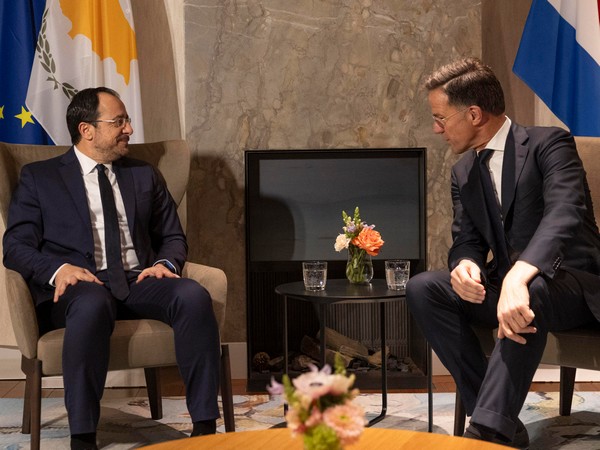
President Nikos Christodoulides met NATO Secretary General Mark Rutte on Wednesday evening in Copenhagen, on the margins of a dinner hosted by Denmark’s royal couple for leaders attending the European Political Community summit.
According to a written statement by the Director of the President’s Press Office, Victoras Papadopoulos, the meeting focused on the Cyprus problem and the further strengthening of EU-NATO cooperation “to the benefit of all member states of both organisations.”
Christodoulides briefed Rutte on recent developments in the Cyprus issue, stressing that progress in EU-Turkey relations depends on concrete steps towards a settlement, based on UN Security Council resolutions and the EU’s principles and values. He pointed to the appointment of Johannes Hahn as the EU’s Special Envoy for Cyprus, calling it an important tool to re-energise efforts.
Defence and security headline 2026 EU presidency
With Cyprus set to assume the rotating Presidency of the Council of the EU on January 1, 2026 - Christodoulides said defence and security will be core priorities, with a particular focus on strengthening Europe’s strategic autonomy.
On EU-NATO ties under the Readiness 2030 initiative, he stressed that cooperation must be inclusive and ensure equal treatment among all EU member states.
The meeting also addressed recent Russian provocations against EU countries that are NATO members. On Ukraine, Christodoulides reaffirmed that Kyiv must be part of any peace initiative and that support for Ukraine will remain a top priority during the Cypriot presidency.
On third-country participation in the SAFE Regulation, he underlined that respect for international law, sovereignty and territorial integrity is a non-negotiable prerequisite.
Intervention at the informal European Council
In a separate intervention at the informal European Council in Copenhagen, which focused on defence and security, Christodoulides again placed Cyprus at the centre of debates over Europe’s readiness.
He emphasised the importance of initiatives such as Readiness 2030 and the SAFE Regulation for Europe’s collective security, condemning Russia’s recent violation of EU airspace and expressing solidarity with affected states. Such actions, he said, pose a direct threat to the Union’s overall security.
Christodoulides stressed that during the Cypriot presidency of the Council of the EU, Nicosia intends to sustain momentum and push forward progress in defence and security policy. “States that pose a threat to member states cannot be allowed to take part in EU security instruments,” he said pointedly.
Cyprus' role in Readiness 2030 and SAFE
Although not a NATO member, Cyprus, he noted, is willing to contribute to closer cooperation and joint actions with NATO under Readiness 2030, provided that all EU member states are treated equally.
At the same time, he cautioned the Union against neglecting other strategically important regions such as the Middle East, stressing that Cyprus will do its utmost to support key strategic actors in the framework of Military Mobility.
Under the SAFE Regulation, Christodoulides said Cyprus plans to upgrade its naval facilities and air bases, reinforcing Europe’s collective security and preparedness.
Ukraine and international law
On Ukraine, Christodoulides condemned Russia’s continued missile strikes and the targeting of civilians, stressing that a peace settlement must respect the UN Charter, sovereignty, and the territorial integrity of all states.
He added that Cyprus is ready to contribute constructively to shaping a broader European security framework.