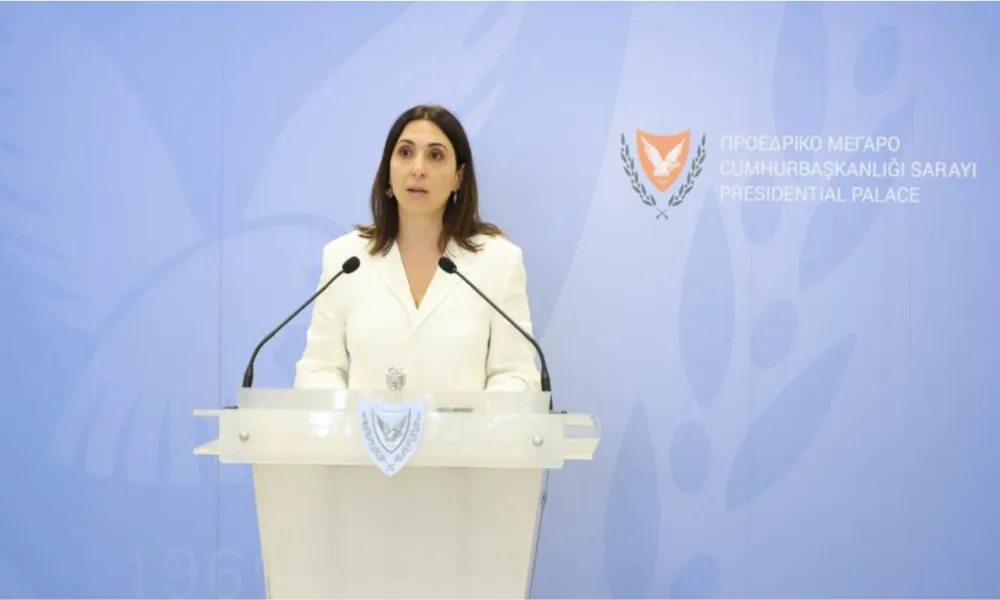
The success of the Cyprus Presidency of the Council of the EU is a success for everyone, Deputy Minister for European Affairs Marilena Raouna said on Tuesday. She briefed the Parliamentary Committee on Foreign and European Affairs on the thematic priorities of the upcoming Cyprus Presidency. If any issue arises concerning EU-Turkey relations during the Presidency, she noted, Cyprus will handle it effectively and as an honest mediator.
Members of the Committee expressed their support for a successful Presidency.
Preparations and Strategic Framework
Raouna informed MPs that with 22 days remaining before Cyprus assumes the Presidency, the high-level programme has been completed. On 21 December, the President of the Republic will present the programme in Lefkara, followed by presentations in Brussels and Strasbourg.
She stressed that the Government sees the Presidency as a national mission and an opportunity for the Republic of Cyprus, at a critical moment for the EU, to act as the voice of the twenty-seven member states, to lead the Council and to negotiate on behalf of all as an honest broker.
The priority programme was shaped on the basis of the eighteen-month joint programme of the Presidency Trio with Poland and Denmark, the EU’s strategic agenda for the next five years, and issues each member state wishes to highlight according to its own national characteristics.
Three Pillars of the Cyprus Presidency
Raouna explained that the Cyprus programme is structured around three main pillars:
- strengthening the EU’s strategic autonomy,
- enhancing the EU’s outward-looking approach, and
- emphasising social cohesion.
Issues to be promoted by the Presidency include migration, housing, combatting poverty, maritime security, mental health, reducing administrative burden for SMEs and advancing pending EU Free Trade Agreements with third countries.
Enlargement as a Geopolitical Priority
Nicosia aims to make progress on accession-related issues during the Presidency. Enlargement, Raouna said, is recognised as a geopolitical necessity for the EU, and Cyprus has prepared a work plan together with the European Commission.
Montenegro has advanced significantly in its negotiations, and the Cyprus Presidency could complete the technical part and launch the ad hoc working group responsible for drafting its Accession Treaty. Regarding Albania, she said Cyprus could be the member state that starts closing negotiation chapters, something that symbolically signals that the country is moving closer to the EU.
On Ukraine and Moldova, Raouna noted that the President of Moldova is expected to visit Cyprus on 12 December. She highlighted that the accession processes of the two countries have been informally linked because of Hungary’s veto concerning Ukraine. Cyprus, she stressed, will move in an inclusive manner with all member states to ensure progress through dialogue.
Legislative Load and EU Budget Negotiations
Cyprus will inherit from Denmark 330 legislative and other files, which it will negotiate during the Presidency within 190 working groups and subgroups in Brussels. The Presidency will also lead negotiations with all member states on the next Multiannual Financial Framework, the EU’s long-term budget, and its distribution across policy areas for the next seven years.
The Presidency will also mark the implementation phase of the EU Pact on Asylum and Migration.
Meetings and Events During the Presidency
The Deputy Minister said 261 meetings will take place in Cyprus during the Presidency, including 23 high-level meetings and an informal European Council on 23 to 24 April 2026. On 24 April, Cyprus intends to host the ten countries participating in the Mediterranean Pact.
There will also be 19 informal ministerial councils, one international ministerial conference and two ministerial meetings.
Cyprus has strengthened its human resources, increasing staff in its Permanent Representation in Brussels from 100 to 250 officials. It has also secured direct Larnaca-Brussels flights, which began on 1 December, with five flights per week during the Presidency and fewer flights continuing until the end of 2026.
EU-Turkey Relations and National Positions
Responding to MPs’ questions, Raouna elaborated on Cyprus’s stance on various issues.
On EU-Turkey relations, she said Cyprus will honour its institutional role as Presidency of the Council, which speaks and negotiates on behalf of the twenty-seven. As the member state closest to Turkey and the only member state under Turkish occupation, Cyprus wants more than any other member state for Turkey to remain on a European course.
This means that Turkey must confront its European obligations, including those related to Cyprus, such as the Cyprus issue and the resumption of negotiations.
When national positions arise, she noted, even if a member state holds the Presidency, it declares its national stance transparently and negotiates it. If a relevant issue arises, she added, Cyprus will manage it effectively as an honest mediator.
Security, Defence and a 360-Degree Approach
On security and defence, Raouna said Cyprus aims to broaden the lens through which its partners view major strategic objectives. The Russian invasion of Ukraine opened a debate on strengthening EU independence in security and defence. She added, however, that this must not be approached solely through the lens of Ukraine.
A 360-degree approach is needed to address threats at all EU borders, including the Eastern Mediterranean. If the EU does not do this now, she warned, it will be a lost opportunity as crises may emerge at different borders tomorrow. This is why maritime security has also been placed on the agenda.
Transatlantic Relations and the Middle East
Raouna said EU–US relations remain of utmost importance and a key pillar of the security architecture. During the Cyprus Presidency, some aspects of the implementation of the trade agreement will be relevant.
Cyprus has no choice but to cooperate with the new US administration, she added, and must establish channels of communication and collaboration. The Middle East and the Eastern Mediterranean are areas where synergies with the United States are possible.
She referred to the humanitarian corridor to Gaza, noting that 33,000 tonnes of aid have already been delivered and that the corridor continues to operate, with potential for further development with EU and international support. The EU, she stressed, must be present at the table where decisions on the Middle East are taken.
Decision-Making and the Question of Unanimity
On the question of unanimity in EU decision-making, Raouna said Cyprus’s position is consistent: unanimity safeguards EU unity and ensures that member states retain ownership over decisions. For matters of foreign policy and security, unanimity must remain, she stressed, as these concern national interests.
Looking Ahead to a Demanding Six Months
Speaking after the meeting, Raouna said that for six months Cyprus will lead one of the EU’s institutional bodies and will steer critical negotiations on major issues such as the Multiannual Financial Framework. Cyprus, she added, will be the voice of its twenty-seven partners during a demanding geopolitical moment.
She noted that under the guidance of the President of the Republic, the Government has worked for the past two years with strategic planning, seriousness and consistency to prepare effectively for this undertaking. The Presidency is seen not only as a six-month opportunity but as a long-term investment for a Cyprus firmly anchored at the core of the EU as an effective member state that contributes solutions to the challenges facing the European family.
The Mediterranean Pact and Regional Cooperation
On the Mediterranean Pact, Raouna said the aim of the Cyprus Presidency is to give it substance through concrete collaborative projects. On 24 April, the first set of projects between the region and the EU will be presented. She added that the European Firefighting Hub announced by the President of the European Commission, to be based in Cyprus and covering the region, has been incorporated into the Pact.
Parliamentary Reactions
Committee Chair and DISY MP Harris Georgiades expressed satisfaction with the level of preparation. He noted the opportunity for Cyprus, through the Presidency, to highlight its role as a small but reliable EU member state with a voice in European politics and in the wider region, particularly in promoting more effective EU engagement in the Mediterranean.
AKEL MP Giorgos Koukoumas said that although the opposition has different views on various issues, they want the Cyprus Presidency to succeed and to reach even higher. They will contribute to this effort, including in the parliamentary dimension.
DIKO MP Chryses Pantelides expressed his party’s readiness to support the Presidency in every way, both in relation to the Executive and Parliament. He wished success to the thousands of civil servants who will be involved in this major national effort over the next six months.
Source: CNA