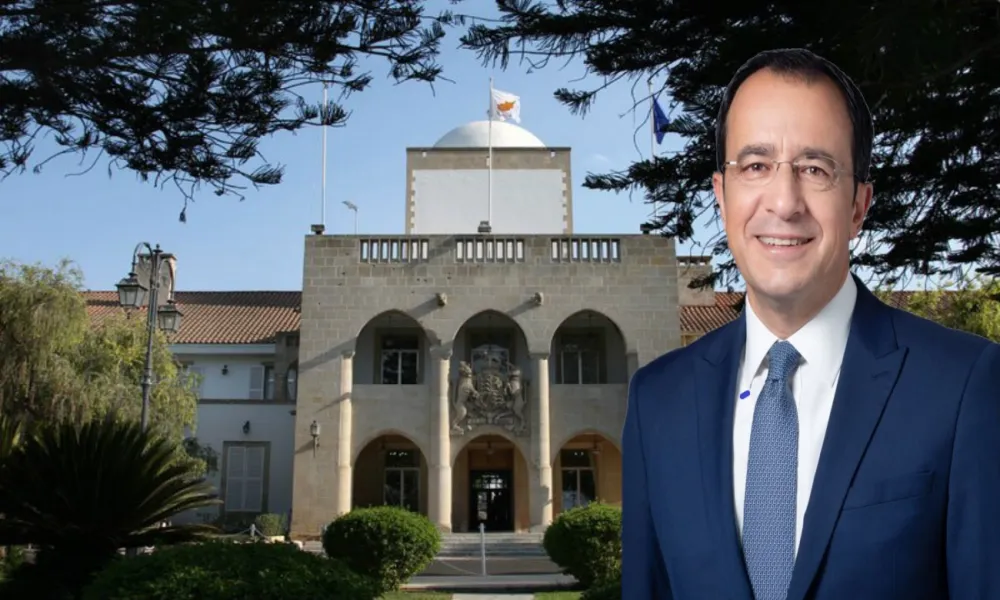
As the criminal investigation into the Videogate affair continues, focusing on close associates of Nikos Christodoulides, legal questions are increasingly being raised about the scope and limits of presidential immunity. While investigators could, under different circumstances, have sought a statement from the President himself, the constitutional framework governing presidential immunity makes such a development highly unlikely.
Had he not been shielded by immunity, President Christodoulides could have been questioned by investigators of the Criminal Investigation Department at Police Headquarters on the nature and depth of his relationship with Cyfield CEO Giorgos Chrysochos, as well as on any guidance he may or may not have given to his close associate and relative by marriage, Charalambos Charalambous, regarding how the Presidential Palace should handle potential major investors.
Investigators could also have sought explanations from the President regarding the much-discussed First Lady’s Fund. The third figure appearing prominently in the controversial video, former Energy Minister Giorgos Lakkotrypis, is alleged to have secured sponsors for the fund, reportedly as a form of quid pro quo for facilitation and access to the Presidential Palace in relation to his business interests. It is recalled that since 2024, parliamentary parties have raised serious allegations that the fund has been used for electoral purposes.
The President could, in principle, have been invited to comment on other equally serious aspects emerging from the video. This, however, is rendered impossible by the immunity attached to his office.
Immunity can only be lifted through Parliament
Under the current legal framework, lifting the immunity of the President of the Republic is considerably more difficult than lifting that of an MP or even the Speaker of the House. According to Article 45 of the Constitution, the President may be prosecuted only for high treason or for offences involving dishonour or moral turpitude, following a resolution of the House of Representatives of Cyprus and with the authorisation of the President of the Supreme Court of Cyprus. This presupposes, of course, that the Attorney General submits a formal application to the Supreme Court seeking the lifting of immunity.
Specifically, prosecution for high treason requires a parliamentary resolution approved by secret ballot and by a majority of at least three quarters of all MPs. For such a resolution to be tabled, it must be signed by at least one fifth of the members of the House. The Supreme Court then examines the evidence and testimony before deciding whether lifting immunity is justified. In cases involving offences of dishonour or moral turpitude, authorisation by the President of the Supreme Court is required.
The legal landscape changes significantly once a President’s term of office ends. At that point, the Attorney General has the constitutional authority to bring the former President before the courts to answer for acts or omissions falling within the scope of the Criminal Code, provided there is the political will to do so. Article 45 nonetheless stipulates that the President is not subject to civil proceedings for acts or omissions committed in the exercise of presidential duties. However, nothing in this provision may be interpreted as depriving any individual of the right to take legal action against the Republic itself.
The commitments of Nicos Anastasiades
Following the deadly explosion at the Evangelos Florakis naval base in Mari on 11 July 2011, and the subsequent debate over possible criminal responsibility of then President Demetris Christofias, Nicos Anastasiades, then DISY’s presidential candidate, made a series of public commitments.
Among them was a pledge to submit legislation limiting the scope of immunity enjoyed by both the President of the Republic and MPs. As part of a broader effort to restore trust in public life, he also committed to introducing bills that would allow for the criminal prosecution of state officials, including independent office holders such as the Auditor General, in cases of deliberate violations of the Constitution or the laws of the Republic.
A bill that never reached Parliament
A bill aimed at limiting the scope of presidential immunity was drafted by the Ministry of Justice and forwarded to the Legal Service for review more than a decade ago.
Entitled “The Responsibility of the President and the Vice President of the Republic (Implementation of Article 45 of the Constitution) Law”, the bill proposed a constitutional amendment allowing for the criminal prosecution of the President and Vice President for offences carrying prison sentences exceeding ten years, as well as for deliberate violations of the Constitution. The Legal Service, however, raised concerns regarding its constitutionality, and the bill was never submitted to Parliament.
Prosecution of officials
By contrast, other bills included in the Anastasiades administration’s governance programme, aimed at strengthening political accountability and transparency, were submitted to Parliament. Some were later withdrawn following strong reactions from affected officials. These included:
-
The Responsibility of Ministers and Ministers Without Portfolio Law of 2013, submitted on 7 November 2013. The bill sought to criminalise deliberate violations of the Constitution or the laws of the Republic, as well as intentional harm to the interests of the Republic by ministers, the government spokesperson or deputy ministers. It was quietly withdrawn by the Anastasiades government following intense opposition.
-
The Responsibility of Independent Officials of the Republic Law of 2013, also submitted on 7 November 2013. This bill aimed to establish criminal liability for deliberate constitutional or legal violations by independent officials such as the Auditor General, Assistant Auditor General, and the Governor and Deputy Governor of the Central Bank. It was withdrawn after the earlier bill concerning ministers was shelved.
-
The Thirteenth Amendment to the Constitution Law of 2016, submitted on 3 March 2016. The bill proposes amending Article 83 of the Constitution so as to limit parliamentary immunity strictly to acts carried out in the exercise of MPs’ parliamentary duties. Debate on the bill remains ongoing. Yesterday, Democratic Rally (DISY) reaffirmed its support, stating that parliamentary immunity cannot extend to serious criminal offences and that equality before the law, transparency and accountability are fundamental principles of democracy.