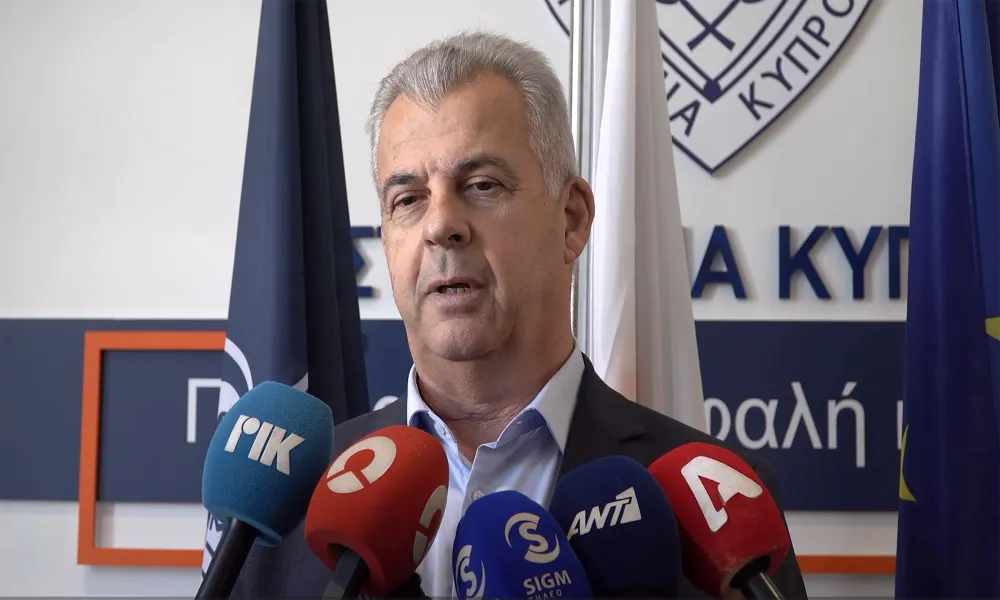
The Justice Minister, Kostas Fytiris, says he is convinced that once the mobile phone deactivation system is fully operational at the prison, criminal activity planned and carried out from inside inmates’ cells will be curbed.
Cutting off illegal mobile phone communication inside Central Prisons will play a key role in limiting organised crime and offences planned and directed from within prisoners’ cells. That is the assessment of the newly appointed Justice Minister, who was speaking to the Parliamentary Human Rights Committee during a discussion on conditions at the Central Prisons.
Mr Fytiris referred to a series of long-standing problems and said measures are now being pushed forward to address them.
On the issue of mobile phones, and responding to questions about problems following the installation of the deactivation system, the minister told MPs that during his visits he personally observed the difficulties. He said he had been informed that the system would be fully operational within the next two months.
As he explained, the mobile phone detection system has been running for around three months, while the deactivation system is expected to come into operation in about two months’ time.
Commenting on the rise in organised crime, the minister stressed that cutting off prisoners’ mobile phone communication would be a substantial step towards limiting criminal activity organised from within Central Prisons.
On the same issue, the Deputy Director of Central Prisons, Maria Siali, told the committee that 90 mobile phone devices had been detected over the past three months.
Director and recruitment
According to the Justice Minister, 90 prison officer posts will be advertised on 23 or 30 January.
As part of a new approach he wants to introduce, he said prison guards will now be referred to as correctional officers, while Central Prisons will be officially termed a correctional institution.
New correctional officers will undergo training and, as stressed, will not be assigned duties before completing it. A dedicated training programme is being prepared for new staff, while existing personnel will also receive further training.
The programme will be designed so as not to disrupt the day-to-day running of the prison. Training, the minister said, will be delivered by psychologists, criminologists and other specialists, with rehabilitation as the core focus.
Mr Fytiris repeated that a merit-based staff evaluation system will be introduced. Personnel will be assessed daily using measurable criteria linked to their duties. An officer working in the high-security wing, for example, will not be scored in the same way as someone assigned to office duties.
The scoring system, which will also apply to police officers, is expected to be presented by March.
On the post of Director of Central Prisons, the minister said that following guidance from the Public Service Commission, the necessary procedures have been approved and the vacancy is expected to be published shortly.
Mr Fytiris said it is his wish, if possible, to amend the job specification so that the selection of the prison director does not follow the standard civil service process, but instead allows for the appointment of the most capable person able to meet the demanding requirements of the role.
He also said the Justice Ministry is examining ways for correctional staff to be formally recognised as a security force, a move he believes would boost interest and attract more applicants to work at the prison.
Expansion suspended
The Justice Minister has decided to suspend plans to extend the existing Central Prisons building.
Explaining the decision to MPs, he said the project would have cost around €40 million and involved expanding the current structure, effectively maintaining the status quo.
“Part of this amount will instead be used for the planning of a new building, which will take around four to five years to construct,” he said.
Commenting on long-standing criticisms contained in reports by the Council of Europe’s Committee for the Prevention of Torture (CPT), Mr Fytiris said the remarks are “an embarrassment”.
He also underlined the need to implement electronic monitoring of detainees, adding that, combined with the operation of juvenile detention facilities, it would help ease overcrowding.
New entrance and security measures
On additional security steps at Central Prisons, the minister said surveillance systems and entry controls are being upgraded.
He confirmed plans for the creation of a second entrance.
“Everyone cannot be entering through the same gate. A new entrance will be opened to allow for more effective checks on those entering the prison,” he explained.
One entrance will be used exclusively by staff, while the other will serve visitors and other authorised persons.
Threats
During the session, MPs raised concerns about threats faced by prison officers and the risks they encounter while carrying out their duties.
Representatives from the two prison officers’ unions spoke about the threats and highlighted the lack of formal procedures for investigating complaints that are submitted.
They also welcomed the fact that the new Justice Minister has placed prison-related problems high on his agenda and is actively pushing for solutions.