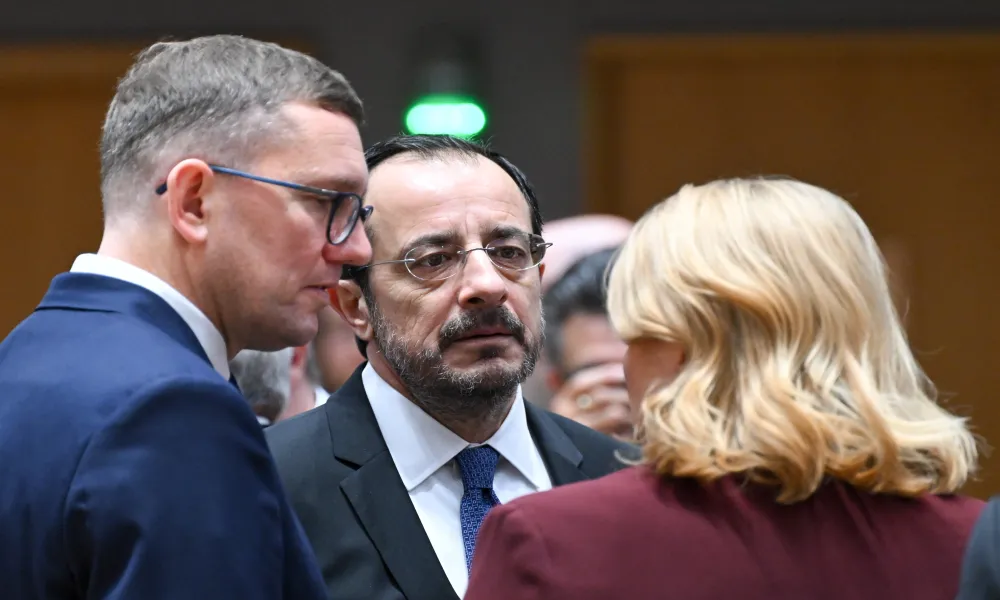
President Nikos Christodoulides, stressed the importance of de-escalating the crisis in the Middle East, noting in an interview with Bloomberg TV on Fridat the need for coordination between the European Union, countries of the region, the United States and third countries, to achieve a ceasefire through diplomatic means.
If de-escalation is not achieved, the consequences will be serious, he said, proposing, among other things, the creation of a “coalition of the willing” to present a de-escalation plan.
NATO unfeasible
Speaking to Bloomberg TV a day after the European Council Summit in Brussels, Christodoulides also referred to relations with the United Kingdom and the British Bases in Cyprus, stating that Nicosia and London need to discuss the issue. On the prospect of joining NATO, he said that if it were possible, Cyprus would be ready to apply, “but it is not feasible.”
Asked how the crisis is affecting Cyprus’ and the EU’s defence strategy, the President noted that “we are part of the region. We are not involved in the war, in this crisis, in any way. My country remains a stable, safe and fully operational hub for business, investment and tourism. We know the region because of our geography and our diplomatic relations with all countries in the region - we do not know it from textbooks - and we bring that perspective to the Europeans.”
Referring to the response of EU member states, he said that “for the first time, we saw European Union solidarity in action. Greece, France, Italy, the Netherlands, Spain reacted immediately to my request and, without triggering Article 42.7, we tested it, and we tested it successfully.” He added that “we need to see how we will give substance to Article 42.7, what we will do in case a member state activates this article.”
Ceasefire necessary
On the EU’s role in the Middle East and the Strait of Hormuz, the President stressed the need for the European Union to play an active role in the region. “Before coming to Brussels, I was in contact by phone with leaders of the region, the Gulf and the Middle East. The countries of the region expect an initiative from the European Union” Christodoulides underlined, insisting on the need for de-escalation. “We need to focus on how we de-escalate. Now is the time for leadership and unity. It is also an opportunity for transatlantic relations. We need to work together, the EU, the United States and the countries of the region, to present a de-escalation initiative,” he stressed.
Asked about the type of initiative the EU should take, as well as the proposal by French President Emmanuel Macron regarding the possible provision of security for navigation, the President of the Republic replied that “we need a diplomatic initiative to achieve a ceasefire - all member states, the countries of the region, the United States, third countries. We need to work together and present something tangible on the table in order to achieve a ceasefire and then discuss the remaining issues.”
Referring to the prospect of Cyprus joining NATO, he noted that “if it were possible for Cyprus to join NATO tomorrow, there is no doubt, we are ready to apply. But it is not possible, and we do not want to apply just to receive a veto from Turkey.” The President also expressed his disagreement with NATO Secretary General Mark Rutte regarding the autonomy of the European Union in security and defence. “It is possible, and it was tested in Cyprus through the response we received from the countries I mentioned earlier, that European defence and security are achievable. And having a strong European defence and security dimension is also helpful for NATO, it is also helpful for the US, it is not something against NATO or against the US.”
British bases 'need to be discussed'
Regarding the issue of the British Bases and relations with the United Kingdom, he said that Cyprus “has excellent relations with the UK government,” noting as an example that Prime Minister Keir Starmer visited Cyprus, the first such visit in 53 years. However, while noting that there is a strategic dialogue and close cooperation, he added that “we are working very closely together, but the issue of the British bases is something we need to discuss. We all understand that the bases in Cyprus are a consequence of the colonial period. We have more than 10,000 Cypriot citizens in the British bases. We have responsibility for these people, for their safety and their well-being, and when this situation is over, we need to have a frank and open discussion with the British government regarding the future of the bases.”
On whether the presence of the bases could make Cyprus a target, the President stressed that “in Cyprus we had a single incident that targeted the British Bases. Cyprus was not attacked, Cyprus is not part of the crisis,” adding that he had already discussed certain developments with the British Prime Minister. “We did not like certain handling of the situation, and when the crisis is over, we need to put everything on the table and decide together on the future of the bases” he said.
Serious consequences over war with Iran
Regarding the impact of the crisis with Iran, the President assessed that “all countries will be negatively affected if the situation continues. If there is no de-escalation, the consequences will be serious - for the economy, tourism, trade, energy,” while proposing coordinated action. “We need to turn this crisis into an opportunity and create, if I may say, a coalition of the willing to present a plan for de-escalation” he said.
On energy and decisions taken at leaders’ level during Thursday’s Summit, the President said that leaders discussed “a number of measures that need to be targeted and temporary,” noting that these go beyond the ETS. “That is why last night we decided to return to the issue in June in order to assess the situation” he added.
On a possible gas price cap, the President said that “this is an option,” but also stressed “the need to take into account that each country has a different energy mix,” and that “there cannot be a single approach for all.”
Dealing with Russia
On Ukraine, Russia and European unity, the President disagreed with Hungarian Prime Minister Viktor Orbán regarding the €90 billion package agreed at the December European Council. “I do not agree with my very good friend Viktor and his position on the €90 billion.”
“You understand that the message we send, if we take decisions at leaders’ level and at the European Council and do not implement them, negatively affects our credibility. I firmly believe there are no deadlocks in diplomacy — we will find a way to implement what we have decided,” he stressed.
Asked about EU–Russia relations and the debate raised by Belgian Prime Minister Bart De Wever, President Christodoulides underlined the need for a unified EU stance. “I discussed the issue yesterday with the Belgian Prime Minister. We all have specific thoughts on how to approach Russia. What we need to do is discuss this at the level of the 27, have a common approach and send a common message to Russia regarding the way forward” he noted.
This is because, according to the President, “if all 27 publicly position themselves differently on how we approach Russia, this is negative for the European Union. Therefore, we need to have this discussion at the level of the European Council, agree on a common approach and follow it.”
Source: CNA