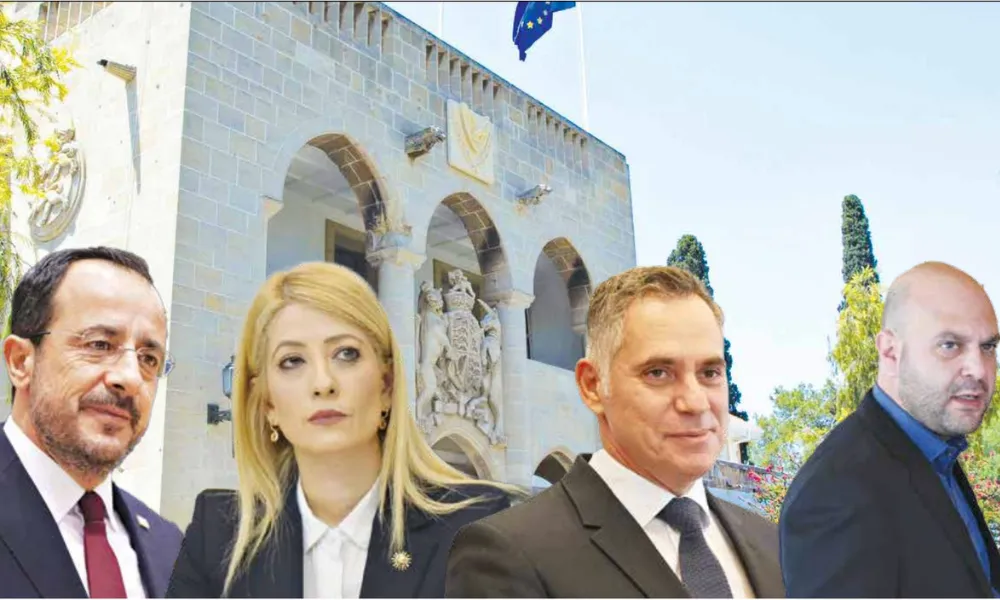

According to information obtained by Politis, warnings from European People’s Party President Manfred Weber that the continuing impression that ELAM is Nikos Christodoulides’ closest interlocutor is creating serious problems and would make it impossible for him to remain accepted within the ranks of the European centre-right.
Five weeks before the parliamentary elections, the simmering crisis in the Cypriot political system, combined with the fluid party landscape, is creating an interesting and perhaps unprecedented political environment. Within this flow of developments, it is clear that the day after the elections will shape not only how both traditional and newer parties emerge from the contest, and how they will navigate the new realities, but also how they will be forced to position themselves in the next electoral process in 2028.
In recent days, scenarios have multiplied, including reports by AlphaNews, about the need to form a new governing arrangement after the elections, with the participation of DISY and DIKO, provided of course that the result is such that a form of influence can be maintained and attached to the so-called centre-right formation.
Moves
This scenario is clearly not merely part of the Executive’s reflections. It is a line of thinking that has almost taken the shape of a full plan on the part of the President and his associates.
Based on the current data, it is clear that Nikos Christodoulides’ stated stance toward the possibility of rapprochement with DISY is not simply a tactical move of the moment, but part of a broader strategic design with a horizon set on 2028. It is a political equation with multiple variables, involving internal balances, electoral data, European alliances and, obviously, the need for political legitimacy without “baggage”.
At this stage, the President appears to be balancing within what one might call a triangular support structure, involving DISY, mainly through its stance in the House, DIKO, and, at a more controversial level, ELAM. His effort to project himself as the representative of the centre-right is a conscious attempt to bridge different audiences and build a broader political base. However, this strategy contains contradictions, particularly when the approach toward ELAM, the party that until recently was the President’s privileged interlocutor, creates friction both domestically, where it remains a point of reference in his rivalry with DISY, and externally.
Avoiding being “tainted”
According to political assessments and behind-the-scenes information, the ideal scenario for the President after the parliamentary elections would be the formation of a government in which DISY would participate actively, even with a significant number of ministries. At the same time, relations with DIKO would be maintained, while ELAM would provide silent or selective support.
Such an arrangement would give Christodoulides three critical advantages: stability in the House, broad political legitimacy, and above all a strong electoral base ahead of 2028. However, the implementation of this scenario faces serious obstacles, the main one being DISY’s stance, which has so far consistently rejected any possibility of joining the government.
This is where the President’s core dilemma becomes clear: how he can make electoral use of ELAM’s momentum without being politically “tainted” by close cooperation with it. The answer lies mainly at the European level. His inclusion in, or continued acceptance by, the European People’s Party (EPP) is a critical factor for his international image and influence. According to information obtained by Politis, warnings from Manfred Weber that the continuation of the impression that ELAM is Christodoulides’ closest interlocutor is creating serious problems and will make his continued acceptance within the European centre-right impossible. Clearly, DISY’s role was and remains important in creating pressure on the President.
In practical terms, this means that Christodoulides risks finding himself politically isolated at European level or pushed toward more populist and marginal political groups. For a President who invests in the image of a reliable European leader, as he wishes to present himself, such a prospect would be deeply negative. That is the concern occupying Nikos Christodoulides at this moment.
A new attempt
Returning to Christodoulides’ tactics, it should be recalled that the effort to reapproach DISY is not new. As early as 2023, after the presidential election and Averof Neophytou’s elimination from the first round, Christodoulides had publicly called for the party to participate in government. The response from the leadership, under Annita Demetriou, was negative and categorical.
Other attempts followed, both through behind-the-scenes contacts and in connection with the reshuffle last year, but without result. Today, the President appears to be preparing a “last” move after the parliamentary elections. This time, however, his approach is based not only on political arguments but also on electoral calculations.
Interest-based calculations
More specifically, he is betting on the possibility of a negative result for DISY. If the party declines significantly, especially if it falls below the psychological threshold of 23%, this could trigger internal turbulence, possibly even a challenge to the leadership. In such an environment, Christodoulides is believed to think that more favourable conditions would emerge to pressure the party into participating, or being drawn into, a governing arrangement as a means of regaining political influence.
According to information, approaches have already been made to specific DISY figures regarding the possibility of their participation in a future government.
The willing are not enough
The information held by Politis is that there are already individuals who do not reject such a prospect in order to be part of governance, even if this does not happen through DISY’s official participation. However, the response remains limited and has not created momentum, since the internal party majority remains firmly opposed to any scenario involving participation in Christodoulides’ government.
Around 65% of the party appears to stand against Christodoulides, while around 30% maintains a more positive stance. This percentage is also reflected in a special survey published today by Politis regarding the performance of ten figures in relation to the prospect of the presidential elections.
On this basis, if DISY manages to maintain a strong electoral performance, the line of autonomy will be reinforced and any cooperation will become even more difficult. If, on the other hand, the party declines, it could be pushed into internal crisis or even a split, creating an unstable and unpredictable political environment. In that case, participation in a government arrangement, which Nikos Christodoulides appears more ready than ever to compose after the elections, would acquire a different dynamic.
Parliamentary equation
Beyond presidential ambitions, the President is also called on to manage the immediate challenge of governance. Estimates regarding the composition of the new House suggest that a strong opposition bloc may emerge, making it more difficult to pass government bills.
In this context, cooperation with DISY acquires a practical dimension as well. It is not merely a strategic option with a view to 2028, but also a necessity linked to the day-to-day functioning of government. Securing parliamentary support is critical for implementing the government’s programme and maintaining political stability.
Scenarios for the day after
Election night is expected to be a turning point for all sides. If DISY manages to maintain a result above 23%, the current leadership and opposition line will be reinforced, making any rapprochement difficult.
By contrast, a lower percentage or the loss of first place could open the way for internal changes and a redefinition of the party’s strategy. In such a scenario, Christodoulides would attempt to use the moment to advance cooperation.
Nikos Christodoulides’ effort to bring DISY into government is not a simple political choice, but a necessity arising from the convergence of internal and external pressures. The need to avoid identification with ELAM, maintain relations with the EPP, and secure parliamentary stability makes cooperation with DISY almost a one-way street.
Based, therefore, on the conditions that will be created after the parliamentary elections, Christodoulides may once again, and for one more time, “knock on the door” of Pindarou.