
Speaking in an interview with Politis Radio, Education Minister Athena Michaelidou said the ministry planned to return to the bicommunal education programme Imagine in January, following modifications introduced to address concerns raised in recent years.
Michaelidou described Imagine as an important initiative whose aim “remains essential”, adding that the changes made were meant to ensure broad acceptance and clarity regarding its objectives.
The programme
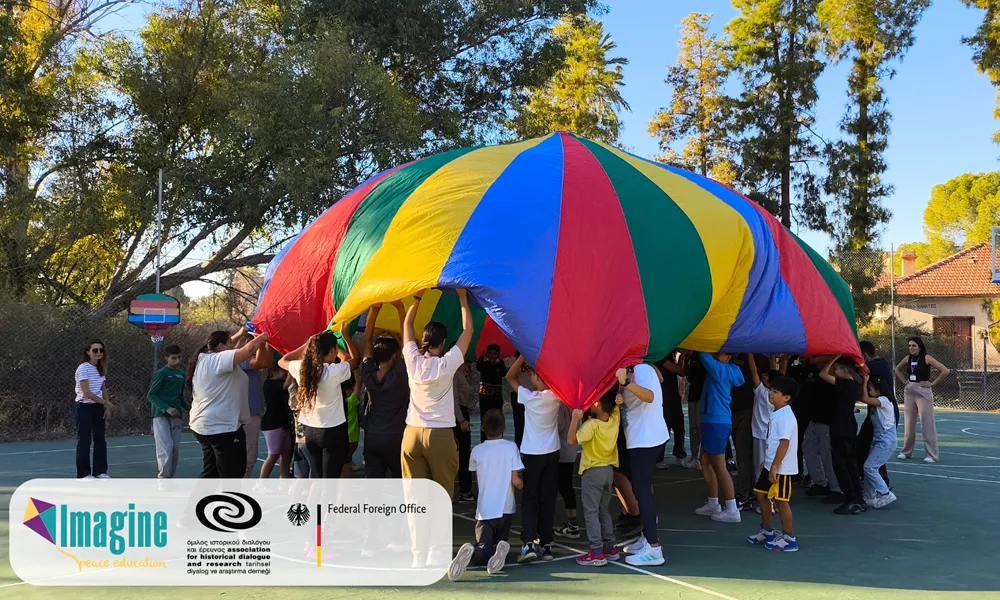
The bicommunal programme Imagine is an official confidence-building measure implemented by the Association for Historical Dialogue and Research (AHDR) under the auspices of the Bicommunal Technical Committee on Education, with funding from the German Federal Foreign Office.
Launched in 2016, it engages young learners and educators through educational workshops and trainings in different themes related to peace, anti-racism and human rights. It involves mono-communal visits to schools on both sides, followed by intercommunal workshops in the buffer zone. All activities are voluntary and require parental consent.
More than 8,000 students and 2,500 teachers have taken part in Imagine since its launch, making it one of the most successful bicommunal educational initiatives on the island.
The history
Previously, the education authorities on both sides would issue circulars to schools, inviting teachers and pupils to declare their interest to participate in the Imagine workshops – always with parental consent – during school hours. The workshops were on a purely voluntary basis. According to AHDR, the vast majority of parents, 94%, would give their consent for their child to participate.
Study visits to the other side of the dividing line were also organised during school hours on a voluntary basis, showing pupils parts of old Nicosia for example, or other places of cultural and historical significance.
In 2022, then Turkish Cypriot leader Ersin Tatar pulled out of Imagine, blocking Turkish Cypriot schools, pupils and teachers from formally engaging in the programme.
AHDR continued engaging with Turkish Cypriot teachers for training and school children for non-formal education activities in afternoons and on weekends. But the intercommunal component of bringing school children together during school hours stopped.
The association also continued mono-communal engagement with Greek Cypriot schools, with the authorisation of the Education Ministry.
However, in March 2025, the chair of the House Education Committee Pavlos Mylonas, a DIKO MP, along with members of ELAM raised the issue of Imagine, objecting to the ‘excursions’ across the divide, with some even calling for the education minister’s resignation.
Come September 2025 and the education minister did not issue the usual circular inviting teachers and pupils to express their interest in participation, thereby preventing schools from formally participating in the programme.
The present
Last week, also speaking on Politis Radio, Michalinos Zembylas, co-chair of the Bi-communal Technical Committee on Education, voiced serious concerns over the absence of this year’s circular from the Education Ministry, which would allow the programme to continue during school hours.
He argued this pointed to a lack of political will and would likely have repercussions both for the credibility of the Greek Cypriot side with the United Nations, where Imagine is recorded as a successful confidence-building measure (CBM), and for the ability of the two communities to prepare the younger generation for future coexistence.
The future
Following the minister's claim that the programme will come back to the school agenda in January, it remains to be seen if and when Turkish Cypriot leader Tufan Erhürman will give the go-ahead for the Turkish Cypriot schools to also return to the highly successful programme.