
Six months into the new school year, the Education Ministry issued a circular on Wednesday, allowing schools, pupils and educators to participate in the peace education programme ‘Imagine’ for the remainder of the school year.
The circular opens the door for participation on a voluntary basis in the programmes implemented by the Association for Historical Dialogue and Research (AHDR), either on school premises or in the Ledra Palace area.
This comes after mounting criticism from within both communities for and against peace education activities that were supposed to be of an intercommunal nature. The Turkish Cypriot leadership opted out of joint peace education activities in 2022 when Ersin Tatar pulled his community out of the programme.
Despite that, AHDR continued activities where possible, both mono-communal and intercommunal, on a voluntary basis, during school hours – covered by a ministry circular issued at the start of each school year – and at weekends. Except in September 2025, when the Education Ministry appeared to get cold feet and failed to issue the relevant circular. This followed grumblings from certain political quarters – mainly DIKO and ELAM –questioning the propriety of Greek Cypriot pupils crossing north on study exchanges, even if this was outside school hours and on a voluntary basis.
As such, the award-winning and highly successful ‘Imagine’ programme, launched in 2017 under the auspices of the bicommunal Technical Committee on Education, has not been implemented in its original format since 2022.
Meanwhile, incumbent Turkish Cypriot leader Tufan Erhürman has yet to seek a return to the intercommunal programme, despite receiving a strong endorsement of his pro-peace agenda last October when he won the leadership race in the first round.
Urgent action needed
The latest report of the Office of the UN High Commissioner for Human Rights (OHCHR) released last month, covering the period from December 2024 to November 2025, called for “urgent action” to be taken.
“Urgent action remains imperative to address the lack of progress over many years in promoting peace education in Cyprus, which holds the potential to transform Cypriot society, given the important role that children can play, including as future leaders, in advancing social inclusion and cohesion as essential components to ensure the success and sustainability of peacebuilding efforts,” said the report.
It noted that during the reporting period, and despite repeated calls by the UN Security Council and the Secretary-General, “there had been no progress in promoting peace education across the island, including with respect to jointly reviewing school materials and implementing the recommendations in the 2017 joint report of the Technical Committee on Education.”
The report added that as a result of the lack of progress in advancing peace education, divisive narratives related to 1963/64 and 1974 continued “to be perpetuated in schools across the island”.
OHCHR also “regrets that the Turkish Cypriot authorities have still not resumed their support for the award-winning ‘Imagine’ project,” said the report.
“This peace education project is the only mechanism in Cyprus that has successfully brought together more than 8,000 students and 2,560 teachers from both communities, building trust.”
The human rights report referred specifically to the fact that the Education Ministry had not – at the time of writing – issued a circular on the ‘Imagine’ project due to “attacks” in February and March 2025 by some MPs and political parties who used “divisive narratives and misinformation to attack and politicize the exchange of study visits between students from both communities organized under the ‘Imagine’ project”.
The report noted, however, that other MPs, teachers and civil society actors sought to counter such narratives by expressing overwhelming support for the project.
Ministry returns to ‘Imagine’
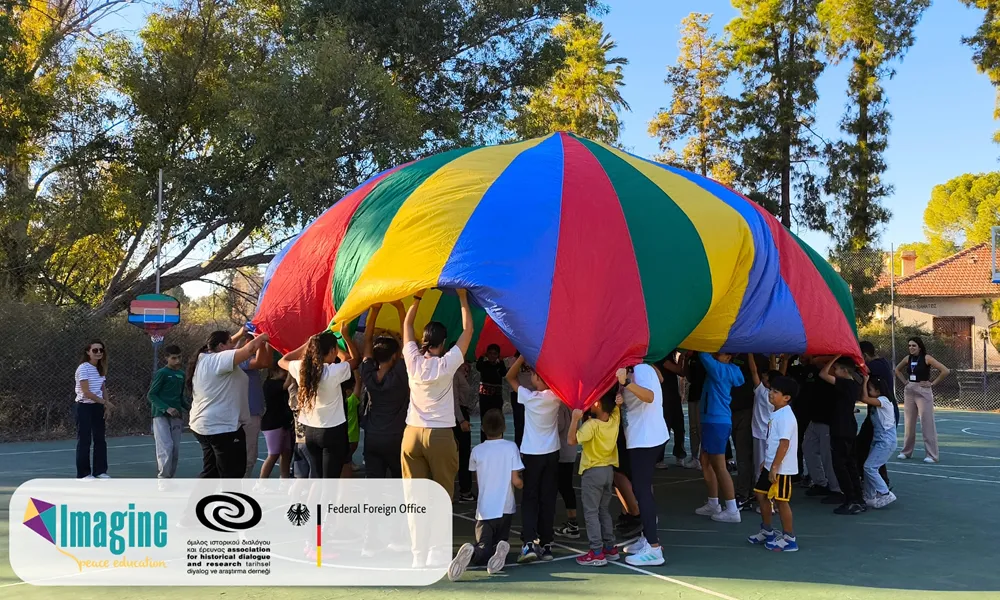
With the circular now issued, training activities for pupils will be organised during school hours, and workshops and a bicommunal conference for teachers will take place outside school hours.
Activities include anti-racism workshops for secondary school pupils, aiming to strengthen contact between Cyprus’ communities and promote peace, understanding and anti‑racism on the island.
The workshops are separated into two stages, starting with preparatory workshops at the school premises, creating a safe environment for discussions on stereotypes, discrimination and racism, followed by visits to the Home for Cooperation in the Ledra Palace area where pupils are supposed to meet their Turkish Cypriot counterparts – subject to the programme’s implementation in its original format.
Other activities include educational walks within the Nicosia Walls where pupils get to explore the history of the city and its communities. The walks at present do not entail crossing the checkpoints.
AHDR also offers workshops for pre-primary, primary and secondary/technical education teachers on themes relating to ‘Education for a Culture of Peace and Non‑Violence’ and ‘Anti‑Racist Education’. A bicommunal Teachers’ Academy for Peace will also be held, providing training for educators on designing lesson plans related to Peace Education.
The ‘Imagine’ programme is funded by the Foreign Office of the Federal Republic of Germany.