
Turkey has submitted a new letter to the United Nations dated 16 February 2026, reiterating its positions on Cyprus and maritime zones in the Eastern Mediterranean. Greek diplomatic sources said the content was largely expected and confirmed that Athens will respond formally.
The letter was filed by Turkey’s Permanent Representative to the UN, Ahmet Yıldız, and references a series of previous communications by Libya, Greece, Egypt and Cyprus.
Representation of Cyprus raised again
On the Cyprus issue, Turkey argues that “there is no authority legally or in practice competent to jointly represent Turkish Cypriots and Greek Cypriots, as well as the island of Cyprus as a whole”.
Ankara refers to earlier correspondence, including a letter dated 28 December 2024, in which it sets out what it describes as the positions of Turkey and the Turkish Cypriot side.
Maritime zones and previous UN submissions
Turkey reiterates its claims regarding maritime boundaries in the Eastern Mediterranean, stating that it has deposited with the UN the outer limits of parts of its maritime jurisdiction based on what it describes as ipso facto and ab initio legal and sovereign rights.
The letter cites a series of notes and communications submitted between 2004 and 2020, including the 18 March 2020 notification of the outer limits of the Turkish continental shelf in the Eastern Mediterranean.
Ankara maintains that part of this shelf was delimited through the 21 September 2011 continental shelf agreement with what it refers to as the “Turkish Republic of Northern Cyprus”, submitted to the UN on 25 April 2014. Another part, it states, was delimited through the 27 November 2019 memorandum of understanding with Libya’s Government of National Accord, which entered into force on 8 December 2019 and was registered with the UN Secretariat under Article 102 of the UN Charter.
Dispute over island rights
The Turkish letter argues that maritime delimitation must be based on equity and the objective of achieving a fair solution. It contends that Greek and Cypriot positions granting islands full maritime effect disregard relevant circumstances and international case law.
Ankara refers to arbitral and International Court of Justice decisions, including the 1977 France–United Kingdom case, the 2009 Romania–Ukraine judgment and the 2012 Nicaragua–Colombia ruling, noting that in some cases islands were given reduced effect or were not fully considered.
Turkey accuses Greece of selective interpretation of the Law of the Sea and of advancing what it calls excessive maritime claims, including through diplomatic notes submitted in August and September 2025.
Objections to Greece–Egypt agreement and maritime planning
Ankara reiterates its view that the 6 August 2020 Greece–Egypt exclusive economic zone agreement is invalid, alleging that it infringes Turkey’s continental shelf rights. It also defends the validity of its memoranda with Libya, including a 3 October 2022 hydrocarbons cooperation agreement and a 25 June 2025 memorandum between Türkiye Petrolleri Anonim Ortaklığı and Libya’s National Oil Corporation.
The letter further criticises Greece’s Maritime Spatial Planning announcement of 16 April 2025, claiming that certain designated areas overlap with Turkish maritime jurisdiction in the Aegean and Eastern Mediterranean. Turkey states that unilateral actions and domestic legislation cannot create legal consequences for third states.
Ankara calls for dialogue
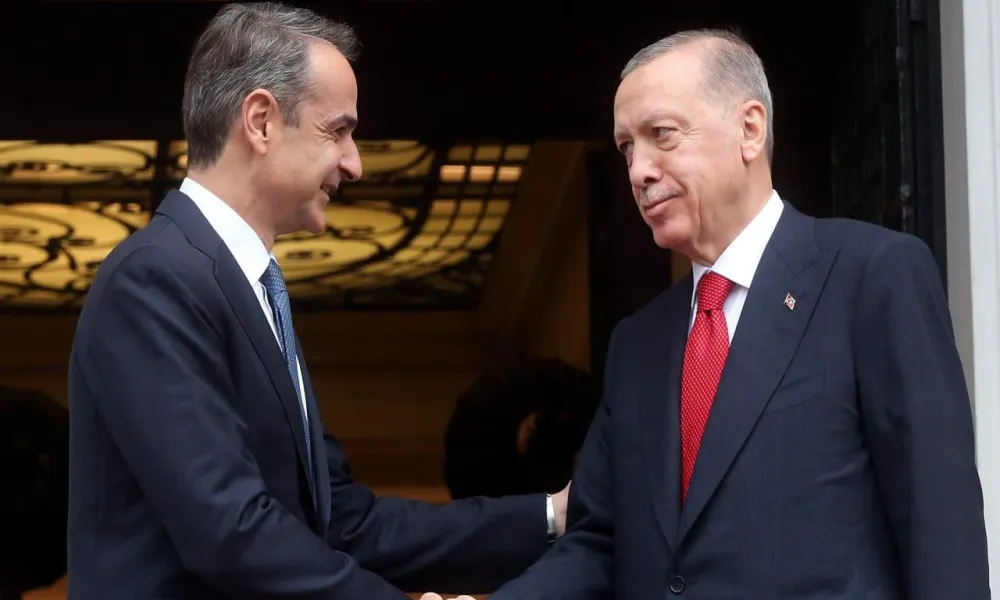
Turkey declares readiness for what it describes as a fair, equitable and peaceful resolution of outstanding issues, including maritime delimitation with coastal states it recognises, in accordance with international law. It also refers to the Athens Declaration of 7 December 2023 signed by President Recep Tayyip Erdoğan and Prime Minister Kyriakos Mitsotakis.
Athens rejects the claims
Greek diplomatic sources rejected the content of the letter, describing it as based on arbitrary interpretations of international law, particularly the Law of the Sea.
Athens notes that Turkey continues not to recognise the Republic of Cyprus, a member state of both the European Union and the United Nations. It underlines that repetition of legally unfounded claims does not confer validity or produce legal effects.
According to Greek sources, islands are entitled to full maritime zones under the Law of the Sea, including in the delimitation of continental shelf and exclusive economic zones between states with adjacent or opposite coasts. They add that Turkey should align with international law in the interest of good neighbourly relations and regional stability.
Source: CNN.gr