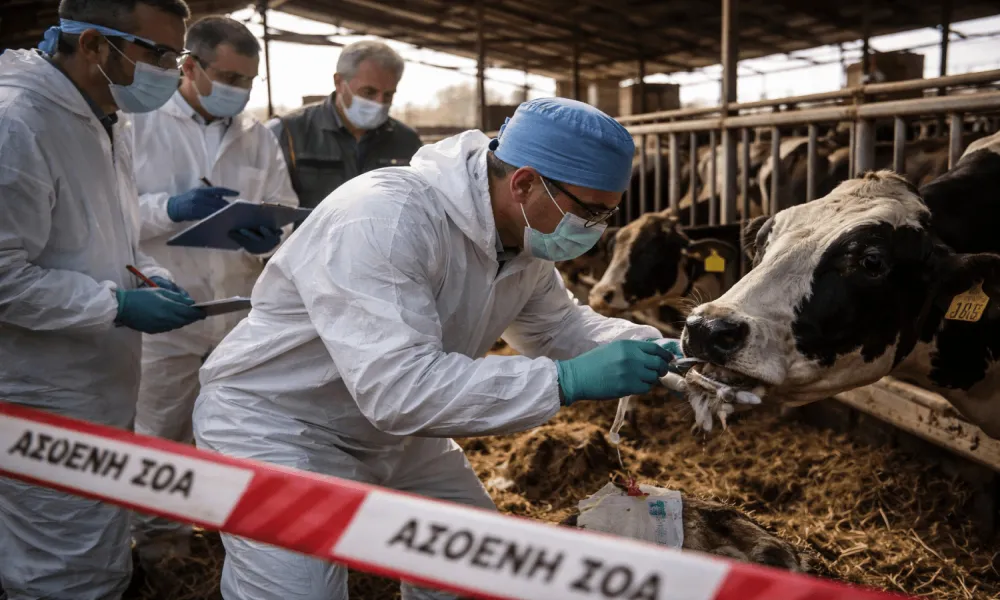

Cyprus is racing to contain a growing foot-and-mouth disease crisis after gaps in prevention and delayed response allowed the virus to spread to dozens of livestock farms, raising concerns about economic fallout and potential risks for halloumi exports.
The warning comes as European Commissioner for Health and Animal Welfare Oliver Várhelyi visited Cyprus on Friday and stressed that EU protocols for tackling the outbreak must be fully implemented.
According to officials, there can be no relaxation of the requirement for mass culling in infected livestock units, a key measure under EU disease-control rules aimed at preventing wider transmission.
Authorities hope that strict implementation of the measures will stabilise the situation and allow the sector to recover after one of the most dangerous animal diseases globally.
Containment remains the priority
“The most critical issue right now, and the ideal scenario, is for the infection to remain limited to the Larnaca district,” said Dr George Nikolaou, clinical assistant professor of veterinary pathology at University of Nicosia.
Nikolaou is a member of the seven-person epidemiological advisory team established by the Ministry of Agriculture to manage the crisis and previously worked in the Veterinary Services.
“If we manage that, we might be able to convince the European Commission that Cyprus has only one infected zone, Larnaca, while the rest of the island remains disease-free,” he told Politis.
Risks for halloumi exports
If the virus spreads further, however, the consequences could be severe.
“In that case the entire island could be declared infected,” Nikolaou warned.
The first immediate impact has already been felt in the pork sector, where exports have been halted in line with EU health regulations. But the longer-term concern involves halloumi, Cyprus’ most valuable agricultural export and a product protected as Halloumi PDO within the European Union.
Even though the cheese undergoes heating during production, which experts say eliminates the virus, Nikolaou said political decisions in other countries could still affect trade.
“We may say, and I believe it myself, that the heating process eliminates the risk. But tell me, which agriculture minister in another country that competes with Cyprus would not find an excuse to restrict imports?” he said.
Cyprus has already fought legal battles to protect the halloumi PDO designation, including disputes with producers in Denmark producing similar white cheeses.

Outbreak already affecting farms
The outbreak has so far spread to 38 livestock units, with approximately 14,000 animals culled, according to the Veterinary Services. Authorities estimate that the total number of animals slated for culling may exceed 20,000.
Mass culling of infected herds, though controversial, is considered necessary to reduce the viral load and prevent wider transmission. At the same time, a nationwide vaccination campaign is underway in an attempt to stop the disease spreading further across the island. Cyprus ultimately hopes to regain its previous status as a “disease-free country without vaccination”, a classification important for international trade.
“If we instead remain classified as an infected country that relies on vaccination, the long-term impact on trade will be significant,” Nikolaou said.
Prevention failures
Experts say the crisis could have been mitigated had stronger preventive measures been implemented earlier. Warning signs appeared in December when cases of foot-and-mouth disease were confirmed in the island’s northern areas. However, according to Nikolaou, monitoring along the Green Line, awareness among farmers and inspections of livestock units near the buffer zone proved insufficient.
As a result, authorities responded to the outbreak roughly two weeks later than they should have, allowing the virus time to spread. Emergency preparedness also appeared lacking.
“Emergency plans existed, but they were clearly not updated,” he said, noting that during the crisis authorities had to determine basic logistics such as burial sites for culled animals and operational responsibilities.
Speed of response crucial
Nikolaou compared the situation with an outbreak in Hungary last year, where authorities responded within hours. “In Hungary, veterinary services intervened within eight hours of the first confirmed cases,” he said. “In Cyprus it took more than 14 days.”
He stressed that the delay was not due to negligence by veterinarians or farmers but rather insufficient communication and training on biosecurity measures. Farmers must be regularly informed about disease risks and required to report suspicious symptoms immediately, he added.
Biosecurity culture gap
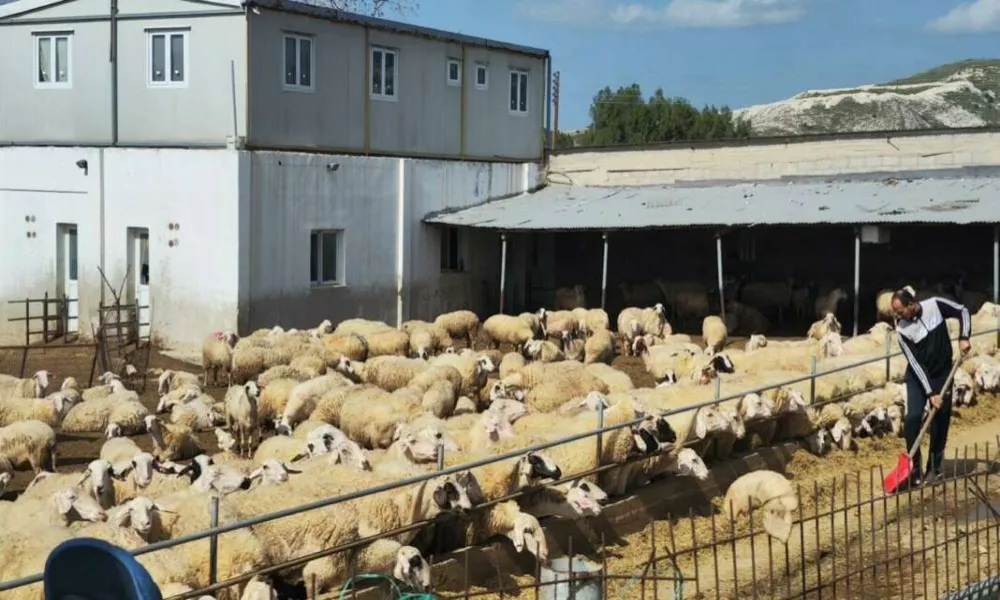
Another structural weakness identified by experts is the lack of biosecurity culture in Cyprus’ livestock sector.
In countries with strict biosecurity standards, such as Hungary, visitors to farms must shower and change clothing before entering livestock facilities.
“In Cyprus anyone can enter a farm, drink coffee and leave without anyone worrying,” Nikolaou said.
Occupied areas complicate response
Cyprus also faces unique challenges due to the island’s political division. Livestock units are densely concentrated in certain areas, allowing viruses to spread quickly once introduced. In addition, the northern part of the island follows different veterinary strategies, including mass vaccination rather than culling. Animal feed and livestock are also imported from Turkey.
According to Nikolaou, this issue cannot be solved by veterinarians alone and requires political coordination. He also noted that Turkish Cypriot veterinarians themselves have expressed serious concerns about imports of hay from Turkey.
“There are rumours that hay imported into the north may have reached the free areas through illegal trade,” he said.
Laboratory risks and research impact
The outbreak is also affecting veterinary research in Cyprus. If the country is officially classified as infected, laboratories abroad may refuse to accept animal tissue samples from Cyprus for research.
Nikolaou noted that laboratory accidents have previously caused outbreaks, citing the 2007 foot-and-mouth incident in the United Kingdom, which originated from a laboratory facility.
“For that reason, foreign laboratories are extremely cautious about accepting samples from infected countries,” he said.
For now, Cyprus’ main objective remains clear: contain the outbreak within a single region before the economic and agricultural damage spreads further.