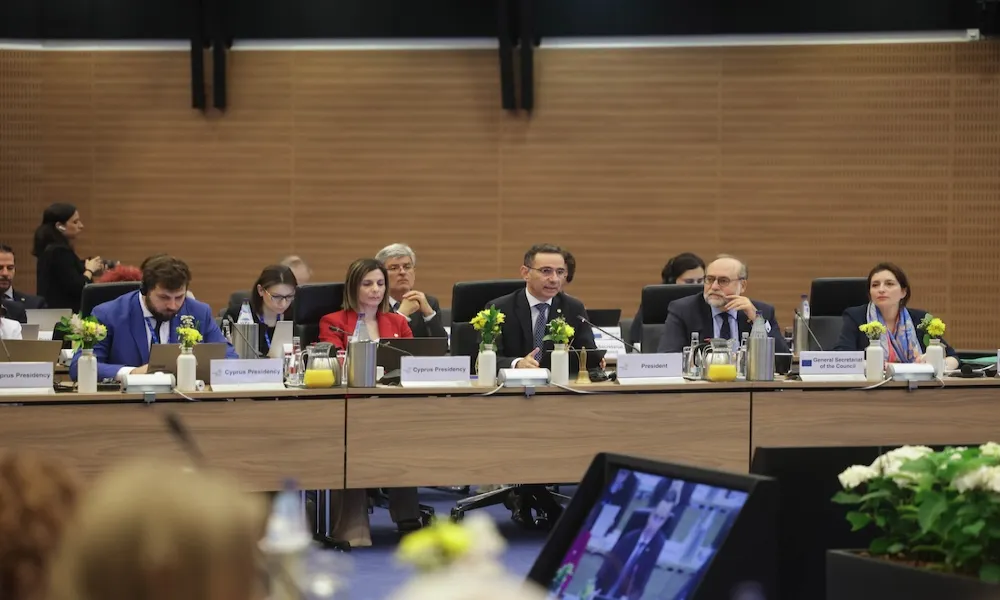
EU member states agree on the need for faster and more coordinated action, officials said after an informal meeting of telecoms and digital policy ministers in Nicosia held under the Cypriot presidency.
Cyprus' Deputy Minister for Research, Innovation and Digital Policy, Nikodemos Damianou, and European Commission Executive Vice-President Henna Virkkunen said discussions focused on accelerating artificial intelligence uptake, protecting children online and strengthening critical infrastructure.
“Our overall approach is the same - we want to be faster, more coherent and more effective,” Virkkunen told a press conference, adding that cooperation was key to delivering results.
From policy to reality
Damianou said the message from Nicosia was that Europe already has strategy and political will, but must now move to large-scale implementation.
“We need to focus on turning policy decisions into operational reality,” he said.
On artificial intelligence, ministers acknowledged strong foundations and progress, but stressed the need to accelerate deployment alongside investment in infrastructure, skills and data.
On child protection online, Damianou said the issue is of growing concern across Europe and requires urgent, coordinated action at EU level, not just nationally.
Challenges
He pointed to existing tools such as the Digital Services framework and AI legislation, stressing the need for alignment, including on issues such as the digital age of majority and technical safeguards like age verification.
He added that the challenge now is consistent and effective implementation, including ensuring platforms take responsibility.
Ministers also discussed protecting Europe’s critical infrastructure, with Damianou highlighting the need for stronger collective resilience in the face of evolving cyber threats.
“In an interconnected Europe, resilience is no longer sectoral - it is systemic,” he said, stressing the importance of coordination at EU level.
Virkkunen said three “defining issues” dominated talks: AI adoption, child protection and infrastructure resilience.
Helping businesses
She said investment in AI in the EU reached €20 billion last year, up 58%, and noted the development of 19 AI “factories” and 13 related hubs, with plans for further expansion.
The Commission is also working to simplify AI rules to help businesses comply, she added.
On implementation, she highlighted the “Apply AI” strategy aimed at boosting competitiveness in sectors such as pharmaceuticals, automotive and robotics.
She said €1 billion has already been mobilised to support AI uptake, including plans for a European network of AI-enabled centres for early detection and diagnosis of cancer and cardiovascular diseases.
Child safety
On child safety, Virkkunen said it remains a top priority, pointing to enforcement of digital services rules and action against cyberbullying.
She also referred to preliminary findings involving Meta, citing insufficient age verification and evidence that more than 10% of children under 13 use its platforms.
She added that the Commission is stepping up protections for users aged 13 to 18 and investigating platforms including TikTok over “addictive design”, as well as Snapchat and other sites.
On infrastructure, she warned of an increasingly complex environment of hybrid threats and stressed the need for coordinated risk assessment and resilience planning, including initiatives on cable security and drone detection.
China
Responding to a question on China’s reaction to EU cybersecurity rules, Virkkunen said all countries must take security seriously and assess risks to critical infrastructure.
“This does not always mean excluding companies entirely, but may involve measures such as data localisation requirements,” she said, adding that cases are assessed individually.
She noted that China also applies similar restrictions for security reasons.
Damianou, responding to a question on potential costs for Cyprus, said claims that the country’s telecom networks rely entirely on Chinese components are outdated.
“This is not about specific countries - it is a risk-based approach,” he said, adding that the challenge is to ensure measures are proportionate and do not overly burden providers or consumers.
He said discussions are ongoing and a final decision has yet to be reached.
CNA