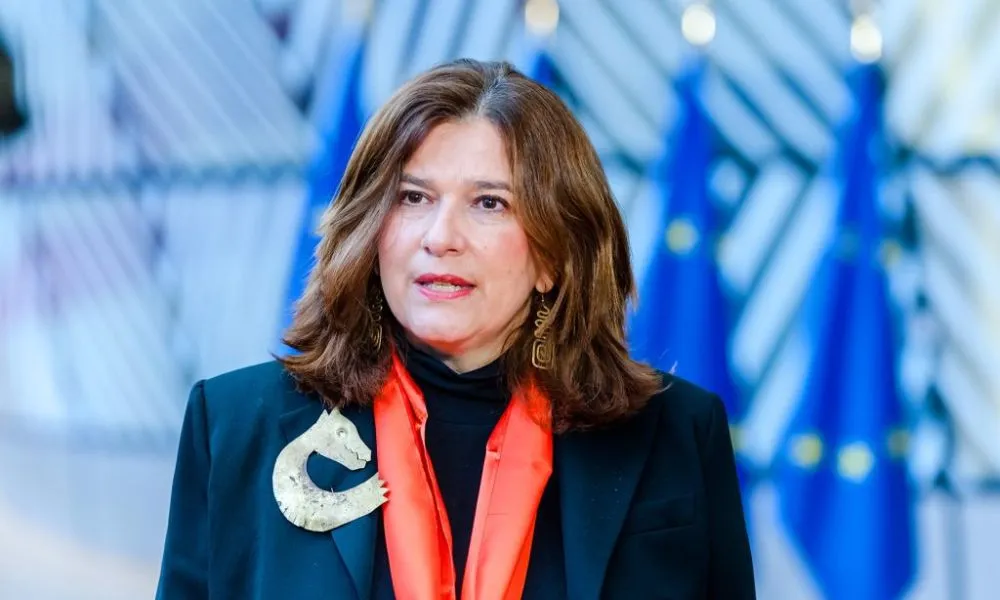

Cyprus is preparing to assume the Presidency of the Council of the European Union, and culture will take a central role in the months ahead. Speaking to the Cyprus News Agency (CNA) on the margins of the EU Ministers’ Council for Culture, Deputy Minister of Culture Dr Vasiliki Kassianidou described a European agenda that seeks to link the past with the future, creativity with innovation and identity with security.
Culture as Europe’s connecting thread
Dr Kassianidou emphasised that culture remains the “connecting link” between member states. Central to this vision is the new European programme “Agora EU”, a strategic initiative with a total budget of €8.5 billion.
The programme replaces and merges two major funding frameworks:
• Creative Europe
• Citizens, Equality, Rights and Values (CERV)
She stressed that the aim is not only financial support but a coordinated European investment in creativity, unity and democratic participation. Issues such as the illicit trafficking of cultural goods, which Cyprus has struggled with for decades, also remain high on the agenda.
Completing the work of the Presidency trio
Discussing Cyprus’ upcoming role, Dr Kassianidou underlined the responsibility of finalising or advancing key issues inherited from the Presidency trio of Poland, Denmark and Cyprus.
She noted that “the groundwork has already been laid, but now it is time for decisions to be completed or pushed forward in a substantial way.”
The €8.5 billion “Agora EU” budget is allocated as follows:
• €3.6 billion for CERV
• €1.8 billion for Creative Europe (Culture)
• €3.2 billion for Media+
This new programme will be linked to the Culture Compass, an initiative being developed by the Commissioner for Culture, Glenn Michalef. The Council is expected to approve the text endorsing the initiative as well as the Commission’s new motto: “Europe for Culture, Culture for Europe.”
Cyprus to promote cultural rights and fight illicit trafficking
Cyprus intends to place cultural rights and the fight against illicit trafficking at the forefront of the Presidency’s cultural priorities. Dr Kassianidou invited her European counterparts to an Informal Council of Ministers in Cyprus on 6 March 2026, where these issues will be spotlighted.
On illicit trafficking, she reminded that it remains “one of the great wounds of the Turkish invasion,” noting that 51 years later, Cyprus is still seeking the repatriation of stolen artefacts. She referred to the newly opened Byzantine Museum, which displays the repatriated Kanakaria mosaics and other looted frescoes, often returned in fragments after being illegally sold abroad.
She added that this challenge is now “very topical,” as Ukraine faces similar destruction of cultural heritage due to the Russian invasion. The Cypriot experience, she noted, shows that such losses are extremely difficult to rectify and require long-term commitment.
Artificial intelligence and protecting creators’ rights
Turning to artificial intelligence, Dr Kassianidou expressed concern about AI’s impact on the creative industries. She stressed the need to protect creators so that AI is used “as a tool, not as something that replaces actors or artists.”
She believes that EU-level legislation is necessary to safeguard rights such as voice, image, music and written work. But she also warned against overregulation that could place Europe at a disadvantage compared with countries like the United States or China.
She cited a current legal case in Poland in which an actor whose voice was replicated by AI cannot defend himself because “there is no legislation on which he can rely.” For this reason, she said, the EU must act quickly to establish a framework that protects creators without stifling innovation.
She also emphasised the need to prevent a digital divide: “We should not create two-speed countries, those that can keep pace with AI and those that risk falling behind.” Training and information programmes will play a key role.
Media freedom and journalist protection
Dr Kassianidou also referred to the growing discussion on truth, accuracy and safety within the media. She highlighted that “for the first time in decades, so many journalists have been lost in wars,” stressing the importance of protecting both journalists and free, reliable information.
Cyprus will place the European Media Freedom Act (MFA) at the centre of these discussions, particularly as it chairs the relevant Committee.
A Presidency focused on common goals
In closing, Dr Kassianidou underscored that the EU Presidency is “a dynamic process” whose purpose is to coordinate, promote and advance common European priorities, not national ones. With culture, rights, innovation and security intertwined, Cyprus aims to place culture firmly at the forefront of Europe’s political agenda.