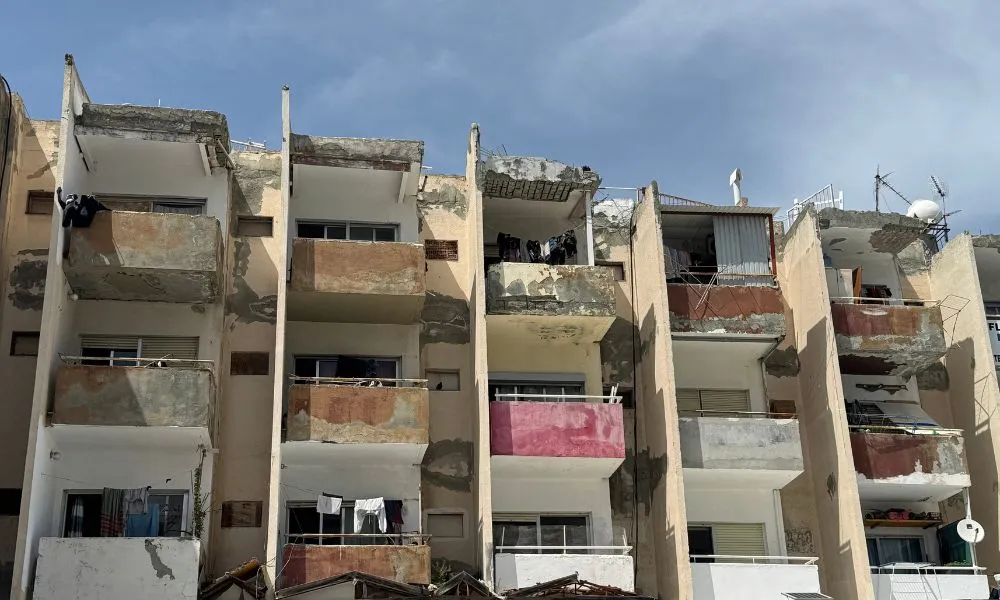

Nearly three weeks after the Limassol tragedy that claimed the lives of two people, much has been said, but a core weakness remains. The way the state, its laws and its institutions operate is still unable to address the serious problem of dangerous buildings through swift procedures. In practice, despite assurances that “all the necessary tools are available”, a long road lies ahead before tangible results emerge.
A clear example is the Seagate apartment block in Germasogeia, which – in theory – should have been evacuated last Monday. To this day, however, the building remains fully occupied, with no clarity over if or when an evacuation will take place.
Politis contacted the relevant authorities to establish where the process currently stands and how the legislation is applied in practice. In essence, very little has happened so far. The District Local Government Organisation acknowledges the need for immediate evacuation but at the same time says its hands are tied.
At the building in question, warning signage was placed declaring it a dangerous structure, while owners and residents were formally notified that they must vacate the premises within three days. The evacuation notice was issued by the district authority on 17 April, with the deadline set for midnight on 20 April. As of today, it appears that no one has vacated the building.
Once the deadline expired, the district authority handed the case to a well-known Limassol law firm to initiate the procedure for securing an eviction order. The law firm is still reviewing the case file in order to submit the application properly, with the appropriate legal content. At the same time, the district authority used land registry records to trace the addresses of apartment owners, who will also be summoned to court, as an eviction order cannot be issued unilaterally.
In court, the lawyers handling the case are expected to base their arguments on technical reports prepared by the authority’s engineers. These reports are visual assessments rather than full structural studies, as a structural study would require time, the owner’s consent and tens of thousands of euros. Armed with these legal and technical arguments, the district authority – through its lawyers – will have to persuade the court to order the evacuation of the building.
A key factor is that a number of businesses operate on the ground floor of the apartment block, and these would be directly affected by any evacuation.
All the above is expected to take about another week to prepare. From that point on, it will be up to the court to decide whether to issue an evacuation order in a single hearing or whether further court appearances will be required.
In conclusion, the case highlights a familiar gap: theory is one thing and practice another, even in a matter that has drawn so much public attention. The necessary legal tools may exist, but activating them immediately appears anything but straightforward.