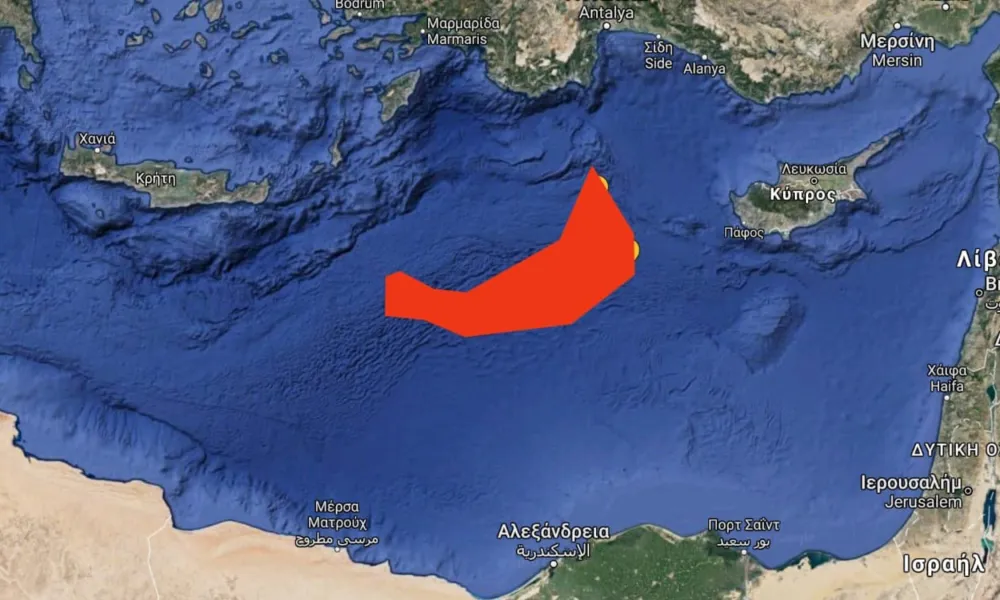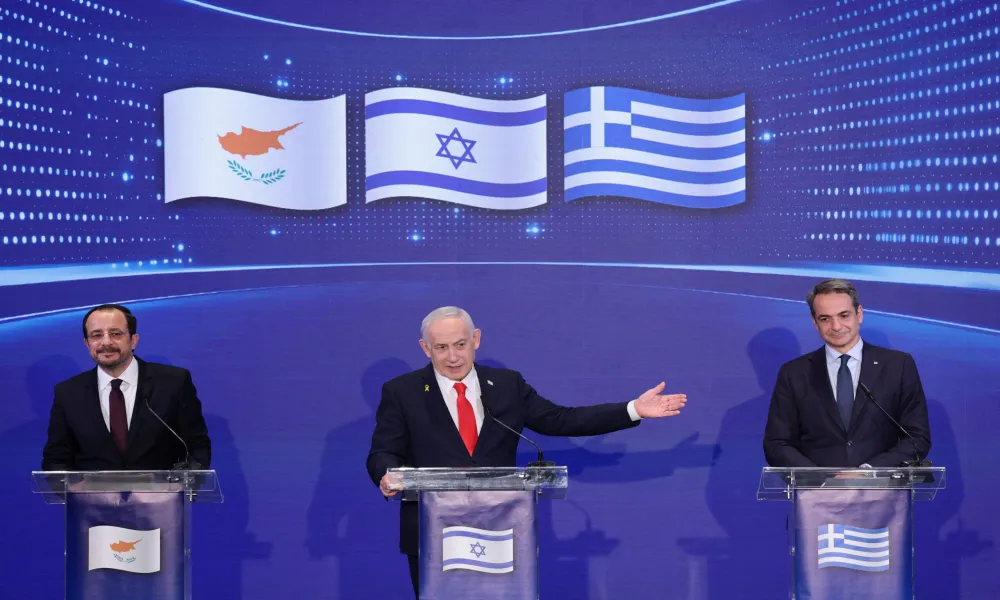

Just before Christmas, Cypriot President Nicos Christodoulides and Greek Prime Minister Kyriakos Mitsotakis travelled to Jerusalem on 22 December to sign a joint declaration with Israeli Prime Minister Benjamin Netanyahu, aimed at deepening defence and military cooperation. The so-called “trilateral declaration” was presented as a “Christmas gift” – positioning Israel as a counterbalance to Turkey. Media coverage focused on joint military planning, naval and air exercises, and the acquisition of weapons systems.
Israeli military sources told the Jerusalem Post on 28 December that a rapid response brigade would be formed, comprising 2,500 troops: 1,000 from Israel, 1,000 from Greece, and 500 from Cyprus. Senior officers were photographed signing a “joint military plan.”
Reuters reported on 29 December that the three countries are forming an alliance with Turkey as a regional counterweight. The declaration describes them as “like-minded” with an “unwavering commitment to deepen cooperation, strengthening the security and resilience of their countries for future generations.” The declaration assumes U.S. participation (3+1) and assigns the Cypriot EU Council Presidency the role of “enhancing relations between the EU and Israel and leveraging their potential as key partners.”
Paper tower
The trilateral declaration quickly collapsed. Speaking in Florida on 29 December, U.S. President Donald Trump stunned Netanyahu, putting a brake on Israel’s moves towards Turkey: “Erdogan is a very good friend of mine, and I respect him – and Bibi respects him – there will be no problem, I assure you!” The Trump administration clearly reads regional dynamics differently, dividing stabilising roles between Israel and Turkey. If Trump’s view prevails, the Cyprus-Greece-Israel alliance is effectively hollow. The U.S. does not support it.
The day after the trilateral meeting, Netanyahu recognised the so-called “Somaliland” state, drawing condemnation from the EU – a position that Cyprus aligned with on 30 December. The day before the trilateral, 12 EU countries, including France, Germany, Italy, Spain, and the Netherlands, condemned Netanyahu’s approval of 19 additional settlements in the West Bank. Cyprus, as EU Council President, did not reflect the EU27’s stance in its communications with Israel, which adopted Netanyahu’s maximalist positions.
Trump handles Netanyahu “in fits and starts,” while the EU condemns unilateral actions. The narrative of a security-focused alliance with Israel is contradicted by the facts.
Zero credibility
Aligning with Netanyahu undermines Cyprus’s credibility, which traditionally bases its diplomacy on peace – a two-state solution to the Palestinian issue, protecting state sovereignty (e.g., “TRNC” and Somaliland), and preventing demographic manipulation through settlements.
Christodoulides is well aware that the UN, with EU support, is working to restart negotiations. It is doubtful whether initiatives like the trilateral help the UN, after eight years of deadlock. It is possible the Cypriot president has other priorities despite public declarations. UN Secretary-General António Guterres continues to focus on the Cyprus-specific agenda left unresolved since Crans-Montana: security – with the abolition of unilateral intervention rights – and political equality between the island’s two communities. Diverting the UN agenda to Netanyahu’s Middle East interests is puzzling.
Why Mitsotakis echoes Netanyahu’s rhetoric remains unclear. Greek diplomacy is seeking a role amid Europe’s deepening geopolitical shifts. Turkey remains central, with Erdogan negotiating with the strongest powers without necessarily being constrained. This was evident during the Trump-Netanyahu meetings in Florida and in European discussions on Ukraine. Mitsotakis has remained largely inactive, pressured by domestic nationalist forces, leaving Greek-Turkish dialogue on the shelf.
Like-minded?
Mitsotakis and Christodoulides travelled to Jerusalem, but their counterpart cannot be considered “like-minded,” and remains internationally wanted for alleged war crimes. Although the war in Gaza has stopped, misery remains, and the Trump plan faces obstacles. No other world leader has made such a gesture of support.
Netanyahu is also fighting domestic corruption charges, seeking personal survival and amnesty from President Herzog. His chances of remaining politically viable while avoiding conviction remain uncertain. Early election forecasts suggest a tightly contested outcome. According to the New York Times (29 December), Netanyahu is playing for time, facing tough decisions ahead.
A 'clanging cymbal'
Cyprus and Greece have never put “all their eggs” in one basket in the Middle East as they have with Netanyahu. Christodoulides allows Netanyahu to drag Cyprus into regional instability. This choice is synonymous with perpetuating destabilisation – hence the rhetoric against Turkey. Trump praises Netanyahu as a hero but may also be seeking to sideline him.
In recent years, Cypriot leaders have expressed strong support for Netanyahu, particularly when avoiding UN negotiations on Cyprus. In January 2020, they signed the EastMed gas pipeline deal with Netanyahu in Athens, which was later nullified by an informal U.S. State Department note in 2021. All energy plans – including the GSI – are on hold due to public disagreements over cost and geopolitical risk concerning Turkey (e.g., the case of Kasos). What remains are myths and narratives, now perpetuated in Cyprus by domestic media (IMEC).
Christodoulides manages the Cyprus issue without notable internal pushback. For the first time, moderate voices have been silent, even as the Cyprus issue has been drawn into Netanyahu’s Middle East agenda. What future does Cyprus face if its leadership turns the island into a permanent arena of conflict between Israel and Turkey? Conversely, what happens if the two regional powers – Israel and Turkey – reconcile under Trump’s doctrine? This may explain Erdogan’s cautious approach to Cypriot alliance initiatives: “Agreements may happen, but none bind us; they do not change our policy. They are like the sound of a clanging cymbal – meaningless noise.”