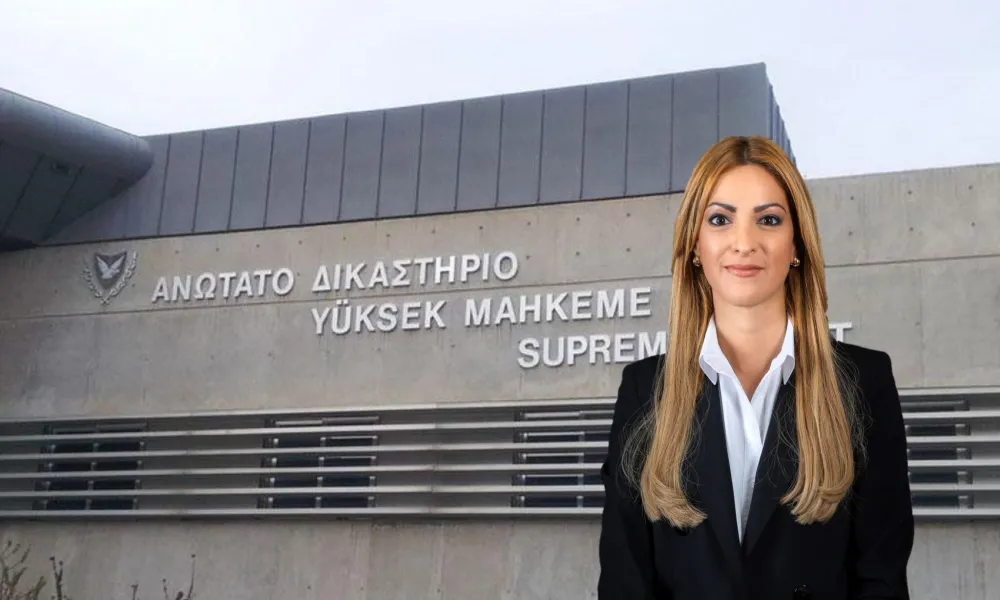
Doria Varosiotou is turning to the European Court of Human Rights (ECtHR) following the rejection of her objection to the decision of the Supreme Judicial Council not to confirm her permanent appointment after the end of her probationary period.
The Supreme Constitutional Court, sitting for the purposes of the case as a secondary judicial council, rejected Varoshiotou’s objection by a majority of five votes to three. Both the majority and minority rulings raise significant legal issues that are expected to feature in the next stage of proceedings, which her lawyer, Achilleas Demetriades, has already announced.
Following the reading of the two decisions, Demetriades said that in “the European Cyprus in which we live, the road to justice does not end in Nicosia, but continues to the European Court in Strasbourg”. Referring in particular to the dissenting opinion and the refusal to refer a question to the European courts, he said the legal effort would continue at European level. He added that the ECtHR would ultimately be called upon to assess whether the decision violated human rights, stressing that the ruling must be carefully studied before the next legal steps are taken.
The majority decision was supported by judges Tasia Psara-Miltiadou, Nikolas Santis, Stalo Hadjiyianni Christodoulou, Elias Georgiou and Marika Kalligerou, while the minority opinion was expressed by Antonis Liatsos (president), Tefkros Oikonomou and Teresa Karakanna.
Reading the majority ruling, Psara-Miltiadou stated that probationary district judges are subject to regular assessments of their performance and conduct every six months during the two-year probation period, with reports submitted to the council. This process was followed in Varoshiotou’s case. The ruling stressed that a probationary appointment does not automatically become permanent without a positive decision by the Supreme Judicial Council, adding that her probation expired on 1 July 2025 and required a new affirmative act to become permanent. The majority concluded that the procedure was lawful under both Cypriot and European law and that no arbitrariness was identified.
Reference to the Thanasis Nicolaou case
The majority ruling also made extensive reference to a Supreme Court decision relating to an application by forensic pathologist Panikos Stavrianou seeking the annulment of Varoshiotou’s findings as coroner in the Thanasis Nicolaou case. The court recalled that it was not the first time serious handling errors had been identified, referring to significant legal mistakes and inconsistencies during the inquest and in the final findings. It was also noted that a key witness was ultimately not allowed to testify, despite prior assurances.
Minority highlights key legal concerns
Attention has also focused on the minority ruling, which raised critical legal issues. The minority argued that the composition of the Supreme Judicial Council was flawed, as the Attorney General, the president of the Cyprus Bar Association and two legal members — as required by law — were not invited to attend the decisive meeting. This, they said, rendered the session unlawful and invalid.
The minority further argued that the case raised a serious issue of European law, which should have been referred to the Court of Justice of the European Union (CJEU). In their view, the appointment of judges on probation without a clear legislative framework, predefined criteria or fixed duration - based instead on long-standing but non-codified practice - may violate principles of judicial independence, security of tenure and effective judicial protection under EU law.
They added that while international and European law does not prohibit probationary or fixed-term judicial appointments in principle, such appointments are only permissible under strict conditions, with objective, pre-established criteria and procedural safeguards equivalent to those applying to the dismissal of permanent judges.
This article was originally published on the Greek-language Politis website.